For a long while now I've been wanting a student to do some work on the link between food prices, riots and other kinds of conflict. I've got a few basic ideas about how this could be done. But I'm also busy and am sure a zillion others are busy working on this too.
So, one of my students, Jon Eyer, just sent me this link. I don't know exactly what these folks are doing or where they got their data. But the graph, reproduced below, sure is compelling. We have had a few papers linking weather to conflict. It seems to me the obvious mechanism in those papers was food prices. So why haven't more people looked at food prices themselves?
And since climate change may cause food prices to rise, Eric Hammel over at Thomas Ricks' FP blog is connecting the dots to argue that climate change is the biggest national security challenge we face.
That might be overstating the case. But this does seem like a very real threat.
Update: Marc Bellemare, who made a comment below, has a very nice new paper on this topic. (Marc, is your paper posted somewhere? Do you want to post a link?)
While I haven't looked at this data or model carefully, it seems to me that the correlation--if real--is fairly convincing evidence of causality going from food prices to riots. We all saw the events leading to price fluctuations shown in the graph. It's pretty clear to me--and I think to anyone who followed this stuff--that events in Africa did not cause the price spikes. We had bad weather in Australia, Russia, China and other places. We had rapidly growing demand in Asia. We had ethanol. Then we had a series of rice export bans. Then we had the fires and export bans in Russia. Africa is way too small in terms of food demand and supply to markedly affect world food prices--which is what the graph seems to show--for causation to be going from conflict to prices. Any other non-causal association would have to come from some third factor that happened to be correlated with both conflict and food prices. It's hard for me to imagine what that third factor would be and what the mechanism would be.
Anyway. I'm sure there are plenty of interesting ways to look at this issue and to really get our heads around it I think we should take stock of all of them.
Tuesday, August 23, 2011
Monday, August 22, 2011
Hotter Planet Doesn't Have to Be Hungry
I'm live at Bloomberg. The usual bailiwick about weather, crop yields and food prices.
My suggested title was: "On the Precipice of a Warming World: Will We Feed Everyone?"
It's interesting how a title can change the tone from one that leans dismal to one that seems optimistic.
Update:
I basically gave three policy suggestions in my Bloomberg piece. What else might I suggest? Well, I find myself in the blurry area of my career that lies between focusing on positive "what is" kinds of questions and normative "what should we do" kinds of questions. I'm still much more comfortable entertaining questions of the "what is" variety, so policy ideas come slowly.
With that caveat in mind, here are four (or three and one-half) policy ideas that I didn't mention in the Bloomberg piece.
1) End ethanol subsidies and mandates. There has been some talk of ending the subsidy, but I think that would be meaningless from a food price perspective unless the mandates were also ended. I'm not at all confident about the political feasibility of such a plan.
2) If ethanol subsidies/mandates cannot be ended completely, perhaps Congress could make mandates and subsidies contingent on price. The idea is to have a safety valve of sorts, so that if prices hit some announced threshold the mandate and subsidies would be curtailed.
3) Develop international agreements that would ensure reasonably low food prices for the world's poorest in exchange for keeping trade open. The idea here would be to reduce the likelihood of export bans and reduce inventories held in speculation of possible future export bans.
4) Similar to point 2, we could make the Conservation Reserve Program (CRP) contingent on price. The CRP, which I've written about before, basically pays farmers not to plant crops and establish natural wildlife habitat, buffer strips, etc. We have about 30 million acres in the program right now--nearly the size of North Carolina. CRP contracts could be written with an escape clause that allows farmers to exit the contracts early if prices get high enough. This would probably make CRP cheaper in the first place, since farmers would be more willing to enroll, and would help to relieve prices when they get too high.
My suggested title was: "On the Precipice of a Warming World: Will We Feed Everyone?"
It's interesting how a title can change the tone from one that leans dismal to one that seems optimistic.
Update:
I basically gave three policy suggestions in my Bloomberg piece. What else might I suggest? Well, I find myself in the blurry area of my career that lies between focusing on positive "what is" kinds of questions and normative "what should we do" kinds of questions. I'm still much more comfortable entertaining questions of the "what is" variety, so policy ideas come slowly.
With that caveat in mind, here are four (or three and one-half) policy ideas that I didn't mention in the Bloomberg piece.
1) End ethanol subsidies and mandates. There has been some talk of ending the subsidy, but I think that would be meaningless from a food price perspective unless the mandates were also ended. I'm not at all confident about the political feasibility of such a plan.
2) If ethanol subsidies/mandates cannot be ended completely, perhaps Congress could make mandates and subsidies contingent on price. The idea is to have a safety valve of sorts, so that if prices hit some announced threshold the mandate and subsidies would be curtailed.
3) Develop international agreements that would ensure reasonably low food prices for the world's poorest in exchange for keeping trade open. The idea here would be to reduce the likelihood of export bans and reduce inventories held in speculation of possible future export bans.
4) Similar to point 2, we could make the Conservation Reserve Program (CRP) contingent on price. The CRP, which I've written about before, basically pays farmers not to plant crops and establish natural wildlife habitat, buffer strips, etc. We have about 30 million acres in the program right now--nearly the size of North Carolina. CRP contracts could be written with an escape clause that allows farmers to exit the contracts early if prices get high enough. This would probably make CRP cheaper in the first place, since farmers would be more willing to enroll, and would help to relieve prices when they get too high.
Thursday, August 18, 2011
Debating Illegal Labor at the New York Times
"Could Farms Survive Without Illegal Labor?"
I'm one of several debaters. I like what Phillip Martin had to say--he's the real expert here. Here's the intro to the broader debate:
There is an old and largely true hypothesis in economics: supply creates its own demand. With regard to low-skilled immigration, one particularly compelling test of this hypothesis is an old study by David Card that examined the unemployment and wage effects of the Mariel Boatlift on the Miami labor market (PDF). That unusual event brought about 125,000 low-skilled laborers to Miami over just a few months, about a 7% increase in the local labor market. You might think that such an event would have caused wages to fall and unemployment to skyrocket. But it didn't. Neither wages nor unemployment changed.
Now, things are probably different in an environment with high unemployment. Standard theories of recessions are the clearest exception the rule that supply creates its own demand. But shifting supply inward--which is effectively what getting tough illegal immigrants amounts to--seems like a really bad way to deal with unemployment relative to finding a way to shift demand outward.
I'm one of several debaters. I like what Phillip Martin had to say--he's the real expert here. Here's the intro to the broader debate:
A farmer in Maine who is raising crops sustainably told Times columnist Mark Bittman, “If the cost of food reflected the cost of production, that would change everything.” Instead, American produce is underpriced, in part because farmers and growers rely on illegal immigrant workers, who are paid little and often have poor working conditions.
This reliance on immigrant workers has farmers lobbying against a bill that would require them to verify migrant workers' status and employ only legal workers, saying such a mandate would cripple the industry.
If American growers are so dependent on illegal labor, would strict verification drive up prices for labor and, ultimately, produce? Are consumers too accustomed to inexpensive vegetables and fruit to accept the cost of legal labor to produce it?I've already received email complaining about my remarks to the effect that getting rid of illegal immigrants would do little for the ranks of unemployed legals seeking work.
There is an old and largely true hypothesis in economics: supply creates its own demand. With regard to low-skilled immigration, one particularly compelling test of this hypothesis is an old study by David Card that examined the unemployment and wage effects of the Mariel Boatlift on the Miami labor market (PDF). That unusual event brought about 125,000 low-skilled laborers to Miami over just a few months, about a 7% increase in the local labor market. You might think that such an event would have caused wages to fall and unemployment to skyrocket. But it didn't. Neither wages nor unemployment changed.
Now, things are probably different in an environment with high unemployment. Standard theories of recessions are the clearest exception the rule that supply creates its own demand. But shifting supply inward--which is effectively what getting tough illegal immigrants amounts to--seems like a really bad way to deal with unemployment relative to finding a way to shift demand outward.
Sunday, August 14, 2011
Does GMO Regulation Enhance Monsanto's Market Power?
I've been wondering for a little while about Monsanto's growing market power in the seed business. Monsanto's growing dominance has coincided with expansion of genetically modified seed. That doesn't mean one caused the other. But there may be a causal link that comes from strong regulation of GMOs relative to traditionally bred crops. This regulation makes it too costly for small or public entities--like universities--to develop GMO seeds and take them to market. The only way to do it is to be really big and have deep pockets like Monsanto does.
This has been the complaint of Ingo Potrykus, who in 1999 invented "golden rice," a genetically modified crop fortified with vitamin A. Potrykus has been working ever since to get the product approved internationally. He would like to help some of the millions that die or become afflicted with blindness due to vitamin A deficiency. Clearly, there is not much money in selling seeds to poor people, so this is not a business Monsanto would get into. And despite overwhelming evidence that golden rice is safe, it could still be another year or more--13+ years in total--before Potrykus gets his seed to market.
Coming back to Monsanto and their market power: The key thing here that worries me is that commodity demand is very inelastic. Prices are super sensitive to quantities. Thus, if Monsanto comes up with a higher-yielding seed and sells it on the same scale it currently sells its various Roundup-Ready (herbicide resistant) varieties, then commodity prices would fall. Possibly by a lot. That would be a good thing for consumers around the world and particularly good for the world's poorest. But as with golden rice, I worry that Monsanto recognizes that it's not in their interest to develop and navigate a high-yielding GMO crop through the bureaucratic regulatory maze. Because if they did, they would cannibalize their own profits by driving down commodity prices and thus the amount they could charge farmers for seed.
The most profitable approach for a dominant seed producer is to develop seed that extracts rents from other input providers. It therefore makes sense that they would build pesticides and herbicide resistance into plants rather than boost heat tolerance, for example. The current line of GMO crops increase their share of the seed market, helps them sell more Roundup, but they probably don't do much to boost yield and drive down commodity prices.
I'm not the kind of person who is knee-jerk anti-regulation. But in the case of GMOs, I think the world has gone overboard with safety and process regulation. It's hard to know for certain but it looks like an unintended consequence of this regulation has been to concentrate the seed business. And that concentration, in turn, may be skewing innovation in ways that are lot less socially useful.
Update: Readers may be interested in this article by David Zilberman, who was one of my professors and a great mentor at UC Berkeley. David (I believe) also made a nice comment below. Some may think that this is some kind of paid endorsement of GMO. I can sympathize with that kind of cynicism. And in some contexts there may be an element of truth to it. But I think the reality may be that GMO regulation actually accentuated Monsanto's market power and influence. And people like David Zilberman and Ingo Potrykus really do have the public interest at heart. I'd like to think I do too. And no, I'm not on Monsanto's payroll. Actually, they don't seem real happy about my work.
This has been the complaint of Ingo Potrykus, who in 1999 invented "golden rice," a genetically modified crop fortified with vitamin A. Potrykus has been working ever since to get the product approved internationally. He would like to help some of the millions that die or become afflicted with blindness due to vitamin A deficiency. Clearly, there is not much money in selling seeds to poor people, so this is not a business Monsanto would get into. And despite overwhelming evidence that golden rice is safe, it could still be another year or more--13+ years in total--before Potrykus gets his seed to market.
Coming back to Monsanto and their market power: The key thing here that worries me is that commodity demand is very inelastic. Prices are super sensitive to quantities. Thus, if Monsanto comes up with a higher-yielding seed and sells it on the same scale it currently sells its various Roundup-Ready (herbicide resistant) varieties, then commodity prices would fall. Possibly by a lot. That would be a good thing for consumers around the world and particularly good for the world's poorest. But as with golden rice, I worry that Monsanto recognizes that it's not in their interest to develop and navigate a high-yielding GMO crop through the bureaucratic regulatory maze. Because if they did, they would cannibalize their own profits by driving down commodity prices and thus the amount they could charge farmers for seed.
The most profitable approach for a dominant seed producer is to develop seed that extracts rents from other input providers. It therefore makes sense that they would build pesticides and herbicide resistance into plants rather than boost heat tolerance, for example. The current line of GMO crops increase their share of the seed market, helps them sell more Roundup, but they probably don't do much to boost yield and drive down commodity prices.
I'm not the kind of person who is knee-jerk anti-regulation. But in the case of GMOs, I think the world has gone overboard with safety and process regulation. It's hard to know for certain but it looks like an unintended consequence of this regulation has been to concentrate the seed business. And that concentration, in turn, may be skewing innovation in ways that are lot less socially useful.
Update: Readers may be interested in this article by David Zilberman, who was one of my professors and a great mentor at UC Berkeley. David (I believe) also made a nice comment below. Some may think that this is some kind of paid endorsement of GMO. I can sympathize with that kind of cynicism. And in some contexts there may be an element of truth to it. But I think the reality may be that GMO regulation actually accentuated Monsanto's market power and influence. And people like David Zilberman and Ingo Potrykus really do have the public interest at heart. I'd like to think I do too. And no, I'm not on Monsanto's payroll. Actually, they don't seem real happy about my work.
Saturday, August 13, 2011
A Malthusian Who Knows Markets
From a profile of Jeremy Grantham published in the New York Times a couple days ago.
Here are a few snippets:
On his track record:
I'm noting Grantham track record and think he's making a lot of sense. But I wonder: How many connoisseurs of bubbles have worked to find the controls? That is, find the historical episodes where there was a rapid market adjustment that may have appeared to be a bubble to the rare connoisseurs but then it turned out not to be a bubble. After the fact, maybe all bubbles look alike. But looking at it from hindsight doesn't really count.
But now Grantham is saying this time is different:
But while I'm nowhere near as confident as Mr Grantham, it seems very possible to me that the long downward trend in commodity prices has reversed permanently.
Here are a few snippets:
On his track record:
Grantham has a long track record. He was right about indexing, an investment strategy he took a lead role in inventing, when everyone else assumed that you should try to beat the market rather than join it, and about the long rally in small-cap stocks in the early 1970s, the bond rebound in 1981 and the resurgence of large-cap growth stocks in the early 1990s. He was also, well in advance, right about one bubble after another: Japan in 1989, tech stocks in 2000, the U.S. housing market and financial markets and global equities in 2008 (in the wake of which, when investors were still reeling, he made a celebrated and early bullish call in a letter titled, Reinvesting When TerrifiedOn prognosticating and environmentalism:
When he reminds us that modern capitalism isn’t equipped to handle long-range problems or tragedies of the commons (situations like overfishing or global warming, in which acting rationally in your own self-interest only deepens the harm to all), when he urges us to outgrow our touching faith in the efficiency of markets and boundless human ingenuity, and especially when he says that a wise investor can prosper in the coming hard times, his bad news and its silver lining come with a built-in answer to the skeptical question that Americans traditionally pose to egghead Cassandras: If you’re so smart, how come you’re not rich?On climate change policy:
Grantham says that corporations respond well to this message because they are “persuaded by data,” but American public opinion is harder to move, and contemporary American political culture is practically dataproof [my boldface]. “The politicians are the worst,” he said. “An Indian economist once said to me, ‘We have 28 political parties, and they all think climate change is important.’ ” Whatever the precise number of parties in India, and it depends on how you count, his point was that the U.S. has just two that matter, one that dismisses global warming as a hoax and one that now avoids the subject.On bubbles and animal spirits:
Grantham, who says that “this time it’s different are the four most dangerous words in the English language,” has become a connoisseur of bubbles. His historical study of more than 300 of them shows the same pattern occurring again and again. A bump in sales or some other impressive development causes people to get excited. When they do, the price of that asset class — South Sea company shares, dot-coms — goes up, and human nature and the financial industry conspire to push it higher. People want to hear good news; they tend to be bad with numbers and uncertainty, and to assume that present conditions will persist. In the financial industry, the imperative to minimize career risk produces herd behavior. As John Maynard Keynes, one of Grantham’s heroes, put it, “A sound banker, alas! is not one who foresees danger and avoids it, but one who, when he is ruined, is ruined in a conventional and orthodox way along with his fellows, so that no one can really blame him.” All these factors contribute to a surge of what Keynes called “animal spirits,” which encourages people to convince themselves that this time prices will just rise and rise.
I'm noting Grantham track record and think he's making a lot of sense. But I wonder: How many connoisseurs of bubbles have worked to find the controls? That is, find the historical episodes where there was a rapid market adjustment that may have appeared to be a bubble to the rare connoisseurs but then it turned out not to be a bubble. After the fact, maybe all bubbles look alike. But looking at it from hindsight doesn't really count.
But now Grantham is saying this time is different:
So it’s news when Grantham, who has built his career on the conviction that peaks and troughs will even out as prices inevitably revert to their historical mean, says that this time it really is different, and not in a good way. In his April letter, “Time to Wake Up: Days of Abundant Resources and Falling Prices Are Over Forever,” he argued that “we are in the midst of one of the giant inflection points in economic history.” The market is “sending us the Mother of all price signals,” warning us that “if we maintain our desperate focus on growth, we will run out of everything and crash.”That sounds even more pessimistic than me, especially that last sentence. Prices will rise, which will keep us from running out.
But while I'm nowhere near as confident as Mr Grantham, it seems very possible to me that the long downward trend in commodity prices has reversed permanently.
Thursday, August 11, 2011
Can't Beat the Heat
Ahem.
Poor Weather Pushes Prices Up for Corn and Soybeans:
The growing season isn't over yet. USDA was too optimistic last year at this time. But I think that was mainly because the heat wave came after surveying for the August crop report was finished (about August 1). If the weather stays good from now until harvest I'd guess the forecast will be about right.
I should also note that at least some of the price bump today could have been a demand shock. Aggregate demand is highly uncertain right now and closely tied to the stock market, which spiked about as much as commodities.
Supply shifts in, demand shifts out, prices go boom!
Update: An interesting tidbit (maybe) for ag. commodity wonks out there: About a week before each USDA forecast comes out, a couple private-market forecasts can be purchased. I don't have links handy, but I suspect all the major commodity players do in fact buy these private market forecasts. Some analysis by Scott Irwin and Daryl Good at UofI shows that private market forecasts are as accurate as USDA forecasts. Still, USDA forecasts move the market quite substantially when they are announced. Why?
Well, it turns out that combining the private-market forecast and USDA forecasts gives a forecast that significantly beats both of them. That means the USDA forecast still contains a lot of information. It also means that the market "surprise" is something far smaller than what was announced, and smaller even than the difference between private-market and USDA forecasts. The implication of all this is that prices are even more sensitive to quantities than they may appear, and about twice as sensitive (I think) as Irwin and Good estimated.
Poor Weather Pushes Prices Up for Corn and Soybeans:
Prices for corn and soybeans jumped in commodities markets on Thursday after the Department of Agriculture said that the onslaught of bad weather, from heat and drought in some areas to heavy rains and flooding in others, would reduce yields for those critical crops.Okay, I'll try to not let this go to my head. But the heat really kills. Maybe not as much when it's wet. But it still kills.
The growing season isn't over yet. USDA was too optimistic last year at this time. But I think that was mainly because the heat wave came after surveying for the August crop report was finished (about August 1). If the weather stays good from now until harvest I'd guess the forecast will be about right.
I should also note that at least some of the price bump today could have been a demand shock. Aggregate demand is highly uncertain right now and closely tied to the stock market, which spiked about as much as commodities.
Supply shifts in, demand shifts out, prices go boom!
Update: An interesting tidbit (maybe) for ag. commodity wonks out there: About a week before each USDA forecast comes out, a couple private-market forecasts can be purchased. I don't have links handy, but I suspect all the major commodity players do in fact buy these private market forecasts. Some analysis by Scott Irwin and Daryl Good at UofI shows that private market forecasts are as accurate as USDA forecasts. Still, USDA forecasts move the market quite substantially when they are announced. Why?
Well, it turns out that combining the private-market forecast and USDA forecasts gives a forecast that significantly beats both of them. That means the USDA forecast still contains a lot of information. It also means that the market "surprise" is something far smaller than what was announced, and smaller even than the difference between private-market and USDA forecasts. The implication of all this is that prices are even more sensitive to quantities than they may appear, and about twice as sensitive (I think) as Irwin and Good estimated.
Wednesday, August 10, 2011
Cheap Stocks Part Duex
The other day I suggested a good index for the relative price of stocks was Robert Shiller's S&P 500 price to earnings ratio multiplied by the 10-yr real rate on treasury bills. When the index is much greater than one, stocks look expensive; when it is much less than one, stocks look cheap.
I couldn't easily construct a long series of that index because inflation-indexed treasuries haven't been around for a long time. So I used the nominal t-bill rate instead.
But if I were using the real rate, today that index would be negative, because the real rate today on 10-yr treasuries is now negative.
Relative to throwing money away, earnings on the S&P 500 look real nice.
And with negative real rates extending over 10 years, I, like many others, lament our misplaced focus on debt and deficits.
I couldn't easily construct a long series of that index because inflation-indexed treasuries haven't been around for a long time. So I used the nominal t-bill rate instead.
But if I were using the real rate, today that index would be negative, because the real rate today on 10-yr treasuries is now negative.
Relative to throwing money away, earnings on the S&P 500 look real nice.
And with negative real rates extending over 10 years, I, like many others, lament our misplaced focus on debt and deficits.
Sunday, August 7, 2011
Is Food Demand Growth in Asia a Myth?
Jayati Ghosh has long detailed piece over at the Guardian's Poverty Matters Blog about world food prices. She argues forcefully that demand growth from China and India are not a driving force in rising food prices. Instead, she says, it's all about ethanol subsidies and speculation.
Ghosh presents a lot of convincing-sounding statistics. I think I've got a reasonably good feel for the data and what she presents does, I fear, gently mislead the reader. I don't disagree with everything she's saying but she's definitely overstating her case.
However, she does have me scratching my head to figure out the best way to put the various factors into clearer perspective. That's something I'll work on.
For now, a few key points:
1) Consumption does not equal demand. Demand is the whole schedule of consumption quantities across a whole range of prices, and holding all else the same. What's ominous is that Asian consumption is growing fairly fast despite rising prices and slowing population growth. That reflects increasing demand for American-like diets rich in animal products and processed foods (especially in China). That increasing demand is not going to slow down unless Asia's economic growth slows down, and I don't want that any more than I expect Ghosh does.
2) Ghosh discusses coarse grains but omits oil seed. The elephant in the room--which is closely connected to coarse grain markets--is soybeans. Soybean production is a big source of growth in staple food production and Asia is sucking it up, big time.
3) Yes, ethanol is a big deal. But that doesn't mean income growth in Asia isn't a big factor too.
4) Speculation has nothing to do with it. If speculation were a driving force, we would see inventory declines. Speculation can only cause prices to spike if it also causes inventories to accumulate. So whatever the contributions of the various factors, they are fundamental, not speculative. I've beat this horse many times, as have others who really know their stuff (Paul Krugman, Jim Hamilton at UCSD, Brian Wright at UC Berkeley, immediately come to mind).
I'm a bit concerned about they way Ghosh presents her data on consumption growth. First, by aggregating across decades and countries consumption is mostly inseparable from production. She shows growth rates for each in a series of decades, and the trend looks downward. That's basically because production growth has been approximately linear, so growth rates have declined as the baseline level production (the denominator) has grown larger. What's ominous is that bit of an increase in the recent decade: that's not production picking up but inventories getting drawn down, hence the price spike.
One thing I find a little strange is an apparent defensiveness on the part of some Asians about Asian demand growth. I, for one, don't blame them for their growth. Rather, I'm concerned that other poor nations (especially some African countries) are not growing as fast, and that many even in relatively rich and relatively growing countries seem to be left behind. We should worry about income inequality, especially in an environment with high and rising prices of food staples.
Ghosh presents a lot of convincing-sounding statistics. I think I've got a reasonably good feel for the data and what she presents does, I fear, gently mislead the reader. I don't disagree with everything she's saying but she's definitely overstating her case.
However, she does have me scratching my head to figure out the best way to put the various factors into clearer perspective. That's something I'll work on.
For now, a few key points:
1) Consumption does not equal demand. Demand is the whole schedule of consumption quantities across a whole range of prices, and holding all else the same. What's ominous is that Asian consumption is growing fairly fast despite rising prices and slowing population growth. That reflects increasing demand for American-like diets rich in animal products and processed foods (especially in China). That increasing demand is not going to slow down unless Asia's economic growth slows down, and I don't want that any more than I expect Ghosh does.
2) Ghosh discusses coarse grains but omits oil seed. The elephant in the room--which is closely connected to coarse grain markets--is soybeans. Soybean production is a big source of growth in staple food production and Asia is sucking it up, big time.
3) Yes, ethanol is a big deal. But that doesn't mean income growth in Asia isn't a big factor too.
4) Speculation has nothing to do with it. If speculation were a driving force, we would see inventory declines. Speculation can only cause prices to spike if it also causes inventories to accumulate. So whatever the contributions of the various factors, they are fundamental, not speculative. I've beat this horse many times, as have others who really know their stuff (Paul Krugman, Jim Hamilton at UCSD, Brian Wright at UC Berkeley, immediately come to mind).
I'm a bit concerned about they way Ghosh presents her data on consumption growth. First, by aggregating across decades and countries consumption is mostly inseparable from production. She shows growth rates for each in a series of decades, and the trend looks downward. That's basically because production growth has been approximately linear, so growth rates have declined as the baseline level production (the denominator) has grown larger. What's ominous is that bit of an increase in the recent decade: that's not production picking up but inventories getting drawn down, hence the price spike.
One thing I find a little strange is an apparent defensiveness on the part of some Asians about Asian demand growth. I, for one, don't blame them for their growth. Rather, I'm concerned that other poor nations (especially some African countries) are not growing as fast, and that many even in relatively rich and relatively growing countries seem to be left behind. We should worry about income inequality, especially in an environment with high and rising prices of food staples.
Friday, August 5, 2011
Stocks are a Really Good Deal
David Leonhardt says stocks are still expensive.
Brad Delong says buy equities!
Two super smart, super educated guys. Who's right?
Brad compares the price to earnings ratio of stocks to the interest rate on treasury bills. David Leonhard compares the price to earnings ratio to its historical average (albeit before the other day's crash).
I'm with Brad Delong. The problem with David's analysis is that he's forgetting week one of econ 101: opportunity cost. The opportunity cost of a dollar invested in the stock market is a dollar not invested in something else. The benchmark alternative is a long-run treasury. Brad points out that the rate on that is just dismal, less than today's dividend yield on stocks and far less than earnings.
David's mistake is a common one. I see the same mistake when looking at home prices (the price to rent ratio relative to its historical average, not relative to interest rates or building costs). It is important to take interest rates into account as well.
Brad Delong does it right by comparing the PE ratio to a proxy for the real (inflation-adjusted) interest rate. Unfortunately it's a bit of work to develop a long history for long-term inflation-adjusted rates. If we had that rate we could develop a decent pricing index for stocks by multiplying a long-term real interest rate by the usual PE ratio (say, Robert Shilller's version, with earnings taken as the average of the past 10 years). When that index gets much above 1, stocks are probably a bad deal. When the index gets well below 1, stocks should look like a good deal.
Since I don't have a long-term real interest rate, but I can easily download a long history of 10 year nominal rates from FRED, here I'll create a second-best pricing index equal to the nominal rate multiplied by Shiller's PE ratio (available here). What you get is the following index:
The red line is drawn at the historical average. Note that this index ends in July, well before the recent crash. Also note that because I'm using a nominal rate rather than a real rate, stocks are probably a decent buy up to an index value that's a bit higher than one.
After yesterday's crash, which brought down interest rates and stock market prices, the index is probably close to 0.5.
Stocks look cheap to me.
Brad Delong says buy equities!
Two super smart, super educated guys. Who's right?
Brad compares the price to earnings ratio of stocks to the interest rate on treasury bills. David Leonhard compares the price to earnings ratio to its historical average (albeit before the other day's crash).
I'm with Brad Delong. The problem with David's analysis is that he's forgetting week one of econ 101: opportunity cost. The opportunity cost of a dollar invested in the stock market is a dollar not invested in something else. The benchmark alternative is a long-run treasury. Brad points out that the rate on that is just dismal, less than today's dividend yield on stocks and far less than earnings.
David's mistake is a common one. I see the same mistake when looking at home prices (the price to rent ratio relative to its historical average, not relative to interest rates or building costs). It is important to take interest rates into account as well.
Brad Delong does it right by comparing the PE ratio to a proxy for the real (inflation-adjusted) interest rate. Unfortunately it's a bit of work to develop a long history for long-term inflation-adjusted rates. If we had that rate we could develop a decent pricing index for stocks by multiplying a long-term real interest rate by the usual PE ratio (say, Robert Shilller's version, with earnings taken as the average of the past 10 years). When that index gets much above 1, stocks are probably a bad deal. When the index gets well below 1, stocks should look like a good deal.
Since I don't have a long-term real interest rate, but I can easily download a long history of 10 year nominal rates from FRED, here I'll create a second-best pricing index equal to the nominal rate multiplied by Shiller's PE ratio (available here). What you get is the following index:
The red line is drawn at the historical average. Note that this index ends in July, well before the recent crash. Also note that because I'm using a nominal rate rather than a real rate, stocks are probably a decent buy up to an index value that's a bit higher than one.
After yesterday's crash, which brought down interest rates and stock market prices, the index is probably close to 0.5.
Stocks look cheap to me.
Thursday, August 4, 2011
Marc Bellemare
Another triangle blogger.
I've been meaning to add Marc Bellemare to my blogroll and just got around to it. Marc is at Duke and shares a lot of my interests, with a bit more of a development focus. He gave a seminar here at NCSU awhile back and will probably give another one sometime soon.
He also just won best AJAE article of the year (AJAE is the top journal in agricultural economics).
Anyway, I recently learned about his blog via an email correspondence. Check it out! It looks like he'll be posting way more frequently than I do.
I've been meaning to add Marc Bellemare to my blogroll and just got around to it. Marc is at Duke and shares a lot of my interests, with a bit more of a development focus. He gave a seminar here at NCSU awhile back and will probably give another one sometime soon.
He also just won best AJAE article of the year (AJAE is the top journal in agricultural economics).
Anyway, I recently learned about his blog via an email correspondence. Check it out! It looks like he'll be posting way more frequently than I do.
Wednesday, August 3, 2011
Is Commodity Price Volatility Good or Bad? Wrong Question.
There's been a lot of discussion about food commodity price volatility and what governments and NGOs like the World Bank should do about it.
In principle, I don't see the question of price volatility as fundamentally different from a question about price levels. Sellers obviously like higher prices and buyers obviously like lower prices. But there is nothing about prices themselves that tell us whether the price is right. Instead, economists ask questions about how the market is functioning. Are there any externalities or other kinds of market imperfections that would cause the price level to be different from what would be if there were no imperfections?
Perhaps less abstractly, we might simply ask questions about what makes prices what they are, and whether some artificial force is keeping prices from their natural equilibrium.
The same goes for price volatility. When someone asks whether price volatility is good or bad--or worse, assumes it's bad and prescribes a policy to control it--my knee-jerk response is that it's the wrong question. We first need to ask why prices are volatile; and, especially, are there some big market imperfections that are causing prices to be more volatile that they would be if markets were functioning well. We simply cannot know whether prices volatility is good or bad without knowing what's causing the volatility.
Furthermore, even if some kind of imperfection is causing prices to be too volatile, we can't think cogently about reasonable policy options without knowing something about the fundamental cause. So, asking questions about whether price volatility is good or bad really misses the point.
Here are two quick examples:
First, suppose price volatility is coming about because we've had an unusual stint of bad weather, drawing down inventories. When inventories are low, just a little bit of news can cause prices to change a lot, since we don't have much of a buffer. In this situation there really isn't a whole lot that can be done that would improve things. Indeed, most anything one tries to do is likely to make matters worse and possibly make prices even more volatile. Put another way, the rise in price and volatility is a symptom of the market trying to deal with the adverse situation.
Second, suppose price volatility has come about from a major exporter suddenly and unexpectedly placed quota on the volume of its exports. This would cause world prices to rise, inventories to decline, and volatility to increase, much like a stint of bad weather shocks. Obviously this would be bad from the vantage point of total economic welfare: the world would be willing to pay more for a unit of the commodity than producers in the exporting country would be willing to sell it. There are mutual benefits from more trade and so we have a clear market imperfection. The best policy response would be to convince the exporting country to drop its quota.
Yes, I realize the real world is more complicated. And there might be some reasonable "second best" policy options for a real-world problem like an export quota that a country just won't drop.
I'm not saying I've got the answers to these more complex situations. All I'm saying is that one cannot begin to deal with the situation without first identifying the source of the problem. Because the prices themselves don't tell us what that problem is.
In principle, I don't see the question of price volatility as fundamentally different from a question about price levels. Sellers obviously like higher prices and buyers obviously like lower prices. But there is nothing about prices themselves that tell us whether the price is right. Instead, economists ask questions about how the market is functioning. Are there any externalities or other kinds of market imperfections that would cause the price level to be different from what would be if there were no imperfections?
Perhaps less abstractly, we might simply ask questions about what makes prices what they are, and whether some artificial force is keeping prices from their natural equilibrium.
The same goes for price volatility. When someone asks whether price volatility is good or bad--or worse, assumes it's bad and prescribes a policy to control it--my knee-jerk response is that it's the wrong question. We first need to ask why prices are volatile; and, especially, are there some big market imperfections that are causing prices to be more volatile that they would be if markets were functioning well. We simply cannot know whether prices volatility is good or bad without knowing what's causing the volatility.
Furthermore, even if some kind of imperfection is causing prices to be too volatile, we can't think cogently about reasonable policy options without knowing something about the fundamental cause. So, asking questions about whether price volatility is good or bad really misses the point.
Here are two quick examples:
First, suppose price volatility is coming about because we've had an unusual stint of bad weather, drawing down inventories. When inventories are low, just a little bit of news can cause prices to change a lot, since we don't have much of a buffer. In this situation there really isn't a whole lot that can be done that would improve things. Indeed, most anything one tries to do is likely to make matters worse and possibly make prices even more volatile. Put another way, the rise in price and volatility is a symptom of the market trying to deal with the adverse situation.
Second, suppose price volatility has come about from a major exporter suddenly and unexpectedly placed quota on the volume of its exports. This would cause world prices to rise, inventories to decline, and volatility to increase, much like a stint of bad weather shocks. Obviously this would be bad from the vantage point of total economic welfare: the world would be willing to pay more for a unit of the commodity than producers in the exporting country would be willing to sell it. There are mutual benefits from more trade and so we have a clear market imperfection. The best policy response would be to convince the exporting country to drop its quota.
Yes, I realize the real world is more complicated. And there might be some reasonable "second best" policy options for a real-world problem like an export quota that a country just won't drop.
I'm not saying I've got the answers to these more complex situations. All I'm saying is that one cannot begin to deal with the situation without first identifying the source of the problem. Because the prices themselves don't tell us what that problem is.
Tuesday, August 2, 2011
Why the Deficit Should Be Bigger
Today the government can borrow money, amortized over 10 years, at just 2.6%.
What would you do if you could borrow a lot money at 2.6% amortized over 10 years? Would you use it to finance a college education? Would you buy a home or larger home? Buy a house and rent it out for, 2-3 times your monthly interest payment? Start a business? Most of us, I think, could find some investment that would pay more than the 2.6% borrowing cost.
But here's the thing: Because the government represents all of us, its expenditures on education, infrastructure and research ultimately benefit all of us, it can (and has) obtained returns far greater than we can earn as individuals. And that doesn't even count Keynesian multiplier effects, which amplify the benefits tremendously.
This should be a no-brainer even if, despite all the evidence, you're an anti-Keynesian. If you're an anti-Keynesian and think that hyperinflation is just around the corner, then this is a truly stupendous deal, since in real terms that nominal 2.6% rate is actually some big negative number. It's almost free money. What's the problem?
If you have actually followed the arguments, know the history, and have seen at the data (1937, the Great Depression, Japan and all that) and realize expansionary fiscal policy really is expansionary when an economy is as depressed as ours, then there is the added bonus of a significant multiplier on top of the added long-run growth.
So deficits should be bigger. Now, in the middle of a deeply depressed economy, is not the time to pay down deficits. That time will come, when interest rates are higher, we don't have so much excess capacity and so much unemployment. At such a time increased government spending would in fact displace private investment and drive interest rates up. But that time is not today and won't be in the next two or three years, at least.
I'm saddened and frustrated by the massive and needless suffering taking place. And worse, by the evening news and our fear-driven leaders who can't even get the basic econ 101 right, and thereby strive to deepen and widen the sea of needless misery.
Update: I realize all this has been said before, perhaps more eloquently, by many others. Just adding another small voice in the wilderness....
What would you do if you could borrow a lot money at 2.6% amortized over 10 years? Would you use it to finance a college education? Would you buy a home or larger home? Buy a house and rent it out for, 2-3 times your monthly interest payment? Start a business? Most of us, I think, could find some investment that would pay more than the 2.6% borrowing cost.
But here's the thing: Because the government represents all of us, its expenditures on education, infrastructure and research ultimately benefit all of us, it can (and has) obtained returns far greater than we can earn as individuals. And that doesn't even count Keynesian multiplier effects, which amplify the benefits tremendously.
This should be a no-brainer even if, despite all the evidence, you're an anti-Keynesian. If you're an anti-Keynesian and think that hyperinflation is just around the corner, then this is a truly stupendous deal, since in real terms that nominal 2.6% rate is actually some big negative number. It's almost free money. What's the problem?
If you have actually followed the arguments, know the history, and have seen at the data (1937, the Great Depression, Japan and all that) and realize expansionary fiscal policy really is expansionary when an economy is as depressed as ours, then there is the added bonus of a significant multiplier on top of the added long-run growth.
So deficits should be bigger. Now, in the middle of a deeply depressed economy, is not the time to pay down deficits. That time will come, when interest rates are higher, we don't have so much excess capacity and so much unemployment. At such a time increased government spending would in fact displace private investment and drive interest rates up. But that time is not today and won't be in the next two or three years, at least.
I'm saddened and frustrated by the massive and needless suffering taking place. And worse, by the evening news and our fear-driven leaders who can't even get the basic econ 101 right, and thereby strive to deepen and widen the sea of needless misery.
Update: I realize all this has been said before, perhaps more eloquently, by many others. Just adding another small voice in the wilderness....
Wednesday, July 27, 2011
Inflation volatility does not go up with inflation
The story used to be that inflation was bad for an economy because greater levels inflation led to greater levels of inflation uncertainty.
Uncertainty isn't exactly the same as volatility, but in practice we often equate the two when we economists do empirical work. So, while I'm not a macro guy, a long, long time ago I wrote a paper for a graduate macro class on the link between inflation and inflation uncertainty. I just used standard time series analysis to predict inflation and then looked at my prediction error in relation to the level of inflation. I didn't see much of a link even then.
Today I see even less of one. To be honest, I haven't run the regressions. I'm just looking at this picture from FRED.
Back in the seventies and early eighties we might have logically conflated levels of inflation with inflation volatility. But today, and over the past decade, inflation has been low and inflation volatility quite high.
The real macro guys probably have a good explanation for this. But whatever it may be, I also wonder if somewhat higher rates of inflation--say the 3-4 percent we had in the 90s, would actually be more stable.
Could this be yet another reason to have a higher inflation target?
Uncertainty isn't exactly the same as volatility, but in practice we often equate the two when we economists do empirical work. So, while I'm not a macro guy, a long, long time ago I wrote a paper for a graduate macro class on the link between inflation and inflation uncertainty. I just used standard time series analysis to predict inflation and then looked at my prediction error in relation to the level of inflation. I didn't see much of a link even then.
Today I see even less of one. To be honest, I haven't run the regressions. I'm just looking at this picture from FRED.
Back in the seventies and early eighties we might have logically conflated levels of inflation with inflation volatility. But today, and over the past decade, inflation has been low and inflation volatility quite high.
The real macro guys probably have a good explanation for this. But whatever it may be, I also wonder if somewhat higher rates of inflation--say the 3-4 percent we had in the 90s, would actually be more stable.
Could this be yet another reason to have a higher inflation target?
Tuesday, July 26, 2011
Mark Bittman Embraces the Food Nanny State
Bittman, who typically writes more about food (I love his minimalist recipes) and less about food policy, fully embraces the idea of taxing "bad" food and subsiding "good" food:
Anyway, this does seem like the kind of thing that could get messy. Do I really need to point to our political environment?
Something simpler, like a tax on sugar-sweetened beverages may make more sense. At least it's specific enough to get our heads around. Also, sugar may also be *the* culprit in our obesity/diabetes epidemic. And apparently there has been some research on it:
Then again, I don't really know this literature well so maybe I missed the really compelling study.
Unfortunately the paper above doesn't help much. It simply cites other work for the crucial demand elasticity, which they pin between -0.8 and -1.2. If the number is -1 it says consumption declines by 1% for every 1% increase in price. This assumes that if we increase price of a 20oz soda from $1.25 to $1.45 consumption would decline by roughly 7%, holding all else the same.
I don't know if that is reasonable or not; I'd need to follow the chain of citations a bit more and dig into modelling assumptions and identification strategies. Experience makes me dubious that the underlying economic science is very compelling, but I am prejudging here.
But let's just suppose that's right.
The biggest challenge I see is that diet drinks wouldn't be taxed and the best way to get a large demand response would be to cause the price of sugary drinks to go up while keeping diet drink prices constant. Now, it seems to me that Bitterman (and the underlying studies) assume full pass-through of the tax on retail price. I'm pretty sure that won't happen in reality.
In reality Coke and PepsiCo will price beverage strategically, given they have considerable market power. Given this, I would expect the big soft drink companies to increase the price diet drinks nearly commensurately with sugar drinks, and that the price increase would fall far short of the tax amount. That's because prices will be tied first and foremost to the elasticity of demand, not marginal cost.
To prove my point, here's an example of a similar situation: The FAA tax on airlines expired last Friday night. You might think that the tax expiration would cause airfare to go down commensurately. Not. Most airlines simply raised prices to by the amount of the tax.
So, even the sugary beverage tax is likely to get complicated. And I'm quite sure Coke and Pepsi won't take this sort of thing lying down.
I'm not radically against the idea of a mild food-nanny state. But I rather imagine that this kind of thing, if passed, might be far less beneficial and have far more unintended consequences than one might initially think.
....Rather than subsidizing the production of unhealthful foods, we should turn the tables and tax things like soda, French fries, doughnuts and hyperprocessed snacks. The resulting income should be earmarked for a program that encourages a sound diet for Americans by making healthy food more affordable and widely available....He gets into details:
...Sweetened drinks could be taxed at 2 cents per ounce, so a six-pack of Pepsi would cost $1.44 more than it does now. An equivalent tax on fries might be 50 cents per serving; a quarter extra for a doughnut. (We have experts who can figure out how “bad” a food should be to qualify, and what the rate should be; right now they’re busy calculating ethanol subsidies. Diet sodas would not be taxed.)...Maybe those experts would be the same ones who brought us the Food Pyramid.
Anyway, this does seem like the kind of thing that could get messy. Do I really need to point to our political environment?
Something simpler, like a tax on sugar-sweetened beverages may make more sense. At least it's specific enough to get our heads around. Also, sugar may also be *the* culprit in our obesity/diabetes epidemic. And apparently there has been some research on it:
Much of the research on beverage taxes comes from the Rudd Center for Food Policy and Obesity at Yale. Its projections indicate that taxes become significant at the equivalent of about a penny an ounce, a level at which three very good things should begin to happen: the consumption of sugar-sweetened beverages should decrease, as should the incidence of disease and therefore public health costs; and money could be raised for other uses.I checked out the Rudd Center and found this study(pdf). The crux, of course, is the elasticity of demand: how much will people cut consumption of sugar-sweetened beverages if they are taxed? That is a very difficult thing to measure. I've never seen it done in a truly convincing way. It must be especially difficult in the soft-drink business given the market power of Coke and Pepsi and the complex strategic pricing games they must play with each other. Regional variation in pricing must have a lot to do with regional differences in demand elasticities; cross-sectional regressions won't work (sorry if that's a bit wonkish--economists should know what I'm talking about).
Then again, I don't really know this literature well so maybe I missed the really compelling study.
Unfortunately the paper above doesn't help much. It simply cites other work for the crucial demand elasticity, which they pin between -0.8 and -1.2. If the number is -1 it says consumption declines by 1% for every 1% increase in price. This assumes that if we increase price of a 20oz soda from $1.25 to $1.45 consumption would decline by roughly 7%, holding all else the same.
I don't know if that is reasonable or not; I'd need to follow the chain of citations a bit more and dig into modelling assumptions and identification strategies. Experience makes me dubious that the underlying economic science is very compelling, but I am prejudging here.
But let's just suppose that's right.
The biggest challenge I see is that diet drinks wouldn't be taxed and the best way to get a large demand response would be to cause the price of sugary drinks to go up while keeping diet drink prices constant. Now, it seems to me that Bitterman (and the underlying studies) assume full pass-through of the tax on retail price. I'm pretty sure that won't happen in reality.
In reality Coke and PepsiCo will price beverage strategically, given they have considerable market power. Given this, I would expect the big soft drink companies to increase the price diet drinks nearly commensurately with sugar drinks, and that the price increase would fall far short of the tax amount. That's because prices will be tied first and foremost to the elasticity of demand, not marginal cost.
To prove my point, here's an example of a similar situation: The FAA tax on airlines expired last Friday night. You might think that the tax expiration would cause airfare to go down commensurately. Not. Most airlines simply raised prices to by the amount of the tax.
So, even the sugary beverage tax is likely to get complicated. And I'm quite sure Coke and Pepsi won't take this sort of thing lying down.
I'm not radically against the idea of a mild food-nanny state. But I rather imagine that this kind of thing, if passed, might be far less beneficial and have far more unintended consequences than one might initially think.
Saturday, July 23, 2011
Cotton prices tumble
Here's the story at the WSJ
Maybe I just got lucky.
My juices are starting to flow for a nice long substantive post about price volatility. I should have time to write on tomorrow's travel day to the AAEA meetings. Maybe see you in Pittsburgh.
Cotton prices, which surged to historic highs this spring, have plunged 38% so far this month, roiling mill owners and apparel makers.I guess I'd just like to note for the record that I called this one a long time ago.
It's a reversal for clothing makers that spent the last year grappling with higher costs and how much, if any, could be passed along to consumers. Now, retailers are wondering if lower cotton prices, off 53% since their March 4 peak, will last or if the roller-coaster ride will continue.
"There's never been this kind of volatility in cotton—ever," Eric Wiseman, chief executive of VF Corp, the world's largest apparel company, said in an interview on Thursday.
...
Maybe I just got lucky.
My juices are starting to flow for a nice long substantive post about price volatility. I should have time to write on tomorrow's travel day to the AAEA meetings. Maybe see you in Pittsburgh.
Friday, July 22, 2011
The Latest Natural Experiment: Carmageddon
I predict: two years from now someone will present a paper in the EE session of the NBER summer institute that exploits Carmageddon as a natural experiment to estimate various acute effects of air pollution or some other consequence of reduced driving and congestion. Maybe someone will try to extrapolate their findings to estimate the social costs and benefits of roads.
I have far less confidence that I will receive an invitation to said meetings. Aw well...
Thursday, July 21, 2011
Thursday, July 14, 2011
NOAA's 8-14 Day Temperature Outlook
Here's the picture:
Compare that to where crops are grown.
And consider that this is probably a particularly sensitive time in the growing season.
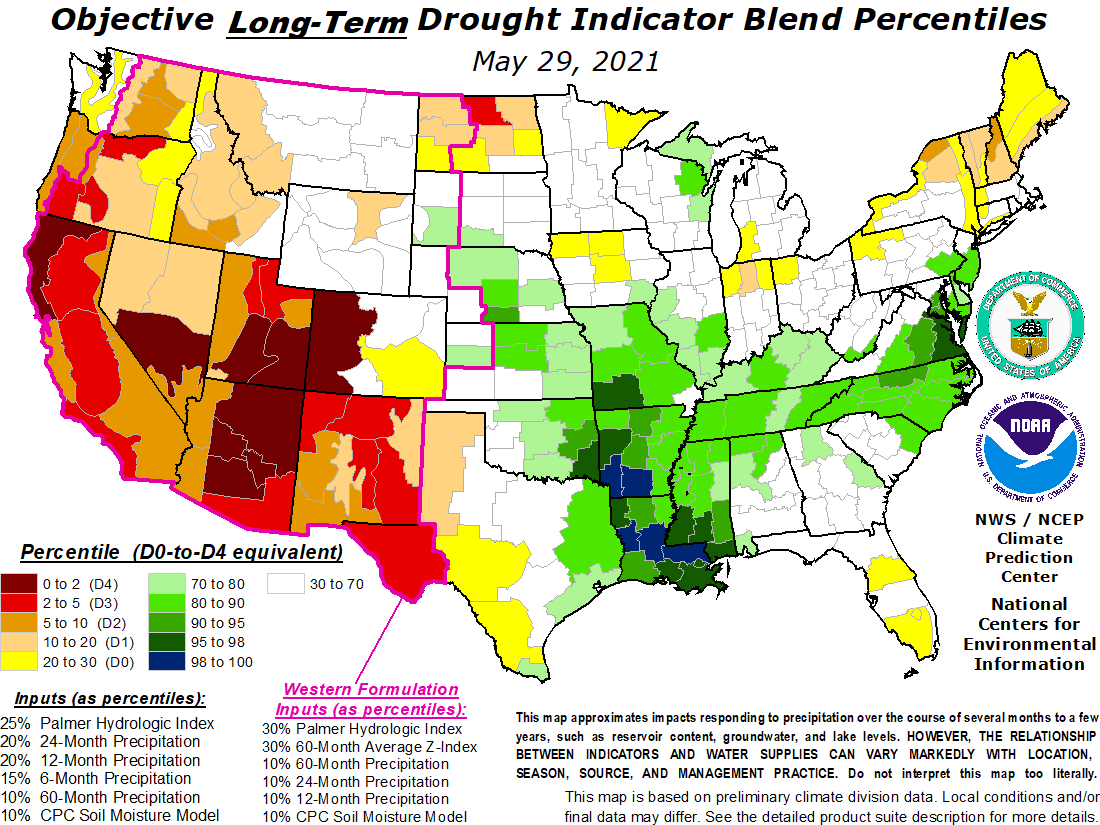
This makes me more bullish on commodity prices than the current drought map does:
Compare that to where crops are grown.
And consider that this is probably a particularly sensitive time in the growing season.
This makes me more bullish on commodity prices than the current drought map does:
Wednesday, July 13, 2011
Feeling the Heat in Kansas
Some are starting the emphasize the heat. And they are at least acknowledging that it's really not so bad: "...last month had been only the 26th hottest June in the past 117 years." And while Kansas is looking pretty hot, it's often that way. That's why it's the most irrigated state in the corn belt. Every other corn belt state looks pretty mild and reasonably moist.
They are forecasting a little 3-day heat wave over the next few days. That's still a far, far cry from 1936.
So why do they have to bury reality way down on paragraph 15 or 20?
One worry about the premature, over-hyped drought stories is that when it really does get bad, everyone will yawn at the usual weather news drama.
They are forecasting a little 3-day heat wave over the next few days. That's still a far, far cry from 1936.
So why do they have to bury reality way down on paragraph 15 or 20?
One worry about the premature, over-hyped drought stories is that when it really does get bad, everyone will yawn at the usual weather news drama.
Tuesday, July 12, 2011
Dust Bowl II?
There's a lot more drought news these days (they gave me a quote all the way at the end of the story). By some measures, particularly the US Drought Monitor, things look pretty bad.
But the time-series plot at the NY Times doesn't go back very far in time. If it did, the current drought would look much less exceptional. Also, the areas with severe drought are not very productive agricultural areas. The Midwestern bread basket looks just fine right now. Although the productive Mississippi Valley looks dry, crops there are irrigated, which should mitigate the damages.
Perhaps more importantly, standard drought indicators don't predict crop outcomes especially well. I wish they'd emphasize extreme heat more than drought. I think we need our own "extreme heat indicator." With any luck, we'll have one soon...
A larger concern could be the heat wave about to hit the midwest. This is a bad time for extreme heat because corn plants are probably close to the flowering stage. If it turns out as hot or a bit hotter than expected, and if that heat sticks around awhile, it will start looking real bad for corn yield.
The price volatility party is just getting started...
But the time-series plot at the NY Times doesn't go back very far in time. If it did, the current drought would look much less exceptional. Also, the areas with severe drought are not very productive agricultural areas. The Midwestern bread basket looks just fine right now. Although the productive Mississippi Valley looks dry, crops there are irrigated, which should mitigate the damages.
Perhaps more importantly, standard drought indicators don't predict crop outcomes especially well. I wish they'd emphasize extreme heat more than drought. I think we need our own "extreme heat indicator." With any luck, we'll have one soon...
A larger concern could be the heat wave about to hit the midwest. This is a bad time for extreme heat because corn plants are probably close to the flowering stage. If it turns out as hot or a bit hotter than expected, and if that heat sticks around awhile, it will start looking real bad for corn yield.
The price volatility party is just getting started...
Thursday, June 30, 2011
Volatile Commodity Prices
Lots of reports today about a plunge in corn and other food commodity prices following good news from the USDA on plantings and progress of this year's corn crop.
In just the last couple weeks corn prices have fallen from nearly $8/bushel to about $6.15. All of that is due to a rather small amount of information about the progress of this year's crop. Yes, there were reports of flooding and late plantings, but that kind of thing rarely has much effect on the overall crop production. The late plantings just set up even more volatility going forward, since the plants will be susceptible to extreme heat in July and August.
This volatility is exactly what economic models predict when inventories are low and cannot buffer weather shocks. I expect to see even larger swings in late July and August, because it's weather in these months, and particularly the amount of extreme heat in the Midwest, that will determine the size of the corn and soybean crops.
But this volatility does provide a teachable moment: it shows how sensitive prices are to small quantity changes. That sensitivity provides some indication of how much ethanol could be influencing food prices globally. And while long-run sensitivities are likely less than those in the short run, it also shows us how sensitive food commodity prices could be to even modest climate change impacts on US and world agriculture.
In just the last couple weeks corn prices have fallen from nearly $8/bushel to about $6.15. All of that is due to a rather small amount of information about the progress of this year's crop. Yes, there were reports of flooding and late plantings, but that kind of thing rarely has much effect on the overall crop production. The late plantings just set up even more volatility going forward, since the plants will be susceptible to extreme heat in July and August.
This volatility is exactly what economic models predict when inventories are low and cannot buffer weather shocks. I expect to see even larger swings in late July and August, because it's weather in these months, and particularly the amount of extreme heat in the Midwest, that will determine the size of the corn and soybean crops.
But this volatility does provide a teachable moment: it shows how sensitive prices are to small quantity changes. That sensitivity provides some indication of how much ethanol could be influencing food prices globally. And while long-run sensitivities are likely less than those in the short run, it also shows us how sensitive food commodity prices could be to even modest climate change impacts on US and world agriculture.
Tuesday, June 14, 2011
I Lean Dismal, But I'm Not a Malthusian
Following his big New York Times piece of food supply, demand and climate change, Justin Gillis has followed up with a series nice blog posts on the Times' blog called Green.
Here are the links:
Reverent Malthus and the Future of Food
Can the Yield Gap Be Closed--Sustainably?
Answering Questions About the World's Food Supply
F.A.O. Sees Stubbornly High Food Prices
World Food Supply: What's To Be Done?
These are nice articles and I highly recommend all of them.
In putting all the pieces together, I think it's important to see how different the current and potentially catastrophic future problems differ from old Malthusian notions. As I've mentioned before, this is as much a global inequality problem as it is a food supply problem.
Economists have long complained about Malthusian types like Paul Erlich because they ignore or downplay the role of prices and incentives. Economists have a good point: if food commodity prices get high enough I believe it's clear we'll have the ability to produce plenty of food. We could probably even grow that food with a lot less pollution byproducts. But to produce that much food "sustainably" would require food prices so much higher than they are today. And if food prices get that high, we'll be in solidly dismal territory for the world's poorest.
So there's the rub: Price response works real nice if we're all relatively rich. The problem is food commodity prices are so low they are basically ignored by consumers in rich countries. But those prices are still high enough that a third of the world struggles to buy enough to meet basic needs. This sits at the crux of why are not going to solve the world's food problems by having the relatively wealthy eat less meat.
Rubbing more salt in that wound is the uncomfortable fact that the historic path to development has been, at least implicitly, through cheap food. I do think it's possible that high prices could be the catalyst for positive change in some places. But it's already clear that institutional changes in the Middle East and North Africa are going to be slow and painful. It's hard for me to be especially optimistic about the institutional and economic progress of poor countries in an environment with high and rising food prices.
I firmly believe that adapting to climate change (at least with regard to food production) would be relatively easy if everyone were as rich as the United States. But that's not the world we live in.
Here are the links:
Reverent Malthus and the Future of Food
Can the Yield Gap Be Closed--Sustainably?
Answering Questions About the World's Food Supply
F.A.O. Sees Stubbornly High Food Prices
World Food Supply: What's To Be Done?
These are nice articles and I highly recommend all of them.
In putting all the pieces together, I think it's important to see how different the current and potentially catastrophic future problems differ from old Malthusian notions. As I've mentioned before, this is as much a global inequality problem as it is a food supply problem.
Economists have long complained about Malthusian types like Paul Erlich because they ignore or downplay the role of prices and incentives. Economists have a good point: if food commodity prices get high enough I believe it's clear we'll have the ability to produce plenty of food. We could probably even grow that food with a lot less pollution byproducts. But to produce that much food "sustainably" would require food prices so much higher than they are today. And if food prices get that high, we'll be in solidly dismal territory for the world's poorest.
So there's the rub: Price response works real nice if we're all relatively rich. The problem is food commodity prices are so low they are basically ignored by consumers in rich countries. But those prices are still high enough that a third of the world struggles to buy enough to meet basic needs. This sits at the crux of why are not going to solve the world's food problems by having the relatively wealthy eat less meat.
Rubbing more salt in that wound is the uncomfortable fact that the historic path to development has been, at least implicitly, through cheap food. I do think it's possible that high prices could be the catalyst for positive change in some places. But it's already clear that institutional changes in the Middle East and North Africa are going to be slow and painful. It's hard for me to be especially optimistic about the institutional and economic progress of poor countries in an environment with high and rising food prices.
I firmly believe that adapting to climate change (at least with regard to food production) would be relatively easy if everyone were as rich as the United States. But that's not the world we live in.
Sunday, June 5, 2011
A Warming Planet Struggles to Feed Itself
The subject heading is the title of the front page article by Justin Gillis in this morning's New York Times. It's a long multi-page feature. It begins:
I had one long phone conversation with Justin Gillis about this piece. It was awhile back. He had spoken with everyone and visited the major research centers. By the time he spoke with me he really knew his stuff. It's nice work. And it's nice to see this issue get front page billing.
I'm mentioned with Wolfram Schlenker in the section "Shaken Assumptions".
CIUDAD OBREGÓN, Mexico — The dun wheat field spreading out at Ravi P. Singh’s feet offered a possible clue to human destiny. Baked by a desert sun and deliberately starved of water, the plants were parched and nearly dead.
Dr. Singh, a wheat breeder, grabbed seed heads that should have been plump with the staff of life. His practiced fingers found empty husks.
“You’re not going to feed the people with that,” he said.
But then, over in Plot 88, his eyes settled on a healthier plant, one that had managed to thrive in spite of the drought, producing plump kernels of wheat. “This is beautiful!” he shouted as wheat beards rustled in the wind.
Hope in a stalk of grain: It is a hope the world needs these days, for the great agricultural system that feeds the human race is in trouble.
The rapid growth in farm output that defined the late 20th century has slowed to the point that it is failing to keep up with the demand for food, driven by population increases and rising affluence in once-poor countries.
Consumption of the four staples that supply most human calories — wheat, rice, corn and soybeans — has outstripped production for much of the past decade, drawing once-large stockpiles down to worrisome levels. The imbalance between supply and demand has resulted in two huge spikes in international grain prices since 2007, with some grains more than doubling in cost.Those price jumps, though felt only moderately in the West, have worsened hunger for tens of millions of poor people, destabilizing politics in scores of countries, from Mexico to Uzbekistan to Yemen. The Haitian government was ousted in 2008 amid food riots, and anger over high prices has played a role in the recent Arab uprisings.
Now, the latest scientific research suggests that a previously discounted factor is helping to destabilize the food system: climate change.Many of the failed harvests of the past decade were a consequence of weather disasters, like floods in the United States, drought in Australia and blistering heat waves in Europe and Russia. Scientists believe some, though not all, of those events were caused or worsened by human-induced global warming.
Temperatures are rising rapidly during the growing season in some of the most important agricultural countries, and a paper published several weeks ago found that this had shaved several percentage points off potential yields, adding to the price gyrations.
...
I'm mentioned with Wolfram Schlenker in the section "Shaken Assumptions".
Wednesday, June 1, 2011
Price to rent ratio and interest rates
No time for thoughtful on-topic posts these days. Hopefully one sleepless night soon.
Here's a quickie on one of my favorite off-topic subjects:
Bill McBride at Calculated Risk reports that the national price-to-rent ratio is back to 1999 levels. That's well before the bubble took hold. For those who look only at this ratio as a guide to home prices, that's probably a sign that prices have reverted to fundamentals.
But consider today's interest rates compared to 1999:
Today we're looking at a 30 year mortgage rate that is about two-thirds the level in 1999.
I'd say that makes prices today look like a really good deal, especially given anecdotal evidence that rents are on the rise. When the economy does truly recover, those buying homes today will do very well.
Beneath national averages there is tremendous variation in price-to-rent ratios. In some areas home prices are much more attractive than others. That means home prices are a screaming deal in some places. Yet home prices are still falling.
I don't mean to give investment advice as much as point out how far off prices seem to be from fundamentals. I'd say our problems with debt deleveraging and irrational pessimism remain quite severe.
Here's a quickie on one of my favorite off-topic subjects:
Bill McBride at Calculated Risk reports that the national price-to-rent ratio is back to 1999 levels. That's well before the bubble took hold. For those who look only at this ratio as a guide to home prices, that's probably a sign that prices have reverted to fundamentals.
But consider today's interest rates compared to 1999:
Today we're looking at a 30 year mortgage rate that is about two-thirds the level in 1999.
I'd say that makes prices today look like a really good deal, especially given anecdotal evidence that rents are on the rise. When the economy does truly recover, those buying homes today will do very well.
Beneath national averages there is tremendous variation in price-to-rent ratios. In some areas home prices are much more attractive than others. That means home prices are a screaming deal in some places. Yet home prices are still falling.
I don't mean to give investment advice as much as point out how far off prices seem to be from fundamentals. I'd say our problems with debt deleveraging and irrational pessimism remain quite severe.
Saturday, May 14, 2011
Another few plots on extreme heat and corn yields
This is similar to something I put up the other day, except with just three states: Iowa, Missouri and Minnesota. That makes it a little easier to see.
Also, David Lobell suggested my remarks about Kansas may be a little off since Kansas is so heavily irrigated. It might be better to draw comparisons between non-irrigated states with different temperature profiles.
So these three states are about the same latitude. Iowa is the nations sweet spot--the best soils and the best climate. Minnesota tends to be a bit cooler than ideal; Missouri is too hot.
I've also added a scatter plot to show the strong association between extreme heat and yield. The outliers in the bottom left of the scatter (cool years with low yields) are from the Great Flood of 1993. I've added regression lines that fit the relationship separately for each state, one for 1980-1995 and one for 1996-2010. While Iowa seems to show more heat tolerance in the more recent period, Missouri looks less heat tolerant in the more recent period. But since Iowa really hasn't experienced any extreme heat since 1996, that flat curve is probably spurious. Also, keep in mind there are no other variables here, and just a little bit of extreme heat probably means lots of beneficial, less-than-extreme heat.
(click for larger view)
When I have a little more time I'll try dig into this stuff a little more. But so far we've found no evidence that crop varieties grown in warmer climates are more heat tolerant than those in cooler climates, and if anything heat tolerance is declining.
Also, David Lobell suggested my remarks about Kansas may be a little off since Kansas is so heavily irrigated. It might be better to draw comparisons between non-irrigated states with different temperature profiles.
So these three states are about the same latitude. Iowa is the nations sweet spot--the best soils and the best climate. Minnesota tends to be a bit cooler than ideal; Missouri is too hot.
I've also added a scatter plot to show the strong association between extreme heat and yield. The outliers in the bottom left of the scatter (cool years with low yields) are from the Great Flood of 1993. I've added regression lines that fit the relationship separately for each state, one for 1980-1995 and one for 1996-2010. While Iowa seems to show more heat tolerance in the more recent period, Missouri looks less heat tolerant in the more recent period. But since Iowa really hasn't experienced any extreme heat since 1996, that flat curve is probably spurious. Also, keep in mind there are no other variables here, and just a little bit of extreme heat probably means lots of beneficial, less-than-extreme heat.
(click for larger view)
When I have a little more time I'll try dig into this stuff a little more. But so far we've found no evidence that crop varieties grown in warmer climates are more heat tolerant than those in cooler climates, and if anything heat tolerance is declining.
My awesome lack of political prescience: fiscal vs. monetary policy
Way back in the early days following the financial crisis, I complained a lot about there not being enough talk of inflation targeting and unconventional monetary policy. At the time I imagined that not doing enough on monetary policy in response to the crisis would give rise to future monetarists who would claim, much as Milton Friedman did about the Great Depression, that all could have been avoided if only the central bank had done its job correctly. I really thought vigorous monetary policy was the best hope for quelling the Great Recession.
I was particularly disappointed in Paul Krugman for not pushing the idea of inflation targeting or other unconventional monetary policies more forcefully. (He clearly supported the idea, but said very little about it.) After all, he had long been the main force underpinning this idea for Japan a decade earlier.
In hindsight, mine was a rather foolish prognostication. Today's conservatives are nothing like Milton Friedman. They are as against active monetary policy as they are against active fiscal policy. Much of this may just be political convenience. Perhaps they simply want what's bad for the economy because they see a bad economy as politically good for Republicans. It's not hard to be that cynical, especially in today's political climate.
Anyway, I recollect all this in response to this post by Paul Krugman and this post by David Beckworth.
I was particularly disappointed in Paul Krugman for not pushing the idea of inflation targeting or other unconventional monetary policies more forcefully. (He clearly supported the idea, but said very little about it.) After all, he had long been the main force underpinning this idea for Japan a decade earlier.
In hindsight, mine was a rather foolish prognostication. Today's conservatives are nothing like Milton Friedman. They are as against active monetary policy as they are against active fiscal policy. Much of this may just be political convenience. Perhaps they simply want what's bad for the economy because they see a bad economy as politically good for Republicans. It's not hard to be that cynical, especially in today's political climate.
Anyway, I recollect all this in response to this post by Paul Krugman and this post by David Beckworth.
Friday, May 13, 2011
Big Brothers
Orwellian indeed. Maybe Ayn Randers should be more inspired by Orwell's Animal Farm than by 1984.
Via Catherine Rampel we have Kris Hundley:
A conservative billionaire who opposes government meddling in business has bought a rare commodity: the right to interfere in faculty hiring at a publicly funded university.
A foundation bankrolled by Libertarian businessman Charles G. Koch has pledged $1.5 million for positions in Florida State University's economics department. In return, his representatives get to screen and sign off on any hires for a new program promoting "political economy and free enterprise."
Traditionally, university donors have little official input into choosing the person who fills a chair they've funded. The power of university faculty and officials to choose professors without outside interference is considered a hallmark of academic freedom.
Under the agreement with the Charles G. Koch Charitable Foundation, however, faculty only retain the illusion of control. The contract specifies that an advisory committee appointed by Koch decides which candidates should be considered. The foundation can also withdraw its funding if it's not happy with the faculty's choice or if the hires don't meet "objectives" set by Koch during annual evaluations.
David W. Rasmussen, dean of the College of Social Sciences, defended the deal, initiated by an FSU graduate working for Koch. During the first round of hiring in 2009, Koch rejected nearly 60 percent of the faculty's suggestions but ultimately agreed on two candidates. Although the deal was signed in 2008 with little public controversy, the issue revived last week when two FSU professors — one retired, one active — criticized the contract in the Tallahassee Democrat as an affront to academic freedom....There was mention of UNC schools in some of this. Despite the pronounced Libertarian influence here, I really hope NCSU doesn't have these kind of financial ties.
Tuesday, May 10, 2011
Counting the reasons for a higher inflation target
While Paul Krugman and Greg Mankiw both explain that inflation is no threat, allow me to follow Brad Delong by listing all the reasons I know for why the Fed's current nominal inflation target of two percent (one percent in practice) is too low.
1) To maximize long run stability, the Fed should target a long-run price level, not a long run inflation rate. This way long-run investors can be reasonably assured of a particular long-run real rate of return for any given investment paying nominal dividends. The idea is that the Fed would thereby promise to correct short-run variations in inflation leading to less long-run mis-pricing of expectations and assets. Now, since inflation of the last few years has been well below target, it would therefore help restore pre-recession expectations if the Fed were to pursue higher inflation for at least a few years.
2) A higher inflation target will reduce odds of hitting the zero lower bound in future crises and recessions, thereby reducing odds of liquidity trap situations like the one we are currently in.
3) To aid the current unusually bad economic situation by encouraging spending now while the general price level is low. This is what Krugman has often described as a "commitment to be irresponsible."
4) To accelerate deleveraging of both private and public debts, thereby aiding spending and growth in the short run (in some ways similar to 3).
5) To encourage somewhat higher nominal interest rates once the economy reaches full employment, thereby reducing the incidence of asset bubbles which can be spurred by low nominal interest rates.
6) To lessen the negative impact of rigidities in nominal wages, particularly downward rigidities. And some compelling theoretical work that fits these facts suggests a higher target (say 3 or 4 percent) would be better for long-run growth.
So, what are the downsides to a somewhat higher inflation target? I can think of a few, but I think they are rather mild. One argument in the literature is that a higher inflation rate is also more uncertain. But level and variability are different things. Point (1) is a better way to deal with uncertainty in inflation. And I also know from some dabbling I did for a class paper many years ago that, at least for the U.S., evidence of a negative uncertainty effect is extremely thin. The best argument I can think of is that by changing the inflation target to something greater than 2 percent now will hurt the Bernanke Fed's credibility given they have so vigorously defended a 2 percent target (or something less) up to this point. Thus, if the Fed changes their target now, markets may be less inclined to believe the new target going forward.
The obvious, reasonable answer to the last conundrum is for the Fed to simply lay out its rationale for changing the target. But since many have built in expectations of a lower target, the Fed would plan to implement the new target gradually, and (preferably) more explicitly. That is, they could lay out a clear goal for a long-run price level that they would like to achieve going forward. That target schedule could incorporate a gradual acceleration of inflation to the new target level. All of this would, of course, be accompanied by the usual caveats that the target would sometime miss too low and sometimes miss too high, and that other mitigating circumstance could make achieving the target more difficult at some times as compared to others.
Anyway, that's my armchair macro thought of the day...
1) To maximize long run stability, the Fed should target a long-run price level, not a long run inflation rate. This way long-run investors can be reasonably assured of a particular long-run real rate of return for any given investment paying nominal dividends. The idea is that the Fed would thereby promise to correct short-run variations in inflation leading to less long-run mis-pricing of expectations and assets. Now, since inflation of the last few years has been well below target, it would therefore help restore pre-recession expectations if the Fed were to pursue higher inflation for at least a few years.
2) A higher inflation target will reduce odds of hitting the zero lower bound in future crises and recessions, thereby reducing odds of liquidity trap situations like the one we are currently in.
3) To aid the current unusually bad economic situation by encouraging spending now while the general price level is low. This is what Krugman has often described as a "commitment to be irresponsible."
4) To accelerate deleveraging of both private and public debts, thereby aiding spending and growth in the short run (in some ways similar to 3).
5) To encourage somewhat higher nominal interest rates once the economy reaches full employment, thereby reducing the incidence of asset bubbles which can be spurred by low nominal interest rates.
6) To lessen the negative impact of rigidities in nominal wages, particularly downward rigidities. And some compelling theoretical work that fits these facts suggests a higher target (say 3 or 4 percent) would be better for long-run growth.
So, what are the downsides to a somewhat higher inflation target? I can think of a few, but I think they are rather mild. One argument in the literature is that a higher inflation rate is also more uncertain. But level and variability are different things. Point (1) is a better way to deal with uncertainty in inflation. And I also know from some dabbling I did for a class paper many years ago that, at least for the U.S., evidence of a negative uncertainty effect is extremely thin. The best argument I can think of is that by changing the inflation target to something greater than 2 percent now will hurt the Bernanke Fed's credibility given they have so vigorously defended a 2 percent target (or something less) up to this point. Thus, if the Fed changes their target now, markets may be less inclined to believe the new target going forward.
The obvious, reasonable answer to the last conundrum is for the Fed to simply lay out its rationale for changing the target. But since many have built in expectations of a lower target, the Fed would plan to implement the new target gradually, and (preferably) more explicitly. That is, they could lay out a clear goal for a long-run price level that they would like to achieve going forward. That target schedule could incorporate a gradual acceleration of inflation to the new target level. All of this would, of course, be accompanied by the usual caveats that the target would sometime miss too low and sometimes miss too high, and that other mitigating circumstance could make achieving the target more difficult at some times as compared to others.
Anyway, that's my armchair macro thought of the day...
Thursday, May 5, 2011
Goldman Sachs DID NOT Cause the Food Crisis
I haven't been, and will not be able to, respond to this silly article in Foreign Policy (no link--they don't deserve it).
So, let's just make this a place holder for now: Goldman Sachs, as evil as they may have been in facilitating the demise of AIG and causing the financial crisis, did not cause the food crisis.
Somehow, some way, we economists need to educate the public about when speculation is good (most of the time) and when it is bad (e.g., the 90s tech boom and the housing bubble).
At least so far, we haven't seen the bad kind of speculation when it comes to food commodities. Maybe it will happen in the future--in fact, I kind of worry we may have a problem in the coming years. But so far, no.
The basic fact is the following: If prices are high when inventories are low, it is not a bubble. End of story.
The tough call is going to be when prices are high and inventories are high. That's not happening right now. But if it happens in the future there will be lots of hopefully intelligent debate about whether expectations about future growing demand or future shrinking supply are or are not reasonable. But right now, and in the recent past, the point is moot. Inventories are low. Prices are driven by fundamentals: supply and demand.
So, let's just make this a place holder for now: Goldman Sachs, as evil as they may have been in facilitating the demise of AIG and causing the financial crisis, did not cause the food crisis.
Somehow, some way, we economists need to educate the public about when speculation is good (most of the time) and when it is bad (e.g., the 90s tech boom and the housing bubble).
At least so far, we haven't seen the bad kind of speculation when it comes to food commodities. Maybe it will happen in the future--in fact, I kind of worry we may have a problem in the coming years. But so far, no.
The basic fact is the following: If prices are high when inventories are low, it is not a bubble. End of story.
The tough call is going to be when prices are high and inventories are high. That's not happening right now. But if it happens in the future there will be lots of hopefully intelligent debate about whether expectations about future growing demand or future shrinking supply are or are not reasonable. But right now, and in the recent past, the point is moot. Inventories are low. Prices are driven by fundamentals: supply and demand.
Why the slowdown in agricultural productivity growth?
Two words:
Climate Change Global Warming.
Well, there may be more to it. Like reduced public research and pathogens like wheat stem rust.
But new research by my colleagues David Lobell and Wolfram Schlenker, along with Justin Costa-Roberts shows that warming has hurt corn and wheat yields on all continents except North America:
A few other links:
Science News
Washington Post
UK Gaurdian
New Scientist
In my view, what's ominous here is that we're probably already seeing noticeable effects from climate change even though the world's biggest producer and exporter---the United States--hasn't seen any negative consequences. Yet. From the projections I've seen, that's mainly good luck. It's been cooler here than in the past. If (er... when) it warms here as projected, then we'll really feel the yield drag.
Perhaps I'm being knit picky, but I find the comparison with 1980 prices to be a strange baseline. Prices are very sensitive to quantities. It's not a question of where prices would be today in comparison to 1980. It's a question of where prices would be today without the warming.
If quantities are some 5% lower than they would have been without warming, my own work on global supply and demand elasticities with Wolfram Schlenker suggests prices would be some 30% lower than without climate change.
Maybe this is a tongue-in-cheek way of being conservative. But it just isn't right.
Update (wonkish clarification): My workhorse model here is just supply and demand. That model tells me that, looking broadly across staple food commodities and globally in scope, the world demand elasticity is in the ballpark of 0.05 and the world supply elasticity is in the ballpark of 0.10. To the extent that one is too big, the other on tends to be too small, and vice versa; so I'm more confident in the sum than the individual elasticities. These numbers mean a inward shift in supply or outward shift in demand of 1% will have a 1/(0.15) or a 6.7% increase in price. I was being a little conservative with a 6-fold larger price increase than the climate-induced quantity shift, partly because the quantity shift they estimate is a bit less than 5%.
Well, there may be more to it. Like reduced public research and pathogens like wheat stem rust.
But new research by my colleagues David Lobell and Wolfram Schlenker, along with Justin Costa-Roberts shows that warming has hurt corn and wheat yields on all continents except North America:
Farms across the planet produced 3.8 percent less corn and 5.5 percent less wheat than they could have between 1980 and 2008 thanks to rising temperatures, a new analysis estimates. These wilting yields may have contributed to the current sky-high price of food, a team of U.S. researchers reports online May 5 in Science. Climate-induced losses could have driven up prices of corn by 6.4 percent and wheat by 18.9 percent since 1980.The article was embargoed until 2pm today, but it's already circulating.
A few other links:
Science News
Washington Post
UK Gaurdian
New Scientist
In my view, what's ominous here is that we're probably already seeing noticeable effects from climate change even though the world's biggest producer and exporter---the United States--hasn't seen any negative consequences. Yet. From the projections I've seen, that's mainly good luck. It's been cooler here than in the past. If (er... when) it warms here as projected, then we'll really feel the yield drag.
Perhaps I'm being knit picky, but I find the comparison with 1980 prices to be a strange baseline. Prices are very sensitive to quantities. It's not a question of where prices would be today in comparison to 1980. It's a question of where prices would be today without the warming.
If quantities are some 5% lower than they would have been without warming, my own work on global supply and demand elasticities with Wolfram Schlenker suggests prices would be some 30% lower than without climate change.
Maybe this is a tongue-in-cheek way of being conservative. But it just isn't right.
Update (wonkish clarification): My workhorse model here is just supply and demand. That model tells me that, looking broadly across staple food commodities and globally in scope, the world demand elasticity is in the ballpark of 0.05 and the world supply elasticity is in the ballpark of 0.10. To the extent that one is too big, the other on tends to be too small, and vice versa; so I'm more confident in the sum than the individual elasticities. These numbers mean a inward shift in supply or outward shift in demand of 1% will have a 1/(0.15) or a 6.7% increase in price. I was being a little conservative with a 6-fold larger price increase than the climate-induced quantity shift, partly because the quantity shift they estimate is a bit less than 5%.
Wednesday, May 4, 2011
Extreme Heat and Corn Yields--a 2010 Update
So we finally have an update of our weather data, following from the hard work of an NCSU graduate student, Jon Eyer.
Here's a preview of what that data shows (click for a larger version):
The left panel shows degree days above 29C, measured continuously over time and space and averaged over growing areas. The right panel shows corn yields, in bushels per acre. The inverse relationship between extreme heat and yields is fairly clear. The one big exception is 1993 when a flood damaged yields severely even though it wasn't very hot.
Three things to note:
First, 2010 was hot, but not nearly as hot as it has been. Given how bad things were relative to expectations, I was expecting a much higher extreme heat measure. Our basic regression model pretty much hit the 2010 yield on the nose, so markets (and the USDA) shouldn't have been surprised conditional on the heat.
Second, projections under most climate change scenarios are a lot worse in the coming years. Overall, weather has been strangely good in the U.S. in recent years. If it stays as cool as 2010, we'll be lucky.
Third, last summer I inadvertently provoked a sharp response from Ted Crosbie of Monsanto by suggesting corn tolerance to extreme heat has been declining over the last few decades. Despite Dr. Crosbie's feelings on the issue, I think there is some tell-tale evidence of just this phenomenon in the graph. Kansas, which is significantly hotter than the other big corn states, had yields similar to the other states 30 years ago. But today Kansas yields there are much lower. I think this is interesting because in earlier work we identified the phenomenon of declining heat tolerance by looking exclusively within states, not at differential trends across states. Also, this pattern doesn't require fancy non-parametric statistics--it's easy to see with the naked eye.
Here's a preview of what that data shows (click for a larger version):
The left panel shows degree days above 29C, measured continuously over time and space and averaged over growing areas. The right panel shows corn yields, in bushels per acre. The inverse relationship between extreme heat and yields is fairly clear. The one big exception is 1993 when a flood damaged yields severely even though it wasn't very hot.
Three things to note:
First, 2010 was hot, but not nearly as hot as it has been. Given how bad things were relative to expectations, I was expecting a much higher extreme heat measure. Our basic regression model pretty much hit the 2010 yield on the nose, so markets (and the USDA) shouldn't have been surprised conditional on the heat.
Second, projections under most climate change scenarios are a lot worse in the coming years. Overall, weather has been strangely good in the U.S. in recent years. If it stays as cool as 2010, we'll be lucky.
Third, last summer I inadvertently provoked a sharp response from Ted Crosbie of Monsanto by suggesting corn tolerance to extreme heat has been declining over the last few decades. Despite Dr. Crosbie's feelings on the issue, I think there is some tell-tale evidence of just this phenomenon in the graph. Kansas, which is significantly hotter than the other big corn states, had yields similar to the other states 30 years ago. But today Kansas yields there are much lower. I think this is interesting because in earlier work we identified the phenomenon of declining heat tolerance by looking exclusively within states, not at differential trends across states. Also, this pattern doesn't require fancy non-parametric statistics--it's easy to see with the naked eye.
Tuesday, May 3, 2011
Declining crop yields
There are many reasons for high commodity prices. But recent data from FAO shows a pretty rapid slowdown in productivity growth. The price spike in 2008 occurred in a particularly bad year in which yields declined on a worldwide basis for three of the four largest food commodities. In 2009 all four of the majors saw yield declines, something that hasn't happened since 1974. 2010 couldn't have been much better and was probably worse, given how bad things were in the U.S, the world's largest producer and exporter (worldwide data for 2010 isn't available yet).
Here's the picture:
The yield slowdown comes at a particularly unfortunate time, with accelerating demand from emerging economies like China and subsidy-driven expansion of ethanol. Keep in mind: we need productivity growth to accelerate considerably to keep up with projected demand growth. FAO says we need 70 percent higher yields by 2050. (Although I'd like to do my own projections, and will one of these days...)
Maybe it's just bad luck with the weather. But I think it just may be a longer run phenomenon.
Yeah, resource scarcity will be in the news for awhile yet.
Update: Lots of interesting commentary over at Mark Thoma's blog. Nice of him to feature this post! (Thanks Mark!). One question came up about planted area diluting yields through expansion onto marginal lands. There might be some of that. But I think it's mainly a combination of weather and slowing technological progress in breeding. Cutbacks on basic science research do have consequences. And so does climate change, even if it hasn't affected the US, yet.
Anyway, here's the graph for planted area:
Here's the picture:
The yield slowdown comes at a particularly unfortunate time, with accelerating demand from emerging economies like China and subsidy-driven expansion of ethanol. Keep in mind: we need productivity growth to accelerate considerably to keep up with projected demand growth. FAO says we need 70 percent higher yields by 2050. (Although I'd like to do my own projections, and will one of these days...)
Maybe it's just bad luck with the weather. But I think it just may be a longer run phenomenon.
Yeah, resource scarcity will be in the news for awhile yet.
Update: Lots of interesting commentary over at Mark Thoma's blog. Nice of him to feature this post! (Thanks Mark!). One question came up about planted area diluting yields through expansion onto marginal lands. There might be some of that. But I think it's mainly a combination of weather and slowing technological progress in breeding. Cutbacks on basic science research do have consequences. And so does climate change, even if it hasn't affected the US, yet.
Anyway, here's the graph for planted area:
Tuesday, April 26, 2011
Thursday, April 14, 2011
Sugar, obeseity and a possible regression discontinuity design
Here is a random research idea that may be crazy. But maybe not. Either way, I really haven't the time to investigate it seriously. Maybe someone else does have the time.
The idea is inspired by two recent things: (1) Tuesday's seminar by David Just of Cornell University, who does research on the intersection of psychology and economics and is currently doing some interesting work on framing and package sizes; and (2) an intriguing article by Gary Taubes who investigates whether sugar is toxic. Taubes is mainly following arguments made by Robert Lustig, a Professor of Pediactrics at UCSF who has an influential YouTube video "Sugar: The Bitter Truth" (nearly 900,000 views--yikes!). That's a 90 minute tribe explaining Lustig's argument for why sugar is *the* culprit in the obesity crisis.
Lustig is pretty strident. Shrill? Regardless, I find his arguments compelling. This is not a quack idea.
Anyway. The theory still needs smoking gun evidence and that is going to be difficult to construct. And we all know there are extraordinary financial interests that will work hard to keep a tight lid on this if does turn out to be true. Corn, ADM, all manner of food processors, etc. It will be hard to obtain funding to do the experimental trials necessary to prove whether or not sugar is in fact toxic.
Are there any natural experiments worth exploiting?
Maybe.
By most accounts, the largest source of sugar is from sugary drinks, particularly soft drinks. Consumption has steadily increased and, at least in the aggregate data, seems to roughly match the obesity crisis. A lot of the growth in consumption must have come about from growth in the sizes of cup and bottle sizes. Years ago a "Coke" came in an 8oz. glass bottle. Later it was 10 oz. And then a 12 oz. can. Doesn't that seem quaint in this era of Double Big Gulp? Speaking of Big Gulps: the first super-sized soft drink at 7-11 convenience stores was in 1980, not long before obesity in the U.S. started its steep rise. But all of this is just anecdotal evidence.... Lots of other things have changed since the 80s.
What might be interesting, if the data can be obtained, is to exploit discrete changes in drink sizes that have taken place over time, and see if these discrete changes are associated with unusually large increases in the incidence of weight gain and diabetes. To do this well would require very large databases of weight, BMI, and/or incidence of diabetes, coupled with detailed data on drink package sizes over time. It would be especially helpful new larger drink sizes were introduced in different places at different times, or if one could exploit demographic or other kinds of variations. The nice thing about changes in drink sizes is that they are discrete and oftentimes large. This could be helpful because the largest possible confounding variable may be changes in consumption of meat or fat. I imagine changes in consumption of fat and meat were relatively smooth by comparison. Unlike food, a few food chain and soft drink companies (e.g. Coke and Pepsi) dominate the market, and sizes and size changes seem relatively uniform, and sometimes large.
The biggest challenge would be to amass the data for such an exercise. But if enough of the right data could be found, such an analysis might provide some powerful evidence, one way or the other.
The idea is inspired by two recent things: (1) Tuesday's seminar by David Just of Cornell University, who does research on the intersection of psychology and economics and is currently doing some interesting work on framing and package sizes; and (2) an intriguing article by Gary Taubes who investigates whether sugar is toxic. Taubes is mainly following arguments made by Robert Lustig, a Professor of Pediactrics at UCSF who has an influential YouTube video "Sugar: The Bitter Truth" (nearly 900,000 views--yikes!). That's a 90 minute tribe explaining Lustig's argument for why sugar is *the* culprit in the obesity crisis.
Lustig is pretty strident. Shrill? Regardless, I find his arguments compelling. This is not a quack idea.
Anyway. The theory still needs smoking gun evidence and that is going to be difficult to construct. And we all know there are extraordinary financial interests that will work hard to keep a tight lid on this if does turn out to be true. Corn, ADM, all manner of food processors, etc. It will be hard to obtain funding to do the experimental trials necessary to prove whether or not sugar is in fact toxic.
Are there any natural experiments worth exploiting?
Maybe.
By most accounts, the largest source of sugar is from sugary drinks, particularly soft drinks. Consumption has steadily increased and, at least in the aggregate data, seems to roughly match the obesity crisis. A lot of the growth in consumption must have come about from growth in the sizes of cup and bottle sizes. Years ago a "Coke" came in an 8oz. glass bottle. Later it was 10 oz. And then a 12 oz. can. Doesn't that seem quaint in this era of Double Big Gulp? Speaking of Big Gulps: the first super-sized soft drink at 7-11 convenience stores was in 1980, not long before obesity in the U.S. started its steep rise. But all of this is just anecdotal evidence.... Lots of other things have changed since the 80s.
What might be interesting, if the data can be obtained, is to exploit discrete changes in drink sizes that have taken place over time, and see if these discrete changes are associated with unusually large increases in the incidence of weight gain and diabetes. To do this well would require very large databases of weight, BMI, and/or incidence of diabetes, coupled with detailed data on drink package sizes over time. It would be especially helpful new larger drink sizes were introduced in different places at different times, or if one could exploit demographic or other kinds of variations. The nice thing about changes in drink sizes is that they are discrete and oftentimes large. This could be helpful because the largest possible confounding variable may be changes in consumption of meat or fat. I imagine changes in consumption of fat and meat were relatively smooth by comparison. Unlike food, a few food chain and soft drink companies (e.g. Coke and Pepsi) dominate the market, and sizes and size changes seem relatively uniform, and sometimes large.
The biggest challenge would be to amass the data for such an exercise. But if enough of the right data could be found, such an analysis might provide some powerful evidence, one way or the other.
Wednesday, April 13, 2011
What crop supply response looks like
The other day I asked where the new cropland was going to come from.
Today we have William Neuman reporting:
But if farmers overuse the land today at the expense of future productivity, they may live to regret it. Prices could be high next year too. And the year after that. A little extra care today could yield even greater profits tomorrow.
Today we have William Neuman reporting:
When prices for corn and soybeans surged last fall, Bill Hammitt, a farmer in the fertile hill country of western Iowa, began to see the bulldozers come out, clearing steep hillsides of trees and pastureland to make way for more acres of the state’s staple crops. Now, as spring planting begins, with the chance of drenching rains, Mr. Hammitt worries that such steep ground is at high risk for soil erosion — a farmland scourge that feels as distant to most Americans as tales of the Dust Bowl and Woody Guthrie ballads. ...
...Now, research by scientists at Iowa State University provides evidence that erosion in some parts of the state is occurring at levels far beyond government estimates. It is being exacerbated, they say, by severe storms, which have occurred more often in recent years, possibly because of broader climate shifts...The article is a little short on quantitative facts. But it's pretty clear that incentives are strong to clear land to try to take advantage of high prices. And since marginal land tends to be more erodible, there will be more erosion.
But if farmers overuse the land today at the expense of future productivity, they may live to regret it. Prices could be high next year too. And the year after that. A little extra care today could yield even greater profits tomorrow.
Tuesday, April 12, 2011
Shouldn't we be taxing gas more heavily?
I was lucky to be able to attend part of the NBER workshop on Environmental and Energy Economics at Stanford last week.
My favorite was a talk by Michael Anderson of UC Berkeley. He spoke about a paper joint with Max Auffhammer, also of UC Berkeley:
"Vehicle Weight, Highway Safety, and Energy Policy"
Sorry, no link. The issue is one that's been talked about many times: an arms race in vehicle weight and safety. The essential problem is that the heavier my vehicle, the safer it is for me and the more dangerous it is for you. Now, if we could all commit to smaller lighter cars, we'd pay less for our cars, have better gas mileage, and beno little less safe [please excuse my exaggeration], since when it comes to car-on-car collisions, it's mainly relative size that matters.
This sets up a classic prisoner's dilemma in which it's smart for one and dumb for all to buy bigger, heavier vehicles.
That basic tension is pretty well known, I think. What Anderson and Auffhammer did was measure, with apparent extraordinary accuracy, the size of the external cost of extra vehicle weight. That is, they estimated how much more likely someone is to die in a car accident if the opposing vehicle weighs a little more. I'm going from memory here, but I recall the number was something like a 50% increase in the odds of fatality for a 1000 lb. increase in vehicle weight. They estimated this using a huge database of actual vehicle-on-vehicle collisions and the estimate seemed amazingly robust. (Still, I need to read the paper...)
Using EPAs measure for the value of a statistical life (something like $5.8 million/life) and information on vehicle mileage, there were able to convert that weight externality into a near-equivalent gasoline tax. That tax didn't exactly match an appropriate tax on weight, but it turned out to be extremely close.
The take home number: $1/gallon.
That's a huge number. Before this study the conventional wisdom among transportation economists was that the largest driving-related externality was congestion, at something like $0.55/gallon. Pollution externalities, including CO2, come in at about $0.33/gallon. These are rough numbers from my recollection.
Can we start taxing gas more heavily already? It's not as if we don't need the revenue.
My favorite was a talk by Michael Anderson of UC Berkeley. He spoke about a paper joint with Max Auffhammer, also of UC Berkeley:
"Vehicle Weight, Highway Safety, and Energy Policy"
Sorry, no link. The issue is one that's been talked about many times: an arms race in vehicle weight and safety. The essential problem is that the heavier my vehicle, the safer it is for me and the more dangerous it is for you. Now, if we could all commit to smaller lighter cars, we'd pay less for our cars, have better gas mileage, and be
This sets up a classic prisoner's dilemma in which it's smart for one and dumb for all to buy bigger, heavier vehicles.
That basic tension is pretty well known, I think. What Anderson and Auffhammer did was measure, with apparent extraordinary accuracy, the size of the external cost of extra vehicle weight. That is, they estimated how much more likely someone is to die in a car accident if the opposing vehicle weighs a little more. I'm going from memory here, but I recall the number was something like a 50% increase in the odds of fatality for a 1000 lb. increase in vehicle weight. They estimated this using a huge database of actual vehicle-on-vehicle collisions and the estimate seemed amazingly robust. (Still, I need to read the paper...)
Using EPAs measure for the value of a statistical life (something like $5.8 million/life) and information on vehicle mileage, there were able to convert that weight externality into a near-equivalent gasoline tax. That tax didn't exactly match an appropriate tax on weight, but it turned out to be extremely close.
The take home number: $1/gallon.
That's a huge number. Before this study the conventional wisdom among transportation economists was that the largest driving-related externality was congestion, at something like $0.55/gallon. Pollution externalities, including CO2, come in at about $0.33/gallon. These are rough numbers from my recollection.
Can we start taxing gas more heavily already? It's not as if we don't need the revenue.
Monday, April 11, 2011
What if subprime and CDOs never happened?
I was watching the Inside Job for the other sleepless night (great movie by the way, both substantively and artistically), and I had a thought about the whole bubble and financial crisis that had not really occurred to me before. It's also a point that I think has been generally overlooked in commentary thus far.
First, some context:
Inside Job does a fine job spelling out the history of deregulation, development of CDOs and growth of the AAA bond market. They also do a really nice job explaining how CDOs worked and ultimately failed and the blatant corruption of the bond rating agencies. These features account for how financial markets were able to innovate new securities in an effort satisfy a nearly unquenchable thirst for low risk assets.
The movie basically blames Greenspan for low interest rates. But if Greenspan was at fault, it was only in that he didn't use the Fed's portfolio to help quench the world's thirst for safe assets. Consider, however, the size of AAA bond market and how much it grew between 2000 and 2008. I don't have the specific numbers in front of me, but it was in the tens of trillions of dollars. The Fed's balance sheet at the time was only about 800 billion. Yeah, maybe the Fed should have tried to increase rates a bit by selling some of its portfolio. But even the Fed was small relative to the demand forces at play.
It's that demand side that gets too little billing in the movie Inside Job. That demand side is the focus of an excellent radio story from This American Life that was broadcast on NPR. (You can listen here--note this was first broadcast before Lehman Brothers collapse and the ensuing crisis). The giant pool of money derived mainly from booming China and oil producing countries, aided partly by China's currency manipulation, which continues to this day.
Okay, that's the background. Now here's my thought of the moment:
What if there wasn't any funny business on the part of the banks and wall street? What if CDOs were regulated all along and we never had a boom in subprime lending and liar-loan mortgages with unverified income? Well, the basic economics tells us that the supply of AAA bonds would have been a lot less than it was. Which, in turn, means that the price of the AAA bonds would have been bid up even more than they were. Which, in turn, means that higher-risk bonds would also have been bid up to a higher price. Which means that interest rates would have fallen to a lower level--probably a significant lower level--than they had already fallen. And with interest rates falling even lower people with suitable credit would have wanted to buy even bigger houses. And people with suitable credit would have been even more tempted to take out even larger home equity lines of credit. And home prices would have kept going up. And so "the bubble," such as it was, almost certainly would have happened anyway.
The best example of this is Canada, where banking didn't get out of control but home prices still boomed. But unlike the US and much of the rest of the world, prices there haven't fallen much either. To the extent that they have fallen, it's probably due to the near collapse of the world economy, not Canadian problems.
Anyway. While all the shenanigans exposed in Inside Job boils my blood as much as the next guy or gal, I think the economic forces at play were even larger than the movie suggests.
Update: I changed the title to something more appropriate.
First, some context:
Inside Job does a fine job spelling out the history of deregulation, development of CDOs and growth of the AAA bond market. They also do a really nice job explaining how CDOs worked and ultimately failed and the blatant corruption of the bond rating agencies. These features account for how financial markets were able to innovate new securities in an effort satisfy a nearly unquenchable thirst for low risk assets.
The movie basically blames Greenspan for low interest rates. But if Greenspan was at fault, it was only in that he didn't use the Fed's portfolio to help quench the world's thirst for safe assets. Consider, however, the size of AAA bond market and how much it grew between 2000 and 2008. I don't have the specific numbers in front of me, but it was in the tens of trillions of dollars. The Fed's balance sheet at the time was only about 800 billion. Yeah, maybe the Fed should have tried to increase rates a bit by selling some of its portfolio. But even the Fed was small relative to the demand forces at play.
It's that demand side that gets too little billing in the movie Inside Job. That demand side is the focus of an excellent radio story from This American Life that was broadcast on NPR. (You can listen here--note this was first broadcast before Lehman Brothers collapse and the ensuing crisis). The giant pool of money derived mainly from booming China and oil producing countries, aided partly by China's currency manipulation, which continues to this day.
Okay, that's the background. Now here's my thought of the moment:
What if there wasn't any funny business on the part of the banks and wall street? What if CDOs were regulated all along and we never had a boom in subprime lending and liar-loan mortgages with unverified income? Well, the basic economics tells us that the supply of AAA bonds would have been a lot less than it was. Which, in turn, means that the price of the AAA bonds would have been bid up even more than they were. Which, in turn, means that higher-risk bonds would also have been bid up to a higher price. Which means that interest rates would have fallen to a lower level--probably a significant lower level--than they had already fallen. And with interest rates falling even lower people with suitable credit would have wanted to buy even bigger houses. And people with suitable credit would have been even more tempted to take out even larger home equity lines of credit. And home prices would have kept going up. And so "the bubble," such as it was, almost certainly would have happened anyway.
The best example of this is Canada, where banking didn't get out of control but home prices still boomed. But unlike the US and much of the rest of the world, prices there haven't fallen much either. To the extent that they have fallen, it's probably due to the near collapse of the world economy, not Canadian problems.
Anyway. While all the shenanigans exposed in Inside Job boils my blood as much as the next guy or gal, I think the economic forces at play were even larger than the movie suggests.
Update: I changed the title to something more appropriate.
Friday, April 1, 2011
Where's the land?
Corn, wheat and cotton plantings are anticipated to go up, and soybeans down just a smidgen. That's not too surprising given how high prices are.
But where's the land coming from? According to USDA, the net increase for these (the four largest cash crops besides hay) will be about 10 million acres. That's nearly one third the size of North Carolina. Notice in the graph that increases for one crop are typically offset by losses in another. Most hay land isn't going to be suitable for these crops.
Two wild guesses:
1) Prospective plantings are a little too optimistic
2) The Conservation Reserve Program is going to have a hard time enrolling much land in its signups this year.
But I don't think these two things can account for 10 million acres.
But where's the land coming from? According to USDA, the net increase for these (the four largest cash crops besides hay) will be about 10 million acres. That's nearly one third the size of North Carolina. Notice in the graph that increases for one crop are typically offset by losses in another. Most hay land isn't going to be suitable for these crops.
Two wild guesses:
1) Prospective plantings are a little too optimistic
2) The Conservation Reserve Program is going to have a hard time enrolling much land in its signups this year.
But I don't think these two things can account for 10 million acres.
Subscribe to:
Comments (Atom)
Renewable energy not as costly as some think
The other day Marshall and Sol took on Bjorn Lomborg for ignoring the benefits of curbing greenhouse gas emissions. Indeed. But Bjorn, am...
-
The other day Marshall and Sol took on Bjorn Lomborg for ignoring the benefits of curbing greenhouse gas emissions. Indeed. But Bjorn, am...
-
The tragic earthquake in Haiti has had me wondering about U.S. Sugar policy. I should warn readers in advance that both Haiti and sugar pol...
-
A couple months ago the New York Times convened a conference " Food for Tomorrow: Farm Better. Eat Better. Feed the World ." ...