This comes from Real Climate, or more specifically, from Steven Levitt's colleague at the University of Chicago: Raymond T. Pierrehumbert, Louis Block Professor in the Geophysical Sciences.
OUch. It makes me utterly ashamed to be an economist.
Update: Joe Romm is relentless. It seems to me Levitt and Dubner should have eaten copious quantities of humble pie on day one. They didn't. Why not?
Maybe because they aren't quite the hard-headed objectivists they paint themselves to be? Here are some interesting musings from Andrew Gelman on the role of ideology the likely underlies a lot of this, and especially its internal contradictions.
Saturday, October 31, 2009


Friday, October 30, 2009
Counting jobs
Okay, I'm not a macroeconomist, so someone please tell me if I way off base here. I'm trying to figure out how reasonable or unreasonable the Obama administration's claim of 1 million jobs saved may be.
The media reports are useless. We all know that every journalist can find a Republican that says it's all bogus and the Obama administration will stand by its numbers. Sadly, none of the news reports walk through the Econ 1 and basic algebra to weigh in on the reasoning underlying the numbers. Bad reporting or stupid reporters? Which is it?
Anyway....
So, as an armchair macro guy I'll borrow Krugman's picture of Okun's law. It shows we get an extra 0.5% change in unemployment for every 1% change in GDP. There are about 150 million jobs in the U.S. so 0.5% is about 750K jobs.
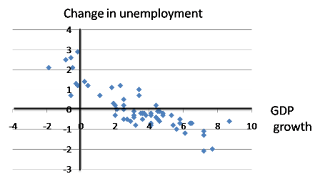
So, in claiming 1 million jobs created or saved, the Obama administration is claiming GDP is about 1.33% larger than it would have been without the stimulus.
Now we have this table from the Economic Policy Institute that, in the first three quarters of 2009, found growth was about 0.3, 2.4, and 2.3 percentage points greater due to stimulus. These are quarterly rates, so we have to divide the sum by 4, which gives us an economy that is about 1.25% greater than it would have been. Now, we're a little ways into the four quarter, so maybe it's okay to fudge things upward by another 2.3/12 or so, to put this up to about 1.45.

Maybe not. You decide. In any case, we're looking at something a little less to a bit more than a million jobs by standard macro calculations. And this does look like a standard macro Keynesian boost.
While this sort of thing is generally difficult to pin down, to me a million jobs looks reasonable. If there's fudging going on, someone please tell me where and how.
Update: Brad Delong explains how to count the costs and benefits. I imagine some would quibble around the edges with his specific numbers. But he has all the right pieces and the numbers can't be far from correct. Also, I think he's assuming a multiplier of 1 when something on the order of 1.5 is probably easy to justify.
The media reports are useless. We all know that every journalist can find a Republican that says it's all bogus and the Obama administration will stand by its numbers. Sadly, none of the news reports walk through the Econ 1 and basic algebra to weigh in on the reasoning underlying the numbers. Bad reporting or stupid reporters? Which is it?
Anyway....
So, as an armchair macro guy I'll borrow Krugman's picture of Okun's law. It shows we get an extra 0.5% change in unemployment for every 1% change in GDP. There are about 150 million jobs in the U.S. so 0.5% is about 750K jobs.

So, in claiming 1 million jobs created or saved, the Obama administration is claiming GDP is about 1.33% larger than it would have been without the stimulus.
Now we have this table from the Economic Policy Institute that, in the first three quarters of 2009, found growth was about 0.3, 2.4, and 2.3 percentage points greater due to stimulus. These are quarterly rates, so we have to divide the sum by 4, which gives us an economy that is about 1.25% greater than it would have been. Now, we're a little ways into the four quarter, so maybe it's okay to fudge things upward by another 2.3/12 or so, to put this up to about 1.45.

Maybe not. You decide. In any case, we're looking at something a little less to a bit more than a million jobs by standard macro calculations. And this does look like a standard macro Keynesian boost.
While this sort of thing is generally difficult to pin down, to me a million jobs looks reasonable. If there's fudging going on, someone please tell me where and how.
Update: Brad Delong explains how to count the costs and benefits. I imagine some would quibble around the edges with his specific numbers. But he has all the right pieces and the numbers can't be far from correct. Also, I think he's assuming a multiplier of 1 when something on the order of 1.5 is probably easy to justify.
Thursday, October 29, 2009
Menzie Chin on futures as predictors of commodity prices
Here is Menzie Chin (my thoughts below):


This is a topic that has long interested me. Fama and French have an earlier piece that looks at this same issue, albeit framed somewhat differently.
In theory, the expected difference between the futures price and spot price is a risk premium. The risk premium for precious metals and natural gas appears to be negative. That is, locking in the price today (removing risk) typically means a higher price as well. If you're making these goods then selling short is a no-brainer. There don't seem to be any positive risk premiums. That is, storing your goods to sell later [without selling short on the futures market] is a risk that pays no reward for any commodity.
So why would the risk premia be negative? One possibility is that these commodities are key inputs to the aggregate economy and price variability comes mainly from supply shocks. That was probably once true for oil but now it seems demand shocks are driving things, which reverses the risk premium (see work by Killian). Alternatively, they can serve as a hedge against financial and economic meltdown. That means buying commodities (going long) is what the market does to reduce their overall exposure to risk.
My dissertation, which I never published, argued that these negative risk premiums help to explain why natural resource prices haven't trended up over time. A negative adjustment for risk means Hotelling's interest rate is probably close to zero.
I'm a little less confident than I used to be about this story. But I still think there is some truth to it. I really need to dust off that paper...
As commodity prices start rising again -- at least some -- the question of whether futures are useful indicators seems relevant. Figure 1 shows the IMF commodity price indices, as reported in the October World Economic Outlook:
Figure 1: Commodity price indices for energy (blue), food (red), agricultural raw materials (green), metals (black) and beverages (teal). NBER defined recession shaded gray, assuming recession ends in 2009M06. Source: IMF, World Economic Outlook (October 2009), data for Chart 1.16.
In a previous set of papers, Oli Coibion, Michael LeBlanc and I examined the predictive power of energy futures post and paper.
In a new paper, Oli Coibion and I update our results regarding energy futures, and metal and agricultural commodities as well, through the end of August 2008, just before the financial crisis broke out in full force. From the paper:
This paper examines the relationship between spot and futures prices for commodities, including those for energy (crude oil, gasoline, heating oil markets and natural gas), precious and base metals (gold, silver, aluminum, copper, lead, nickel and tin), and agricultural commodities (corn, soybean and wheat). In particular, we examine whether futures prices are (1) an unbiased and/or (2) accurate predictor of subsequent spot prices. We find that while energy futures prices are generally unbiased predictors of future spot prices, there are certain notable exceptions. For both base and precious metals, the results are much less favorable to unbiasedness hypothesis. For precious metals and copper and lead, we strongly reject the null that β=1 at all three horizons. For the these other base metals, while we cannot reject that β=1, due to large standard errors. Finally, both corn and soybean futures have β close to 1, while wheat has β<1. Excepting oil and base metals, futures tend to outperform a random walk specification in out of sample forecasts.
The regression we run is:
st - st-k = β 0 + β 1 (f t|t-k - st-k) + ε t
Where st is the log spot price at time t, ft|t-k is the log futures price at time t-k that matures at time t. The resulting β coefficients at the three month horizons are displayed in Figure 2.
Figure 2: β1 coefficients, estimated via OLS. *** denotes significantly different from unity at the 1% level, using HAC robust standard errors. Source: Author's calculations.
Despite the bias in futures, along a RMSE dimension, futures outperform a random walk for most commodities, except for base metals (the out of sample period is 03M01 to 08M07). That being said, the outperformance relative to a random walk is seldom statistically significant.
This is a topic that has long interested me. Fama and French have an earlier piece that looks at this same issue, albeit framed somewhat differently.
In theory, the expected difference between the futures price and spot price is a risk premium. The risk premium for precious metals and natural gas appears to be negative. That is, locking in the price today (removing risk) typically means a higher price as well. If you're making these goods then selling short is a no-brainer. There don't seem to be any positive risk premiums. That is, storing your goods to sell later [without selling short on the futures market] is a risk that pays no reward for any commodity.
So why would the risk premia be negative? One possibility is that these commodities are key inputs to the aggregate economy and price variability comes mainly from supply shocks. That was probably once true for oil but now it seems demand shocks are driving things, which reverses the risk premium (see work by Killian). Alternatively, they can serve as a hedge against financial and economic meltdown. That means buying commodities (going long) is what the market does to reduce their overall exposure to risk.
My dissertation, which I never published, argued that these negative risk premiums help to explain why natural resource prices haven't trended up over time. A negative adjustment for risk means Hotelling's interest rate is probably close to zero.
I'm a little less confident than I used to be about this story. But I still think there is some truth to it. I really need to dust off that paper...
On the commodity share of retail food prices
A professor of biological sciences emails:
In case others are interested, here's my reply:
I believe the general principle is well known. The numbers in the quote came from my own back-of-the-envelope calculations. There are about 6 lbs. of corn used to produce each lb. of beef. Corn sells for about $3.70/bushel. A bushel is 56 lbs. So I figured the value of corn in a pound of beef was about 40 cents, or 10 cents in a quarter pound hamburger. If corn went up to $37.00, a lot of people in poor countries would starve to death. But the price of a burger would go up just 90 cents.
A few key economic concepts to keep in mind: Markets for raw commodities are extremely competitive, meaning that individual buyers and sellers really don't have any control over the prices they pay or receive. Things are different at later stages in the process from raw commodities to retail. Some buyers (like Walmart) have a lot of market power. Also, usually an individual store can adjust retail prices up without losing all their customers or adjust prices down without instantly selling everything they have. These basic ideas suggest that retail food prices would probably go up less than the change in commodity value contained in the retail food.
Also, empirically, retail prices tend vary less than wholesale prices in absolute terms. In other words, I was being conservative--a pound of beef would probably go up a lot less than 90 cents.
USDA ERS (Economic Research Service) has a few studies looking at prices at different steps along the retail path.
Authors doing recent research in this area include Ephraim Leibtag and Emi Nakamura. If you google those names and "pass through" you should find some interesting stuff.
I would like to follow up on your observation that "Raw commodities make up such a tiny share of retail food prices we would hardly notice a 10-fold increase in corn prices. The price of a quarter-pound hamburger (produced from corn-fed beef) would probably go up by less than a dollar."I knew someone would ask that question...
Could you direct me to the analysis or more general treatments of the supply chain costs? At the moment, I'm very interested in supply costs and retail costs for soybean-based products. I'm a molecular scientist and not an economist, so I appologise if my request is very basic!
In case others are interested, here's my reply:
I believe the general principle is well known. The numbers in the quote came from my own back-of-the-envelope calculations. There are about 6 lbs. of corn used to produce each lb. of beef. Corn sells for about $3.70/bushel. A bushel is 56 lbs. So I figured the value of corn in a pound of beef was about 40 cents, or 10 cents in a quarter pound hamburger. If corn went up to $37.00, a lot of people in poor countries would starve to death. But the price of a burger would go up just 90 cents.
A few key economic concepts to keep in mind: Markets for raw commodities are extremely competitive, meaning that individual buyers and sellers really don't have any control over the prices they pay or receive. Things are different at later stages in the process from raw commodities to retail. Some buyers (like Walmart) have a lot of market power. Also, usually an individual store can adjust retail prices up without losing all their customers or adjust prices down without instantly selling everything they have. These basic ideas suggest that retail food prices would probably go up less than the change in commodity value contained in the retail food.
Also, empirically, retail prices tend vary less than wholesale prices in absolute terms. In other words, I was being conservative--a pound of beef would probably go up a lot less than 90 cents.
USDA ERS (Economic Research Service) has a few studies looking at prices at different steps along the retail path.
Authors doing recent research in this area include Ephraim Leibtag and Emi Nakamura. If you google those names and "pass through" you should find some interesting stuff.
Tuesday, October 27, 2009
Alternatives to Biotech Food
Here are a few follow up ideas from the NYT Room for Debate. This is such a huge topic it's hard to know what to put in 300 words. I opted more for context than hard recommendations in my 300 word spiel. If I had more space I probably would have laid out these additional points:
- I don't think biotech crops are evil and could be a big help, especially in developing nations. But I think we'd be naive to think these will solve all the world's food problems going forward. Maybe they will but they probably won't.
- Good development policy, whatever that may be, is surely good food policy. In many ways food is too cheap relative to income in rich countries and too expensive relative to income in poor countries. Both problems are solved if incomes are more equal. Figuring out good development policy is, err..., much harder...
- I think a meat tax makes a lot of sense. Taxing meat would help to keep staple grains cheap and plentiful, which would help the poorest food-importing countries and probably improve health outcomes in rich countries. Some economists would probably cry foul. They might claim lump-sum transfers of cash would be a better way to deal with the underlying distributional issue. The problem is effective transfers to especially poor countries are very difficult. (Consider why those countries are poor in the first place.) Also, given our semi-public health care systems in rich countries, there could be negative externalities from meat consumption.
- Stop ethanol subsidies. These look really silly.
- Then there is that other externality we might want to tax or cap (CO2).
- I do think population growth is a concern, but one intimately tied to the broader problem of poverty and income inequality. Educate women and provide them with birth control and people live longer and countries grow richer. This touches on the most important aspects of good development policy of which I am aware.
- I think both Paul Ehrlich and Julian Simon were foolish gamblers. It's very hard to predict where prices are headed. Julian Simon was simply lucky. From here on I can see both dismal and relatively utopian futures as distinctly possible.
- While dismal outcomes are possible, they are not Malthusian. We have birth control today. The economic tensions are very different from those described by Malthus.
Monday, October 26, 2009
Climate change, food supply and the role of genetically modified crops
I think higher food prices--the kind the poor will see much more than anyone reading this blog post--are one of the biggest risks from global warming. If you don't care about whether the poor eat or not, I think you will care about the civil conflict that would accompany their hunger. If GMOs solve the problem, great. But I'm kinda skeptical that they will...
Here I am live at the New York Times Room for Debate:
Here I am live at the New York Times Room for Debate:
About 30 years ago Julian Simon, an economist, made a famous bet with Paul Ehrlich, the entomology professor and author of “The Population Bomb.” The bet was about the future direction of resource prices.
Where Mr. Ehrlich saw population growth leading to scarcity in resources and higher prices, Mr. Simon saw an impending resource boom that would easily compensate for population growth. Mr. Simon handily won the bet.
Staple commodity prices — from food to oil to metals — have all trended flat or downward over the long run. Technological optimists point to this fact and believe resource scarcity is of little concern to our post-industrial society. In a sense, they’re right. But what about the part of the world that isn’t industrialized?
I am mindful of arguments coming from technological optimists who believe crop yields will continue to rise, that there is plenty of oil still left to find and that geo-engineering will solve global warming.
But I don’t think today’s doomsayers are a few voices in small corners of the scientific community. There is a real threat to worldwide food security over the next 10 to 40 years. The threat comes from global income inequality combined with projected global warming, which could cause tremendous declines in crop yields.
For the United States — by far the world’s largest producer and exporter of food commodities — my own statistical research with Wolfram Schlenker predicts yield declines of 18 percent to 35 percent for corn and soybeans due to global warming, and more than twice these losses by the end of this century.
A recent, far more comprehensive study by the International Food Policy Research Institute predicts large food production declines and higher prices for the whole world.
For people in the United States these dramatic predictions are actually of little direct concern. Raw commodities make up such a tiny share of retail food prices we would hardly notice a 10-fold increase in corn prices. The price of a quarter-pound hamburger (produced from corn-fed beef) would probably go up by less than a dollar. It’s hard to believe we’d buy much less meat as a result. Indeed, demand growth today comes less from population growth and more from rising incomes and meat consumption in China. (Keep in mind that it takes five to 10 calories of staple grains to make one calorie of meat.)
But three billion people — nearly half the planet — live on $2.50 per day or less. The poor typically spend a third to half of their income on food, composed mainly of staple commodities. If food quantities go down and prices go up, it’s the world’s poor who consume less.
If incomes were more equal around the world, prices would rise much further and we would buy less meat, but there would be little risk of famine.
Still, it could be that new genetically modified seeds will accelerate yield growth and offset projected damages from global warming. So far, genetically modified crops have shown yield gains in developing nations, but only modest gains in rich countries. And though yields have grown, my research shows no growth in tolerance to extreme heat, which is the key challenge going forward.
The green revolution didn’t come about from a wondrous market. It came from public investments in crop science that people like Norman Borlaug then spread around the world. But public funding of crop science research has diminished over the years. Now seems like a good time to increase that kind of investment.Update: I put a few further policy recommendations here.
Sunday, October 18, 2009
Mark Thoma asks if there is a solution to the Pundit's Delimma
Here's Mark Thoma:
Yeah, I think so. But why? Probably because it pays more that it did in the past. So why does it pay more today than it used to?
Telling it good and telling it straight is a long-term strategy. That strategy was possible under old profit models of broadcast news and a few key print media sources. In the long run, lies would be punished with smaller audiences, circulations, and advertising dollars.
But today, with an increasingly fractured media comprised of a zillion outlets sharing fewer advertising dollars, and the internet spreading news free of charge, the long view no longer pays. Old profit models no longer work and everyone is grasping. All of this makes the media business short-sighted, because odds are better than not that any one of them won't be around long enough to reap the long-term benefits of telling it good and telling it straight.
I think this problem may well resolve itself, but it will take time. We're in transition. If and when the media business settles down into a new paradigm and it becomes clear who will stick around and what their business models will look like, the incentive to take a longer view will be restored. And at least some of what we see, hear and read will be worth seeing, hearing, and reading.
Or so I hope.
Update: I do find marvelously hopeful the quick and thorough debunking of the Superfreakonomics chapter on climate change. The media of yesteryear couldn't do that. Joe Romm, Paul Krugman, and especially Brad Delong, among many others, have done a wonderful public service here.
Another Update: Despite his promise not to, Delong came along with more excellent criticism of Superfreak. Some pretty good substance in the comments, too.
Mark Liberman at Language Log says the game theory can explain why pundits "best move always seems to be to take the low road":
...Overall, the promotion of interesting stories in preference to accurate ones is always in the immediate economic self-interest of the promoter. It's interesting stories, not accurate ones, that pump up ratings for Beck and Limbaugh. But it's also interesting stories that bring readers to The Huffington Post and to Maureen Dowd's column, and it's interesting stories that sell copies of Freakonomics and Super Freakonomics. In this respect, Levitt and Dubner are exactly like Beck and Limbaugh.
We might call this the Pundit's Dilemma — a game, like the Prisoner's Dilemma, in which the player's best move always seems to be to take the low road, ....
Is media becoming increasingly crass? Are scholars and intellectuals increasingly aiding and abetting the debasement of information?...Pundits (and regular journalists) also play an iterated version of this game — but empirical observation suggests that the penalties for many forms of bad behavior are too small and uncertain to have much effect. Certainly, the reputational effects of mere sensationalism and exaggeration seem to be negligible. ...I think it's correct that the penalties pundits face for "many forms of bad behavior are too small and uncertain to have much effect," but I'm not sure that was always true to the extent it's true today. So the question to me is why the tolerance for this behavior has changed over time (has it changed?).... ....Is there a solution?
Yeah, I think so. But why? Probably because it pays more that it did in the past. So why does it pay more today than it used to?
Telling it good and telling it straight is a long-term strategy. That strategy was possible under old profit models of broadcast news and a few key print media sources. In the long run, lies would be punished with smaller audiences, circulations, and advertising dollars.
But today, with an increasingly fractured media comprised of a zillion outlets sharing fewer advertising dollars, and the internet spreading news free of charge, the long view no longer pays. Old profit models no longer work and everyone is grasping. All of this makes the media business short-sighted, because odds are better than not that any one of them won't be around long enough to reap the long-term benefits of telling it good and telling it straight.
I think this problem may well resolve itself, but it will take time. We're in transition. If and when the media business settles down into a new paradigm and it becomes clear who will stick around and what their business models will look like, the incentive to take a longer view will be restored. And at least some of what we see, hear and read will be worth seeing, hearing, and reading.
Or so I hope.
Update: I do find marvelously hopeful the quick and thorough debunking of the Superfreakonomics chapter on climate change. The media of yesteryear couldn't do that. Joe Romm, Paul Krugman, and especially Brad Delong, among many others, have done a wonderful public service here.
Another Update: Despite his promise not to, Delong came along with more excellent criticism of Superfreak. Some pretty good substance in the comments, too.
Saturday, October 17, 2009
Bad for yields does not mean bad for farmers' profits
Yes, we do predict large negative impacts to U.S. crop yields from global warming. Yes, there are many reasons why things might not get as bad as we predict. But the evidence, I think, is pretty clearly bad for crop yields.
So, in response to Grist and the position by the American Farm Bureau on climate change, one may wonder: Why would farmers oppose the climate bill if they have so much to lose from potential global warming?
There is a simple answer: a big hit to crop yields does not imply a big hit to farmers' profits. In fact, if the rest of the world is unable to make up for U.S. losses, a big hit to yields is probably a very good thing for farmers profits. At least for the corn-soybean guys in the Midwest.
You see, the demand curve for basic grains is very steep. We've estimated an elasticity of about 0.05 (also see this paper). So if yields worldwide get cut by 50%, and no additional supply comes online to replace that loss, prices will go up 1000%, and farmers revenues will go up 500%. Farmers' profits will go up by a lot more than 500%.
So, while climate change is looking bad for buyers of basic grains, like North Carolina hog farmers and the urban poor in developing nations, those who grow basic grains will do very well. The incentives are very clear: opposing climate change legislation is good for corn growers' pocketbooks.
Thursday, October 15, 2009
Ezra Klein on climate change and agriculture
Here's a first for me: I'm quoted in the Washington Post! And so is this wee little blog.
Kudos and thanks to Ezra Klein for writing about implications of global warming on crop yields. The big study by IFPRI was the main focus, as it should have been, but he also wrote a bit about our study.
Two little quibbles:
(1) Our temperature threshold of 84F is actually the optimal temperature for corn. It gets bad pretty quickly for temperature much hotter than that, but a little hotter is still okay. Much above 90 is bad, but it depends on how long it stays that hot. Anyway, I probably could have been clearer about this in my earlier blog posts.
(2) I'm still a lowly assistant professor, not Professor, despite my rapidly advancing age. You see, I'm new to the academic thing. Just over a year ago I was a government bureaucrat at the USDA.
But thank you kindly for the exposure Ezra, it's much appreciated.
Growing Areas in Brazil and the United States with Similar Exposure to Extreme Heat Have Similar Yields
Update: The letter to PNAS by Meerburg et. al is here. Our reply is here.
Boy, that was fast.
Less than three weeks after PNAS published Wolfram Schlenker’s and my paper predicting big negative impacts from global warming on U.S. corn, soybean and cotton yields, we were notified about a letter to the editor commenting on our article. The PNAS editors had already agreed to publish the letter when they told us about it. We had seven days to write a maximum 500-word reply.
The jist their letter: It’s already hotter in Brazil than the United States, and some areas of Brazil have higher yields than the United States, so we were being too “pessimistic” about what might happen to U.S. yields. More precisely, they claimed 2008 soybean yields in the Brazilian state of Mato Grasso were higher than U.S. yields of that year.
Hmmmm. Well, we didn’t claim our results extended to Brazil. Brazil differs from the U.S. in many ways. For one, Brazil is a lot closer to the equator, which makes sunlight exposure markedly different. Both countries are also quite large. The U.S., like Brazil, has widely varying temperatures and crop yields. So, to our way of thinking, such a comparison really deserves more careful thought and analysis than a drive-by letter to the editor.
We didn’t understand the statistics given by the commenters, so we did a little digging of our own. Mind you, we didn’t have time for a full-blown study. But here’s what we found:
First, they cherry picked the state and the year from Brazil. Mato Grasso is the highest yielding state in Brazil and 2008 was a remarkably good year for them, due to unusually good weather. Other states in Brazil have average yields that are about half those of Mato Grasso.
Second, Mato Grasso yields were higher than average yields in the U.S. as a whole, but not higher than the best yielding states in the U.S.
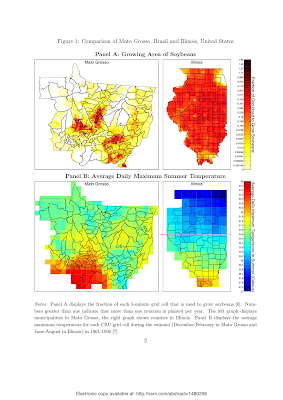
Third, if we narrow our comparison by looking a particular state—Illinois, the number two yielding soybean state in the U.S.—and also look more closely at the data, Mato Grasso doesn’t look much warmer. In fact, the southern half of Illinois, which has average yields comparable to those in Mato Grasso, also has comparable exposure to extreme heat. (Northern Illinois is cooler and higher yielding than both Mato Grasso and Illinois). This can be seen from careful inspection of the maps below (click the figure for more detail). It turns out that there aren’t any soybeans grown in the hottest part of Mato Grasso. It’s not clear whether the commenters took into account the locations in Mato Grasso where soybeans are actually grown.
Anyway, we couldn’t include figures or appendices in our 500 word reply to the comment, so we posted a short article on SSRN with more detail (see here). The actual comment and reply should show up at PNAS soon.
Boy, that was fast.
Less than three weeks after PNAS published Wolfram Schlenker’s and my paper predicting big negative impacts from global warming on U.S. corn, soybean and cotton yields, we were notified about a letter to the editor commenting on our article. The PNAS editors had already agreed to publish the letter when they told us about it. We had seven days to write a maximum 500-word reply.
The jist their letter: It’s already hotter in Brazil than the United States, and some areas of Brazil have higher yields than the United States, so we were being too “pessimistic” about what might happen to U.S. yields. More precisely, they claimed 2008 soybean yields in the Brazilian state of Mato Grasso were higher than U.S. yields of that year.
Hmmmm. Well, we didn’t claim our results extended to Brazil. Brazil differs from the U.S. in many ways. For one, Brazil is a lot closer to the equator, which makes sunlight exposure markedly different. Both countries are also quite large. The U.S., like Brazil, has widely varying temperatures and crop yields. So, to our way of thinking, such a comparison really deserves more careful thought and analysis than a drive-by letter to the editor.
We didn’t understand the statistics given by the commenters, so we did a little digging of our own. Mind you, we didn’t have time for a full-blown study. But here’s what we found:
First, they cherry picked the state and the year from Brazil. Mato Grasso is the highest yielding state in Brazil and 2008 was a remarkably good year for them, due to unusually good weather. Other states in Brazil have average yields that are about half those of Mato Grasso.
Second, Mato Grasso yields were higher than average yields in the U.S. as a whole, but not higher than the best yielding states in the U.S.
Third, if we narrow our comparison by looking a particular state—Illinois, the number two yielding soybean state in the U.S.—and also look more closely at the data, Mato Grasso doesn’t look much warmer. In fact, the southern half of Illinois, which has average yields comparable to those in Mato Grasso, also has comparable exposure to extreme heat. (Northern Illinois is cooler and higher yielding than both Mato Grasso and Illinois). This can be seen from careful inspection of the maps below (click the figure for more detail). It turns out that there aren’t any soybeans grown in the hottest part of Mato Grasso. It’s not clear whether the commenters took into account the locations in Mato Grasso where soybeans are actually grown.
Anyway, we couldn’t include figures or appendices in our 500 word reply to the comment, so we posted a short article on SSRN with more detail (see here). The actual comment and reply should show up at PNAS soon.

Friday, October 9, 2009
Optimal contracts for jumped-up monkeys
Amid the serious health care debate we have Brad Delong responding to Marty Feldstein with:
But seriously, if we're all jumped-up monkeys (and let's face it, many of us are) forget the copay on preventative care. In fact, wouldn't it be more profitable if insurance companies paid patients for preventative-care visits? Once upon a time I would have swallowed the prima facie evidence that insurance companies don't pay for prevention as proof such a policy wasn't optimal. I suppose I still lean in that direction. But I'm not so sure...
...[P]eople are really lousy consumers of medical services when they have to spend their own nickel. Why, just this morning Anthem Blue Cross waived the copays on all flu shots. That's not something you would want to do if people were anything more than jumped-up monkeys with brains designed to figure out whether the fruit is ripe..Which made me laugh very hard...
But seriously, if we're all jumped-up monkeys (and let's face it, many of us are) forget the copay on preventative care. In fact, wouldn't it be more profitable if insurance companies paid patients for preventative-care visits? Once upon a time I would have swallowed the prima facie evidence that insurance companies don't pay for prevention as proof such a policy wasn't optimal. I suppose I still lean in that direction. But I'm not so sure...
Thursday, October 8, 2009
IFPRI Report on Climate Change and Food
IFPRI came out with a big report that, like our study, also predicts pretty dismal outcomes for crop yields. Here's a nice summary and link to the report:
Wolfram Schlenker and I are more "raw data" kind of folks and are nowhere near ready to make these kinds of broader predictions. But I do know these guys at IFPRI have been working hard on this stuff for a long time. Awhile back I presented our work at IFPRI and for awhile they seemed interested in our statistical approach to modeling yields. But ultimately I guess they found that for many countries it's hard to get the necessary high-quality data.
I can't claim to understand the details of their model. But from what I do know, their results smell about right to me...
Funny, it wasn't that long ago everyone was saying that, for the world as a whole, climate change would be a wash and maybe even good for agriculture. What's changed? Three key things:
1) A lot less optimism about the positive effects of CO2 fertilization.
2) A greater appreciation for the detrimental effects of extreme heat.
3) Steadily worsening predictions for the amount of warming that will take place.
This analysis brings together, for the first time, detailed modeling of crop growth under climate change with insights from an extremely detailed global agriculture model, using two climate scenarios to simulate future climate. The results of the analysis suggest that agriculture and human well-being will be negatively affected by climate change:There are a lot of differences between what IFPRI did and what we did. At its core, the IFPRI uses crop simulation models developed and used by agronomists. We looked at the raw data and did everything from scratch. IFPRI also looked at the whole world where we looked at just the U.S.. IFPRI then combined the agronomics with a lot of complicated economic modeling, and went on to predict price responses an adaptation effects.
- In developing countries, climate change will cause yield declines for the most important crops. South Asia will be particularly hard hit.
- Climate change will have varying effects on irrigated yields across regions, but irrigated yields for all crops in South Asia will experience large declines.
- Climate change will result in additional price increases for the most important agricultural crops–rice, wheat, maize, and soybeans. Higher feed prices will result in higher meat prices. As a result, climate change will reduce the growth in meat consumption slightly and cause a more substantial fall in cereals consumption.
- Calorie availability in 2050 will not only be lower than in the no–climate-change scenario—it will actually decline relative to 2000 levels throughout the developing world.
- By 2050, the decline in calorie availability will increase child malnutrition by 20 percent relative to a world with no climate change. Climate change will eliminate much of the improvement in child malnourishment levels that would occur with no climate change.
- Thus, aggressive agricultural productivity investments of US$7.1–7.3 billion are needed to raise calorie consumption enough to offset the negative impacts of climate change on the health and well-being of children.
Wolfram Schlenker and I are more "raw data" kind of folks and are nowhere near ready to make these kinds of broader predictions. But I do know these guys at IFPRI have been working hard on this stuff for a long time. Awhile back I presented our work at IFPRI and for awhile they seemed interested in our statistical approach to modeling yields. But ultimately I guess they found that for many countries it's hard to get the necessary high-quality data.
I can't claim to understand the details of their model. But from what I do know, their results smell about right to me...
Funny, it wasn't that long ago everyone was saying that, for the world as a whole, climate change would be a wash and maybe even good for agriculture. What's changed? Three key things:
1) A lot less optimism about the positive effects of CO2 fertilization.
2) A greater appreciation for the detrimental effects of extreme heat.
3) Steadily worsening predictions for the amount of warming that will take place.
Wednesday, September 30, 2009
Fiscal stimulus vs. quantitative easing
I've been puzzled by many things surrounding the rancorous macroeconomic debate. One has been the relatively subdued debate on the optimal balance between fiscal stimulus and unconventional monetary policy (aka, quantitative easing). Long ago I expected a modern revival of Keynes vs. Friedman monetarist debate. There was some discussion but it has seemed subdued relative to what I would have expected. My impression was that this didn't happen because it seems most conservatives don't like either fiscal policy or aggressive monetary policy (yet another puzzle). I also thought that, maybe, the liberal-moderate wing of economists preferred fiscal stimulus because they thought the size of government was probably a little too small anyway.
But now I think the truth is we know little about quantitative easing and this makes economists of all stripes nervous. And what little is known isn't especially encouraging. In any case, I like the fact that Krugman has responded to those asking for more discussion on the subject:
But now I think the truth is we know little about quantitative easing and this makes economists of all stripes nervous. And what little is known isn't especially encouraging. In any case, I like the fact that Krugman has responded to those asking for more discussion on the subject:
Does unconventional monetary policy solve the zero bound problem?
Some comments on my post on the true cost of fiscal stimulus argue that the zero lower bound aka liquidity trap isn’t really binding, because the Fed is using other measures to expand the economy. A few commenters imply that I haven’t been paying attention.
Well, yes I’m aware that BB is doing a bunch of unconventional stuff. But the available — albeit thin — evidence is that it takes a huge expansion of the Fed’s balance sheet to accomplish as much as would be achieved by a quite modest cut in the Fed funds rate. And the Fed isn’t willing to expand its balance sheet to the $10 trillion or so it would take to be as expansionary as it “should” be given, say, a Taylor rule.
Jim Hamilton also seems to think there is a limit to what the Fed can do. I really respect Jim Hamilton's views because he focuses squarely on the facts and it is impossible for me to tell whether he leans left or right politically--two things I like a lot in economists.Which means that the zero bound is still binding, which means that right now we’re very much still in liquidity trap territory.
Monday, September 28, 2009
Costs of cap and trade, a few links
I'm not super current on the details of the Waxman-Markey bill. But here are a few must read links:
CBO analysis of costs (CBO is reasonably objective, in my view)
Heritage foundation analysis (what you can always expect from Heritage)
EPA analysis
Review of McKinsey research
Krugman: It's easy being green
Krugman: Pigou, Glenn Beck, and the false case against cap-and-trade
Krugman: The textbook economics of cap-and-trade
A series of nice posts by Robert Stavins
Something I really need to understand better: how emissions permits allocated to electricity companies are passed through to consumers in the form of lower electricity prices. This doesn't seem to get all the incentives right. I really wish (hope?) they somehow impose multi-tiered pricing wherein the marginal price increases sharply with level of use. This could keep the burden low while providing strong incentives for energy efficiency.
Saturday, September 26, 2009
Implications of Climate Change on Food Crops
Last week Food Technology Magazine asked me to do a little write up for their blog. If you've read my earlier posts about my work with Wolfram Schlenker on potential climate change impacts on crop yields, there isn't much new here. But since I'm swamped and don't have time to post anything else right now, here it is:
In a recent study, Wolfram Schlenker and I set out to develop a better statistical model linking weather and U.S. crop yields for corn, soybeans, and cotton—the largest three crops in the U.S. in production value. Corn and soybeans are of particular interest because they are really important for global food prices and the U.S. contributes about 40% of the world’s production of these crops, and a much larger share of world exports for these crops. The goal was to find the causal links between observed climate and yields so that we might predict how yields will change as the climate changes.
The novelty of our work is that it carefully accounts for variation in temperatures over time and space. This contrasts with earlier studies that compare yields to average weather outcomes, like average temperature. The problem with averages is that they dilute nonlinearities—effects of the extremes—that are clearly important for crop growth and yield.
Findings
Our major new finding is that extreme heat is critical to yield outcomes. A key measure of extreme heat is given by how much temperatures exceed about 29°C (84°F) during the growing season. The threshold varies somewhat by crop—29°C (84°F) for corn, 30°C (86°F) for soybeans, and 32°C (90°F) for cotton. Below the threshold, warmer temperatures are more beneficial for yields; damages stemming from temperatures much above the threshold can be staggeringly large.
Another important finding is that the non-linear relationship between weather and yields across time in a fixed location is nearly an identical match to the non-linear relationship found when comparing weather distributions and yields across locations with different climates. This indicates farmers in southern areas have been unable to adapt to their warmer climates.
When we use the estimated relationship to predict yield outcomes under projected climate change scenarios, we find that between 2070 and 2099 nationwide average yields on corn, soybeans, and cotton are projected to fall 30–46% under the slowest Hadley III warming scenario and 63–82% under the fastest Hadley III warming scenario. Predicted declines are substantial even in the more immediate future (2020–2049).
Implications
What are the implications of these dramatic findings? Well, it’s hard to tell. The results should provide good motivation for seed companies and plant scientists to develop more heat tolerant plants. Some think CO2 fertilization will offset a large portion of losses from climate change. But it also seems clear that farmers will want to change the kinds of crops they grow and possibly their planting dates. It’s also possible gains in cooler parts of the world will offset losses in the U.S. The extent to which new areas become arable will determine how crop prices will change. To me, the inescapable conclusion is that the magnitude of climate changes currently anticipated will cause the face of agriculture worldwide to change dramatically. And to some extent this is true regardless of whether or not we markedly reduce CO2 emissions in the near future.
Friday, September 25, 2009
A proposed new definition of macroeconomics
Krugman on Skidelsky's proposed definition of macro:
Although an increasing number of economists are becoming wedded to the idea that the only kind of empiricism that should be done in economics involves randomized controlled experiments or nearly ideal natural experiments, for which uncertainty can more-or-less be statistically quantified in an objective manner (Heckman might disagree), this is still the minority. While I appreciate experiments and natural experiments, I find other kinds of modeling and empiricism valuable, and so do, I suspect, most economists of all stripes.
Still, this looks like an interesting book. Let's see if it's on Kindle...
[M]acroeconomics should be defined as the field that studies those areas of economic life in which irreducible uncertainty, uncertainty that cannot be tamed with statistics, dominates.Krugman gives the impression that he disagrees with this definition. I hope he disagrees. Sheesh. This definition could apply to almost any field of economics.
Although an increasing number of economists are becoming wedded to the idea that the only kind of empiricism that should be done in economics involves randomized controlled experiments or nearly ideal natural experiments, for which uncertainty can more-or-less be statistically quantified in an objective manner (Heckman might disagree), this is still the minority. While I appreciate experiments and natural experiments, I find other kinds of modeling and empiricism valuable, and so do, I suspect, most economists of all stripes.
Still, this looks like an interesting book. Let's see if it's on Kindle...
Saturday, September 19, 2009
Toxic waters
The New York Times is doing a nice series on water pollution. In my circles the problems with agricultural waste have been well known for a long time. See, for example, these reports from USDA-ERS from a few years back [1, 2, 3]. It's become more of a concern as the livestock industry has rapidly become more concentrated. With lots of animals in a small area it effectively creates a pretty serious sewage problem. North Carolina was on the front lines of the rapidly concentrating hog industry so these problems have been around here for awhile. The Times seems to focus on dairy, which has become concentrated more recently. My understanding (I haven't looked at the data) is that Idaho--the focus of one of the Times videos--is getting more dairy because their regulations are less strict.
Anyway, it's nice to see some national attention given to this problem. My impression is that most do not realize how important agriculture is for water quality.
There are zillion epidemiological and economic studies looking at air pollution but I've seen much less on water. Actually, the only person I know that is attempting to use quasi-experimental methods now fashionable in empirical economics is Stacy Sneeringer (ungated copies of her papers can be found here). Stacy is visiting USDA-ERS and I just spoke with her last week. The challenges include complicated geology and thin and poor water quality data. Still, for aspiring number crunchers, there's plenty of room for more research on this topic.
Friday, September 18, 2009
Fine scale weather data for the continguous United States
My coauthor Wolfram Schlenker and I are making our fine-scale weather data publicly available for all who want to use it. These are the data we used in our PNAS study of crop yields.
The raw data files give daily minimum and maximum temperatures and total precipitation on a 2.5x2.5 mile grid for the contiguous United States from 1950-2005. The data set is massive (60GB as zipped files, approximately 300GB unzipped). We had hoped to post all the data on a website but it's just too big. Instead, we have put the data onto 8 DVDs and we are happy to ship them to you. Just send one of us an email.
A website documenting the raw data and how to use them is located here. The site includes STATA computer code that can be used to transform the raw temperature data into degree day measures with bounds of your own choosing.
We hope many find these data useful.
Thursday, September 17, 2009
About the Great Marcoeconomic Debate
The increasingly snarky debate between so-called saltwater and freshwater macroeconomists seems to be drawing the irk of some of my colleagues walking the halls of my institution. The public airing of our dirty laundry seems to make some uncomfortable.
For context, here's my earlier short post and a great compilation of the Great Debate by Mark Thoma.
I sympathize with my colleagues, but feel differently. I actually find it all fun and interesting, even if the snark is too thick. (Maybe this is easier for me to stomach as a non-macro specialist.) In the long run we'll remember the substance as much as the snark, and the substance will stick. Airing dirty laundry is good for the profession because it provides full transparency. With full transparency and the lightning-quick back-and-forth of the internet, no longer will it be possible for economics students to be indoctrinated into any particular school of thought without easily checking out what the other side has to say. Reclusiveness is bad for science and, if nothing else, the public food fight kills reclusiveness. So bring it on!
A few of my random thoughts about all of this:
1) In some ways the "failure" of macroeconomics has been exaggerated. I believe most macroeconomists are nonideological and much of the macroeconomic consensus remains intact. The great majority still believe, I think, that monetary policy should be the main tool used to combat business cycles when we are not at the zero lower bound of interest rates. And since we don't hit the zero-rate lower bound very often, most are mostly on the same page. To a large extent, Friedman's monetarist position stands.
2) There would seem to be more disagreement about what to do if interest rates fall to zero. But the quality of that debate hasn't been as good as it should have been. Part of the problem is that the freshwater side seems to be ignoring the zero-rate dichotomy (what to do at the zero lower bound).
3) I still don't think conservative economists have made enough or clear enough arguments about alternatives to fiscal policy at the zero lower bound. I think (though I'm not a macro guy) that monetarist alternatives are still on the table, they're just really strange alternatives. Krugman and other saltwater folks are kinda ignoring these alternatives and they're not being called on it, or at least not very effectively.
4) There have been more wild and unsubstantiated claims coming from the right as compared to the left (e.g., Casey Mulligan's argument about spontaneous laziness causing recessions--okay he didn't say it exactly like that, but what he said is pretty close and equally and obviously ridiculous; Cochrane's overly dismissive view of Keynesian ideas as "fairy tales"; multiple claims that fiscal stimulus exaggerates the size of recessions in light of substantial theory and evidence to the contrary; Posner's bad math and false claims of ethical breaches by Romer; and so on...). The full-fledged rational-exptations-to-the-hilt, no-sticky-prices, true believers need to face up to reality.
5) I don't think Krugman is being shrill (well, maybe a little) or political to call these guys (in 4) on their unsubstantiated (and clearly political) extremism. While Krugman has some pretty strong political views, he does a pretty good job laying out a strong intellectual basis for his position and navigating back and forth between theory and evidence. In contrast, the other side is ignoring compelling theory and compelling evidence that strongly contradicts their positions. And then they accuse Krugman of political hackery? Uhm, who's the teapot calling the kettle black?
6) Following up from (3), there must be some good intellectual counterpoints to the stimulus-loving saltwater front and they should be made. But politically conservative economists aren't making those arguments, or at least they aren't making them very well. Ken Rogoff may be an exception, but he just doesn't seem to be drawing the wide attention of other conservative economists. It seems to me Greg Mankiw is the one to do it. But his posts are just too thin and oblique. I think reality-based conservatives need to be making better monetarist arguments--inflation targeting and all that. Maybe they don't want to offend their more extreme Ron Paul (Austrian?) followers who overly fear inflation and long for a return to the gold standard. I'm speculating; I don't know. Vigorous debate is good. But substance so far has been unduly one-sided because, for some unknown reason, the other side isn't being very clear or convincing. For example, John Taylor seems to contradict his own Taylor Rule. I think his Rule is currently screaming for the printing presses yet he seems to claim the Fed is being too loose with money. I just don't get it.
7) I actually thought Krugman's piece was pretty balanced. He's not simply embracing Keynesianism. He's also saying where Keynesians and New Keynesians fall short, and that we need to bring behavioral economics into the mix and connect macro with finace. These seem like an inescapable truths to me. Facts are something we need to contend with. To some conservative economists it seems the thought of bringing psychology into economics is tantamount to giving in to liberals and socialists. I don't see that at all. Indeed, the Austrians would seem to embrace behavioral aspects of economic behavior.
8) Like I said earlier, I think the bubbleheads (Shiller, Krugman, many others...) don't seem to be paying enough attention to the fact that asset prices appear more rational at the height of bubbles than they do during normal times or recessions. It would seem irrational pessimism rather than irrational exuberance is the more pervasive problem. I think that paints things in a somewhat different light than typical bubble rhetoric. It certainly helps us to understand why many economists didn't expect such a sharp downfall (mea culpa). They call it the equity premium puzzle in finance. Anyway, this, I think, is a key area where behavioral economics, finance and macroeconomics need to link up. But since I'm not a macro guy I'm certainly not the one to try doing it.
Update (9/18): I agree with the comments about inflation targeting and apparent internal political conflict among conservative economists about such a position. But that's a poor excuse for the better scholars of that crowd. As far as I can tell, the only viable position for conservatives is to say the Fed, despite its aggressive efforts, still did too little too late. Here is what appears like a serious attempt at this position by Scott Sumner that will be presented at Cato and Jim Hamilton's response to it. I'm not in a position to judge the merits.
Update (9/20): Taking the snark up another notch, here's David Levine and response by Brad Delong.
Okay, I'm really beginning to see how the snark gets in the way of substance. The problem is the opposite side latches on to some exaggerated snark and not the surrounding substance. Each side then reacts by responding only to the exaggerated snark coupled with a little new substance. So the more snarky things become, both the snark and substance spiral, but there's little focused debate on substance.
So, starting with Krugman's piece, his exaggerated and snarky title really hurt the egos of the predominantly freshwater folks who have done a lot of interesting and useful stuff. It's just questionable whether those interesting and useful things inform our recent and current macro situation. So these folks who have done some useful, interesting (and often very mathematical) things are understandably offended by Krugman. He really should have thrown a bone. Then his broader points (which were pretty good ones, I think) might have elicited more constructive debate.
Then the snark externality just gets larger with each iteration. So it goes...
Sigh... the pluses and minuses of the internet era... I still think its benefits far outweigh the costs.
This more recent post by Krugman is rather pointed but I think a lot more constructive in tone. It matches what I recall learning in graduate school in the late 1990s. The standard justification given for rational expectations approaches was that, especially with the apparent taming of business cycles, departures from full-rationality was just small stuff. They had a point, until...
Monday, September 14, 2009
Mark Thoma points us to Famine
I really need read this book. Mark Thoma: "Could it Happen Again"
I've been reading a book called Famine, and they were far more common in the past than I realized. It notes that, historically, societies have been able to deal with one year of bad harvest. It's not costless, and sometimes markets or governments do not deliver the food where it is needed, but there is generally enough food in reserve to augment the poor harvest sufficiently to avoid widespread hunger (this was no accident historically, governments kept food in reserve to smooth variations is supply). But when there are poor harvests two years in a row, whether it be from natural disasters such as weather problems or human caused problems such as war, then the problems become severe. No matter how well markets or governments work, there aren't generally enough supplies in reserve to withstand two consecutive years of substantially reduced harvests.
This book, together with the financial crisis, make me wonder just how insulated modern societies are from these kinds of problems. Could the world withstand two consecutive years of food shortage? I suppose we believe, as we believed with the economy, that modern institutions and technology insulate us from such problems, it can't happen in our advanced societies. But what would happen if an unexpected volcano's emissions blocked sunlight for two harvests, or if some fungus or bacteria suddenly appears wiping out grain supplies worldwide for several years? How bad would conditions be, and how bad would fights between nations get if there truly was a worldwide food shortage?
Based on the stylized facts I know, I believe large-scale famine could very easily happen again. All we need is a little more demand growth from rapidly advancing countries like China and India, a little bad luck with the weather, and continued stagnation and bad governance in the some of the poorest countries. Put it all together and, well, it seems both scary and plausible.My guess is that we are closer to the edge than we like to believe.
Subscribe to:
Posts (Atom)
Renewable energy not as costly as some think
The other day Marshall and Sol took on Bjorn Lomborg for ignoring the benefits of curbing greenhouse gas emissions. Indeed. But Bjorn, am...

-
A couple months ago the New York Times convened a conference " Food for Tomorrow: Farm Better. Eat Better. Feed the World ." ...
-
Some of the worst water quality problems result from nutrient leaching and runoff from agricultural lands. Nitrogen and phospho...
-
 Economists like to emphasize how people and businesses will adapt to climate change. On a geological scale the world is warming very...
