Sunday, August 31, 2014

Commodity Prices: Financialization or Supply and Demand?


I've often panned the idea that commodity prices have been greatly influenced by so-called financialization---the emergence of tradable commodity price indices and growing participation by Wall Street in commodity futures trading. No, Goldman Sachs did not cause the food and oil-price spikes in recent years. I've had good company in this view.   See, for example, Killian, Knittel and Pindyck, Krugman (also here), Hamilton, Irwin and coauthers, and I expect many others.

I don't deny that Wall Street has gotten deeper into the commodity game, a trend that many connect to  Gorton and Rouwenhorst (and much earlier similar findings).  But my sense is that commodity prices derive from more-or-less fundamental factors--supply and demand--and fairly reasonable expectations about future supply and demand.  Bubbles can happen in commodities, but mainly when there is poor information about supply, demand, trade and inventories.  Consider rice, circa 2008.

But most aren't thinking about rice. They're thinking about oil.

The financialization/speculation meme hasn't gone away, and now bigger guns are entering the fray, with some new theorizing and evidence.

Xiong theorizes (also see Cheng and Xiong and Tang and Xiong) that commodity demand might be upward sloping.  A tacit implication is that new speculation of higher prices could feed higher demand, leading to even higher prices, and an upward spiral.  A commodity price "bubble" could arise without accumulation of inventories, as many of us have argued.  Tang and Xiong don't actually write this, but I think some readers may infer it (incorrectly, in my view).

It is an interesting and counter-intuitive result.  After all, The Law of Demand is the first thing everybody learns in Econ 101:  holding all else the same, people buy less as price goes up.  Tang and Xiong get around this by considering how market participants learn about future supply and demand.  Here it's important to realize that commodity consumers are actually businesses that use commodities as inputs into their production process.  Think of refineries, food processors, or, further down the chain, shipping companies and airlines.  These businesses are trying to read crystal balls about future demand for their final products.  Tang and Xiong suppose that commodity futures tell these businesses something about future demand.  Higher commodity futures may indicate stronger future demand for their finished, so they buy more raw commodities, not less.

There's probably some truth to this view.  However, it's not clear whether or when demand curves would actually bend backwards.  And more pointedly, even if the theory were true, it doesn't really imply any kind of market failure that regulation might ameliorate. Presumably some traders actually have a sense of the factors causing prices to spike: rapidly growing demand in China and other parts of Asia, a bad drought, an oil prospect that doesn't pan out, conflict in the Middle East that might disrupt future oil exports, and so on.  Demand shifting out due to reasonable expectations of higher future demand for finished product is not a market failure or the makings of a bubble.  I think Tang and Xiong know this, but the context of their reasoning seems to suggest they've uncovered a real anomaly, and I don't think they have.  Yes, it would be good to have more and better information about product supply, demand and disposition.  But we already knew that.

What about the new evidence?

One piece of evidence is that commodity prices have become more correlated with each other, and with stock prices, with a big spike around 2008, and much more so for indexed commodities than off-index commodities.


This spike in correlatedness happens to coincide with the overall spike in commodity prices, especially oil and food commodities.  This fact would seem consistent with the idea that aggregate demand growth--real or anticipated--was driving both higher prices and higher correlatedness.  This view isn't contrary to Tang and Xiong's theory, or really contrary to any of the other experts I linked to above.  And none of this really suggests speculation or financialization has anything to do with it.  After all, Wall Street interest in commodities started growing much earlier, between 2004 and 2007, and we don't see much out of the ordinary around that time.

The observation that common demand factors---mainly China growth pre-2008 and the Great Recession since then---have been driving price fluctuations also helps to explain changing hedging profiles and risk premiums noted by Tang and Xiong and others.  When idiosyncratic supply shocks drive commodity price fluctuations (e.g, bad weather), we should expect little correlation with the aggregate economy, and risk premiums should be low, and possibly even negative for critical inputs like oil.  But when large demand shocks drive fluctuations, correlatedness becomes positive and so do risk premiums.

None of this is really contrary to what Tang and Xiong write.  But I'm kind of confused about why they see demand growth from China as an alternative explanation for their findings. It all looks the same to me.  It all looks like good old fashioned fundamentals.

Another critical point about correlatedness that Tang and Xiong overlook is the role of ethanol policy.  Ethanol started to become serious business around 2007 and going into 2008, making a real if modest contribution to our fuel supply, and drawing a huge share of the all-important US corn crop.


During this period, even without subsidies, ethanol was competitive with gasoline.  Moreover, ethanol concentrations hadn't yet hit 10% blend wall, above which ethanol might damage some standard gasoline engines.  So, for a short while, oil and corn were effectively perfect substitutes, and this caused their prices to be highly correlated.  Corn prices, in turn, tend to be highly correlated with soybean and wheat prices, since they are substitutes in both production and consumption.

With ethanol effectively bridging energy and agricultural commodities, we got a big spike in correlatedness.  And it had nothing to do with financialization or speculation.

Note that this link effectively broke shortly thereafter. Once ethanol concentrations hit the blend wall, oil and ethanol went from being nearly perfect substitutes to nearly perfect complements in the production of gasoline.  They still shared some aggregate demand shocks, but oil-specific supply shocks and some speculative shocks started to push corn and oil prices in opposite directions.

Tang and Xiong also present new evidence on the volatility of hedgers positions. Hedgers--presumably commodity sellers who are more invested in commodities and want to their risk onto Wall Street---have highly volatile positions relative to the volatility of actual output.


These are interesting statistics.  But it really seems like a comparison of apples and oranges.  Why should we expect hedger's positions to scale with the volatility of output?  There are two risks for farmers: quantity and price.  For most farmers one is a poor substitute for the other.

After all, very small changes in quantity can cause huge changes in price due to the steep and maybe possibly backward-bending demand.  And it's not just US output that matters.  US farmers pay close attention to weather and harvest in Brazil, Australia, Russia, China and other places, too.

It also depends a little on which farmers we're talking about, since some farmers have a natural hedge if they are in a region with a high concentration of production (Iowa), while others don't (Georgia).  And farmers also have an ongoing interest in the value of their land that far exceeds the current crop, which they can partially hedge through commodity markets since prices tend to be highly autocorrelated.

Also, today's farmers, especially those engaged in futures markets, may be highly diversified into other non-agricultural investments.  It's not really clear what their best hedging strategy ought to look like.

Anyhow, these are nice papers with a bit of good data to ponder, and a very nice review of past literature.  But I don't see how any of it sheds new light on the effects of commodity financialization. All of it is easy to reconcile with existing frameworks.  I still see no evidence that speculation and Wall Street involvement in commodities is wreaking havoc.

Thursday, June 5, 2014

Adaptation with an Envelope


Economists like to emphasize how people and businesses will adapt to climate change.  On a geological scale the world is warming very fast.  But on a human scale it is warming slowly, so we can easily adjust infrastructure and management decisions to the gradually changing climate.  For example, in agriculture farmers can gradually adjust planting times, cultivars, and locations where we grow crops, and so on.

So how much does adaptation really buy us?  As it turns out, probably very little, at least in most contexts. 

Since it is economists who often emphasize this point, sometimes even intimating that otherwise negative impacts could turn positive with adaptation, perhaps we should pause for a moment to consider what basic microeconomic theory says about it.  And we have a ready-made tool for the job, called the envelope theorem (or here), that provides essential insight.

I'll try to make this intuitive, but it helps to be a little formal.  Suppose agricultural yield is:

$ y = f(x, r) $

where $r$ indicates climate and $x$ represents farmers' decisions.  I'm just using notation from a generic case in the second link above.

Farmers' decisions are not random.  With time and experience, we should expect farmers to optimize decisions for their climate.  Call these optimal decisions $x^*(r)$.  So, the outcomes we observe in practice are

$ y^* = f(x^*(r), r) $

Now, to obtain a first-order approximation of the effect of climate change on yield, we need to find $\frac{dy^*}{dr}$, which is just a fancy way of saying the marginal change in observed yield for a small change in climate.  Multiply this marginal change by the total change in climate (the change in $r$), and we get a first-order approximation to the total impact.

If you've taken basic calculus, you learned the chain rule, which says that:

$\frac{dy^*}{dr}  =  \frac{df}{dx} \frac{dx}{dr} +  \frac{df}{dr}$

If the farmer is optimizing, however,  $ \frac{df}{dx} = 0 $.  The farmer cannot improve yield outcomes by changing decisions, because s/he's already optimizing.  So

$ \frac{dy^*}{dr} =   \frac{df}{dr} $

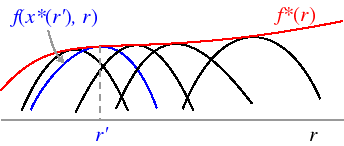
And this gives the heart of the envelope theorem: to a first approximation, we don't need to worry about changes in behavior ($\frac{dx}{dr}$, or adaptation) to evaluate the effect of a change in climate on output.  The fact that behavior is already optimized means that behavioral adjustments will be second-order.

Here's an illustration of the math from lifted from the link above. The black and blue curves hold farmers's decisions fixed at different levels of $x$, optimized at each $r$  The $f^*(r)$ ( or $y^*$) we observe is the "upper envelope" of the all the blue and black curves with different, optimized levels of $x$.


Now, if $f^*(r)$ is highly nonlinear, and we are contemplating a very large change in climate, then adaptation will come into play. But even then it's probably not going to be a primary consideration.

I don't expect this basic insight, drilled into every economist during their first year of grad school (and even some undergraduates), will stop some economists from over-emphasizing adaptation.  But our own basic theory nevertheless indicates it is a small deal.  And it seems to me that the evidence so far bears this out just as clearly as the theory does.

Thursday, April 10, 2014

Devise a better net-metering agreement for residential solar

A question for my undergraduate environmental economics students:

Navigate to http://www.uhero.hawaii.edu/news/view/274 and read about the costs and benefits of installing PV, from a household's perspective and from Hawaiian Electric's. Play around with the interactive calculator. Dick Rosenblum, the CEO of Hawaiian Electric, often complains about net metering agreements because homeowners get retail prices instead of wholesale prices for the energy their panels generate. (Also see this article by energy economist Severin Borenstein.) 

As the UHERO blog post points out, a side effect from current net metering agreements is that households over-install solar. As a result, they often pay a zero marginal price for electricity, which discourages conservation. 

Devise a different model for net metering agreements that can address both Dick Rosenblum's complaints and restore incentives for households with solar to conserve energy.

Feel free to help my students out by suggesting answers in the comment section ;-)

Thursday, April 3, 2014

Pushing the limit of solar in Hawai'i

Sorry for the radio silence.  Way too much going on.

However, I am doing a little blogging for UHERO, focusing on Hawai'i's interesting electricity situation.  We have the highest electricity prices in the country, about 3.5 times those on the mainland.  That fact coupled with tax credits and a lot of sunshine has given us more solar penetration, by far, than anyplace in the country.  Most statistics you'll find tend to be a bit dated---there's more penetration here than most people know, and it's pushing the limit of our grid.

Anyhow, below are links to my first two posts about the situation.  More to come soon, I hope.

Is Monopoly a Barrier to Hawai'i's Ascent?

Why are Hawai'i's Electricity Prices So High?


Thursday, January 2, 2014

Not fit to print, but why?

A brief follow up to my post the other day about the disasterous NY Times article by David Kocieniewski.

Flex Salmon and Jayson Lusk, among others, have written similar and more detailed pieces detailing Kocieniewski's reporting slight of hand.  I really thought this sort of thing was beneath the NY Times.  The editors there certainly deserve some of the blame.

Journalistic malfeasance aside, where is this attack coming from?  Why does Kocieniewski and NY Times go to such great lengths to attack two relatively innocuous academic economists?  Why do they seem to have a bee in their bonnet about commodity price speculation?

I don't know the answers to these questions.  But I'm wondering if momentum on financial regulatory reform may be a bit less innocent that Paul Krugman seems to think. Some might note that the Mike Konczal article that Krugman references mentions the heavy influence of Gary Gensler, chairman of the Commodity Futures Trading Commission.  I wonder if old powerful commodity interests may be an unlikely ally of Elizabeth Warren in the fight to regulate Wall Street banks more tightly.  The commodity groups aren't fans of regulation, and I doubt they share Warren's concern for consumers and market stability.  But presumably they don't like growing competition from Wall Street.  There would seem to be big private interests that favor financial reform.

Yes, I'm reading tea leaves here.  Does anyone have better insight?


Saturday, December 28, 2013

NY Times attack by innuendo: Commodity price speculation edition

I've written a few times [e.g., 1, 2, 3, ] about commodity price speculation, arguing that speculation hasn't been the cause of volatility in recent years.  My views on this haven't changed, but I'm open to new arguments for why I and legions of other economists might be wrong. 

Overall, I haven't found this topic to be a very interesting, because those arguing that Wall Street caused the food price crisis, or caused oil prices to spike, really haven't presented any kind of logical argument.  All they do is point to the fact that Wall Street has gotten into the commodity game more than they have in the past.  But this isn't news and it falls far short of an explanation for how their trading activities are affecting prices. I haven't seen a serious study claiming a link, only magazine articles and opinion pieces, all thin on substance.  Professionally, I don't see this as interesting work.  This review lays things out pretty clearly.

I've been waiting for this issue to die.  But it seems there are political winds that won't let it.  Yesterday the New York Times came out with a new attack on academics, particularly Craig Pirrong and Scott Irwin.  These guys have been doing some consulting work, mainly for oil companies and the Chicago Mercantile Exchange.  These companies have also been giving money to their universities.  The documentary Inside Job is referenced (a great movie, by the way).  

There is a lot of innuendo in the story, and I do feel uncomfortable about academic economists getting cushy consulting contracts with big trading companies.  Still, the scale of what's mentioned seems tame relative to the kind of consulting gigs that seem commonplace in the economics realm of academia, or even the levels of corporate cash given to universities. 

The story is most notable for what it lacks: how, exactly, are the various companies distorting markets in a way that hurts consumers and or producers?  Inside Job describes the shady business of securities backed by stated-income mortgages, how Goldman Sachs was shorting the products it was selling to clients, etc.  We can see that there were shady business dealings and how they probably helped to fuel the real estate bubble.  So, where's the real underlying story in commodity market trading?

I don't think this story measures up to the New York Times' standard.  It's sad, because there might actually be a story here, but it would require a lot more legwork by Kocieniewski   That story, however, is probably a bit less salacious than what Kocieniewski was shooting for. My guess (I welcome challenges--I'm not sure about this) is that the  real story is a battle between old-school commodity groups (ADM, Cargill, and other so-called "majors" that both speculate and store commodities) and new competition from Wall Street, like JP Morgan Chase and Goldman Sachs.  I would further guess that some of the strangeness in commodity prices over recent years, like futures prices sometimes not converging to spot prices, is partly a refection of this changing marketplace.  Note, however, that the "strangeness" in pricing of which I speak has basically zero relevance to producer and consumer prices.  

My vague sense is that incompleteness in these markets---the fact that future contracts are only for certain months and certain delivery dates---procures a special advantage to the majors who control inventories at delivery points.  I'd further guess that Wall Street players are getting into commodities partly for diversification, and partly because they figure they can skim some the rents earned by the commodity players. 

Anyhow, I don't have all the details figured out.  It's something I started to pencil out once, but, like I said, I don't see this as especially useful for larger-scale questions about supply and demand, policy, climate change, etc. So I figure I've got better things to do.  

For the record, I've never had a consulting contract with commodity group or Wall Street firm.

Wednesday, November 20, 2013

Fixed Effects Infatuation

The fashionable thing to do in applied econometrics, going on 15 years or so, is to find a gigantic panel data set, come up with a cute question about whether some variable x causes another variable y, and test this hypothesis by running a regression of y on x plus a huge number of fixed effects to control for "unobserved heterogeneity" or deal with "omitted variable bias."  I've done a fair amount of work like this myself. The standard model is:

y_i,t = x_i,t + a_i + b_t + u_i,t

where a_i are fixed effects that span the cross section, b_t are fixed effects that span the time series, and u_i,t is the model error, which we hope is not associated with the causal variable x_i,t, once a_i

If you're really clever, you can find geographic or other kinds of groupings of individuals, like counties, and include group-by-year fixed effects:

y_i,t = x_i,t + a_i + b_g,t + u_i,t

The generalizable point of my lengthy post the other day on storage and agricultural impacts of climate change, was that this approach, while useful in some contexts, can have some big drawbacks. Increasingly, I fear applied econometricians misuse it.  They found their hammer and now everything is a nail.

What's wrong with fixed effects? 

A practical problem with fixed effects gone wild is that they generally purge the data set of most variation.  This may be useful if you hope to isolate some interesting localized variation that you can argue is exogenous.  But if the most interesting variation derives from a broader phenomenon, then there may be too little variation left over to identify an interesting effect.

A corollary to this point is that fixed effects tend to exaggerate attenuation bias of measurement errors since they will comprise a much larger share of the overall variation in x after fixed effects have been removed.

But there is a more fundamental problem.  To see this, take a step back and think generically about economics.  In economics, almost everything affects everything else, via prices and other kinds of costs and benefits.  Micro incentives affect choices, and those choices add up to affect prices, cost and benefits more broadly, and thus help to organize the ordinary business of life.  That's the essence of Adam's Smith's "invisible hand," supply and demand, and equilibrium theory, etc.  That insight, a unifying theoretical theme if there is one in economics, implies a fundamental connectedness of human activities over time and space.   It's not just that there are unobserved correlated factors; everything literally affects everything else.  On some level it's what connects us to ecologists, although some ecologists may be loath to admit an affinity with economics.

In contrast to the nature of economics, regression with fixed effects is a tool designed for experiments with repeated measures.  Heterogeneous observational units get different treatments, and they might be mutually affected by some outside factor, but the observational units don't affect each other.  They are, by assumption, siloed, at least with respect to consequences of the treatment (whatever your x is).  This design doesn't seem well suited to many kinds of observational data.

I'll put it another way.  Suppose your (hopefully) exogenous variable of choice is x, and x causes z, and then both x and z affect y.  Further, suppose the effects of x on z spill outside of the confines of your fixed-effects units.  Even if fixed effects don't purge all the variation in x, they may purge much of the path going from x to z and z to y, thereby biasing the reduced form link between x and y. In other words, fixed effects are endogenous.

None of this is to say that fixed effects, with careful account of correlated unobserved factors, can be very useful in many settings.  But the inferences we draw may be very limited.  And without care, we may draw conclusions that are very misleading. 

Monday, November 11, 2013

Can crop rotations cure dead zones?

It is now fairly well documented that much of the water quality problems leading to the infamous "dead zone" in the Gulf of Mexico (pictured above) come from fertilizer applications on corn. Fertilizer on corn is probably a big part of similar challenges in the Chesapeake Bay and Great Lakes.

This is a tough problem.  The Pigouvian solution---taxing fertilizer runoff, or possibly just fertilizer---would help.  But we can't forget that fertilizer is the main source of large crop productivity gains over the last 75 years, gains that have fed the world.  It's hard to see how even a large fertilizer tax would much reduce fertilizer applications on any given acre of corn.

However, one way to boost crop yields and reduce fertilizer applications is to rotate crops. Corn-soybean rotations are most ubiquitous, as soybean fixes nitrogen in the soil which reduces need for applications on subsequent corn plantings.  Rotation also reduces pest problems.  The yield boost on both crops is remarkable.  More rotation would mean less corn, and less fertilizer applied to remaining corn, at least in comparison to planting corn after corn, which still happens a fair amount.

I've got a new paper (actually, an old but newly revised paper), coauthored with Mike Livingston of USDA and Yue Zhang, a graduate student at NCSU, that might provide a useful take on this issue.  This paper has taken forever.  We've solved a fairly complex stochastic dynamic model that takes the variability of prices, yields and agronomic benefits of rotation into account. It's calibrated using the autoregressive properties of past prices and experimental plot data.  All of these stochastic/dynamics can matter for rotations. John Rust once told me that Bellman always thought crop rotations would be a great application for his recursive method of solving dynamic problems.

Here's the jist of what we found:

Always rotating, regardless of prices, is close to optimal, even though economically optimal planting may rotate much less frequently.  One implication is that reduced corn monoculture and fertilizer application rates might be implemented with modest incentive payments of  \$4 per acre or less, and quite possibly less than \$1 per acre.

In the past I've been skeptical that even a high fertilizer tax could have much influence on fertilizer use. But given low-cost substitutes like rotation, perhaps it wouldn't cost as much as some think to make substantial improvements in water quality.

Nathan Hendricks and coauthors have a somewhat different approach on the same issue (also see this paper).  It's hard to compare our models, but I gather they are saying roughly similar things.

Tuesday, November 5, 2013

Weather, storage and an old climate impact debate

This somewhat technical post is a belated followup to a comment I wrote with Tony Fisher, Michael Hanemann and Wolfram Schlenker, which was finally published last year in the American Economic Review.  I probably should have done this a long time ago, but I needed to do a little programming.  And I've basically been slammed nonstop.

First the back story:  The comment re-examines a paper by Deschanes and Greenstone (DG) that supposedly estimates a lower bound on the effects of climate change by relating county-level farm profits to weather.  They argue that year-to-year variation in weather is random---a fair proposition---and control for unobserved differences across counties using fixed effects.  This is all pretty standard technique.

The overarching argument was that with climate change, farmers could adapt (adjust their farming practices) in ways they cannot with weather, so the climate effect on farm profits would be more favorable than their estimated weather effect.

Now, bad physical outcomes in agriculture can actually be good for farmers' profits, since demand for most agricultural commodities is pretty steep: prices go up as quantities go down.  So, to control for the price effects they include year fixed effects.  And since farmers grow different crops in different parts of the country and there can be local price anomalies, they go further and use state-by-year fixed effects so as to squarely focus on quantity effects in all locations.

Our comment pointed out a few problems:  (1) there were some data errors like missing temperature data apparently coded with zeros and much of the Midwest and most of Iowa dropped from the sample without explanation; (2) in making climate predictions they applied state-level estimates to county-level baseline coefficients, in effect making climate predictions that regress to the state mean (e.g., Death Valley and Mt. Witney have different baselines but the same future); (3) all those fixed effects wash out over 99 percent of weather variation, leaving only data errors for estimation; (4) the standard errors didn't appropriately account for the panel nature of the spatially correlated errors.

These data and econometric issues got the most attention.  Correct these things and the results change a lot.  See the comment for details.

But, to our minds, there is a deeper problem with the whole approach.  Their measure of profits was really no such thing, at least not in an economic sense: it was reported sales minus a crude estimate of current expenditures.  The critical thing here is that farmers often do not sell what they produce.  About half the country's grain inventories are held on farm.  Farms also hold inventory in the form of capital and livestock, which can be held, divested or slaughtered.  Thus, effects of weather in one year may not show up in profits measured in that year.  And since inventories tend to be accumulated in plentiful times and divested in bad times, these inventory adjustments are going to be correlated with the weather and cause bias.

Although DG did not consider this point originally, they admitted it was a good one, but argued they had a simple solution: just include the lags of weather in the regression. When they attempted this, they found lagged weather was not significant, and thus concluded that this issue was unimportant.  This argument is presented in their reply to our comment.

We were skeptical about their proposed solution to the storage issue.  And so, one day long ago, I proposed to Michael Greenstone, that we test his proposed solution. We could solve a competitive storage model, assume farmers store as a competitive market would, and then simulate prices and quantities that vary randomly with the weather.  Then we could regress sales (consumption X price) against our constructed weather and lags of weather plus price controls. If the lags worked in this instance, where we knew the underlying physical structure, then it might work in reality.

Greenstone didn't like this idea, and we had limited space in the comment, so the storage stuff took a minimalist back seat. Hence this belated post.

So I recently coded a toy storage model in R, which is nice because anyone can download and run this thing  (R is free).  Also, this was part of a problem set I gave to my PhD students, so I had to do it anyway.

Here's the basic set up:

y    is production which varies randomly (like the weather).
q    is consumption, or what's clearly sold in a year.
p    is the market price, which varies inversely with q (the demand curve)
z    is the amount of the commodity on hand (y plus carryover from last year).

The point of the model is to figure out how much production to put in or take out of storage.  This requires numerical analysis (thus, the R code).  Dynamic equilibrium occurs when there is no arbitrage: where it's impossible to make money by storing more or storing less.

Once we've solved the model, which basically gives q, p as a function of z, we can simulate y with random draws and develop a path of q and p.  I chose a demand curve, interest rate and storage cost that can give rise to a fair amount of price variability and autocorrelation, which happens to fit the facts.  The code is here.

Now, given our simulated y, q and p, we might estimate:

(1)   q_t = a + b0  y_t + b1 y_{t-1} + b2 y_{t-2} + b3 y_{t-3} +  ... + error

(the ... means additional lags, as many as you like.  I use five.)

This expression makes sense to me, and might have been what DG had in mind: quantity in any one year is a function of this year's weather and a reasonable number past years, all of which affect today's output via storage.  For the regression to fully capture the true effect of weather, the sum of b# coefficients should be one.

Alternatively we might estimate:

(2)   p_t q_t = a + b0  y_t + b1 y_{t-1} + b2 y_{t-2} + b3 y_{t-3} +  ... + error

This is almost like DG's profit regression, as costs of production in this toy model are zero, so "profit" is just total sales.   But DG wanted to control for price effects in order to account for the pure weather effect on quantity, since the above relationship, the sum of the b# coefficients is likely negative.  So, to do something akin to DG within the context of this toy model we need to control for price.  This might be something like:

(3)  p_t q_t = a + b0  y_t + b1 y_{t-1} + b2 y_{t-2} + b3 y_{t-3} +  ... + c p_t + error

Or, if you want to be a little more careful, recognizing there is a nonlinear relationship, we might have a more flexible control for p_t, and use a polynomial. Note that we cannot used fixed effects like DG because this isn't a panel.  I'll come back to this later.  In any case, with better controls we get:
 
(4)   p_t q_t = a + b0  y_t + b1 y_{t-1} + b2 y_{t-2} + b3 y_{t-3} +  ... + c1 p_t  + c2 p_t^2 + c3 p_t^3 +  error

At this point you should be worrying about having p_t on both the right and left side.  More on this in a moment.  First, let's take a look at the results:

Equation 1:
            Estimate Std. Error t value Pr(>|t|)
(Intercept)     1.68       1.32    1.28     0.20
y               0.39       0.03   15.62     0.00
l.y             0.23       0.03    9.17     0.00
l2.y            0.10       0.03    3.83     0.00
l3.y            0.07       0.03    2.66     0.01
l4.y            0.07       0.03    2.69     0.01
l5.y            0.06       0.03    2.34     0.02


The sum of the y coefficients is 0.86.  I'm sure if you put in enough lags they would sum to 1. You shouldn't take the Std. Error or t-stats seriously for this or any of the other regressions, but that doesn't really matter for the points I want to make. Also, if you run the code, the exact results will differ because it will take a different random draw of y's, but the flavor will be the same.

Equation 2:
            Estimate Std. Error t value Pr(>|t|)
(Intercept)  4985.23     166.91   29.87        0
y             -72.15       3.19  -22.63        0
l.y           -43.67       3.20  -13.64        0
l2.y          -22.52       3.21   -7.03        0
l3.y          -15.61       3.21   -4.87        0
l4.y          -13.58       3.19   -4.26        0
l5.y          -12.26       3.19   -3.85        0


All the coefficients are negative.  As we expected, good physical outcomes for y mean bad news for profits, since prices fall through the floor.  If you know a little about the history of agriculture, this seems about right.  So, let's "control" for price.

Equation 3:
            Estimate Std. Error t value Pr(>|t|)
(Intercept)  2373.15     167.51   14.17        0
y             -28.12       2.91   -9.66        0
l.y           -17.72       2.10   -8.43        0
l2.y          -11.67       1.63   -7.17        0
l3.y           -8.07       1.57   -5.16        0
l4.y           -5.99       1.56   -3.84        0
l5.y           -5.68       1.54   -3.68        0
p               7.84       0.44   17.65        0


Oh, good, the coefficients are less negative.  But we still seem to have a problem.  So, let's improve our control for price by making it a 3rd order polynomial:

Equation 4:
            Estimate Std. Error       t value Pr(>|t|)
(Intercept)  1405.32          0  1.204123e+15     0.00
y               0.00          0  2.000000e-02     0.98
l.y             0.00          0  3.000000e-02     0.98
l2.y            0.00          0  6.200000e-01     0.53
l3.y            0.00          0 -3.200000e-01     0.75
l4.y            0.00          0 -9.500000e-01     0.34
l5.y            0.00          0 -2.410000e+00     0.02
poly(p, 3)1  2914.65          0  3.588634e+15     0.00
poly(p, 3)2  -716.53          0 -1.795882e+15     0.00
poly(p, 3)3     0.00          0  1.640000e+00     0.10


The y coefficients are now almost precisely zero. 

By DG's interpretation, we say that weather has no effect on profit outcomes and thus climate change is likely to have little influence on US agriculture.  Except in this simulation we know that in the underlying physical reality is that one unit of y ultimately has a one unit effect on the output.  DG's interpretation is clearly wrong.

What's going on here? 

The problem comes from an attempt to "control" for price.  Price, after all, is a key (the key?) consequence of the weather. Because storage theory predicts that prices incorporate all past production shocks, whether they are caused by weather or something else, in controlling for price, we remove all weather effects on quantities.  So, DG are ultimately mixing up cause and effect, in their case by using a zillion fixed effects. One should take care in adding "controls" that might actually be an effect, especially when you supposedly have a random source of variation.  David Freedman, the late statistician who famously critiqued regression analysis in the social sciences and provided inspiration to the modern empirical revolution in economics, often emphasized this point.

Now, some might argue that the above analysis is just a single crop, that it doesn't apply to DG's panel data. I'd argue that if you can't make it work in a simpler case, it's unlikely to work in a case that's more complicated.  More pointedly, this angle poses a catch 22 for the identification strategy: If  inclusion of state-by-year fixed effects does not absorb all historic weather shocks, then it implies that the weather shocks must have been crop- or substate-specific, in which case there is bias due to endogenous price movements even after the inclusion of these fixed effects. On the other hand, if enough fixed effects are included to account for all endogenous price movements, then lagged weather by definition does not add any additional information and should not be significant in the regression.  Prices are a sufficient statistic for all past and current shocks.

All of this is to show that the whole DG approach has problems.  However, I think the idea of using lagged weather is a good one if combined with a somewhat different approach.  We might, for example, relate all manner of endogenous outcomes (prices, quantities, and whatever else) to current and past weather. This is the correct  "reduced form."  From these relationships, combined with some minimalist economic structure, we might learn all kinds of interesting and useful things, and not just about climate change.   This observation, in my view, is the over-arching contribution of my new article with Wolfram Schlenker in the AER

I think there is a deeper lesson in this whole episode that gets at a broader conversation in the discipline about data-driven applied microeconomics over the last 20 years.  Following Angrist, Ashenfelter, Card and Krueger, among others, everyone's doing experiments and natural experiments.  A lot of this stuff has led to some interesting and useful discoveries.  And it's helped to weed out some applied econometric silliness.

Unfortunately, somewhere along the way, some folks lost sight of basic theory.   In many contexts we do need to attach our reduced forms to some theoretical structure in order to interpret them.  For example, bad weather causing profits to go up in agriculture actually makes sense, and indicates something bad for consumers and for society as a whole.

And in some contexts a little theory might help us remember what is and isn't exogenous.

Wednesday, October 23, 2013

What is the value of symbolic action?

Robert Stavins argues that largely symbolic actions do not help and may ultimately hurt the cause for action on climate change (HT Mark Thoma):
Over the past year or more, across the United States, there has been a groundswell of student activism pressing colleges and universities to divest their holdings in fossil fuel companies from their investment portfolios.  On October 3, 2013, after many months of assessment, discussion, and debate, the President of Harvard University, Drew Faust, issued a long, well-reasoned, and – in my view – ultimately sensiblestatement on “fossil fuel divestment,” in which she explained why she and the Corporation (Harvard’s governing board) do not believe that “university divestment from the fossil fuel industry is warranted or wise.”  I urge you to read her statement, and decide for yourself how compelling you find it, and whether and how it may apply to your institution, as well. 
About 10 days later, two leaders of the student movement at Harvard responded to President Faust in The Nation.  Andrew Revkin, writing at the New York Times Dot Earth blog, highlighted the fact that the students responded in part by saying, “We do not expect divestment to have a financial impact on fossil fuel companies …  Divestment is a moral and political strategy to expose the reckless business model of the fossil fuel industry that puts our world at risk. 
I agree with these students that fossil-fuel divestment by the University would not have financial impacts on the industry, and I also agree with their implication that it would be (potentially) of symbolic value only.  However, it is precisely because of this that I believe President Faust made the right decision.  Let me explain.
Some may feel exasperated.  If students cannot even make a symbolic or moral point, what can they do?  If your initial reaction is skepticism, I encourage you to click through and read the whole thing, including an earlier post where he addresses what individuals and small institutions can do to curb global warming.  His bottom line: 
Try to focus on actions that can make a real difference, as opposed to actions that may feel good or look good but have relatively little real-world impact, particularly when those feel-good/look-good actions have opportunity costs, that is, divert us from focusing on actions that would make a significant difference.  Climate change is a real and pressing problem.  Strong government actions will be required, as well as enlightened political leadership at the national and international levels.
Stavins also describes some reasons why symbolic activities might be counterproductive.  

I've got one small quibble.  Stavins is right that the over-arching actions required to curb global warming require national and international government. This may seem too remote for many individuals and institutions who want to actively engage.

But with CO2 concentrations already reaching over 400ppm, there is also a fairly large amount of warming already baked into our future.  Different locations will be affected in different ways, and state and local communities and governments need contingency plans and strategies for adaptation.  Building codes and land use regulations need to be revised.  There is also plenty of waste and inefficiency in current state and local policies.

So, if you want to act locally instead of nationally or globally, try to find practical ways for local governments and institutions to improve their regulatory systems.  Here in Hawai'i, we could probably manage our local public resources: energy, water and coastal ecosystems much better, regardless of climate change.  And given warming and sea level rise already anticipated, we need to develop sensible policies for adaptation.

The first step is to thoroughly educate yourself on the local challenges and policy tradeoffs.  Doing that is probably more work than you think.  As Stavins intimates, it seems people often focus on simple (but ultimately useless) symbolic actions because they're easy to do.  Perhaps we make ourselves feel better by talking gravely about the problems and in making great moral pronouncements about what other people should be doing.  Nevermind that all of this accomplishes precisely nothing.

Monday, September 30, 2013

Desperate times bring desperate measures

Update: Edwardo Porter makes the same point, only he does a much better job of it.

A bit off topic, but the impending government shutdown has me thinking in simple game theoretic terms.

Some on the left (and right) seem to think that Congressional actions are "crazy" as government shutdown is likely to hurt the Republican party.  After all, that's what happened the last time when Newt Gingrich shut down the government in 1995, which led to his demise and helped Clinton win reelection against Dole in 1996.

It's probably fair to guess that, while this time is different (isn't every time, at least a little?), the shutdown will likely hurt the Republican party.  So why are they doing it?  Are they really crazy?  Has the radical fringe taken over and leading us over the cliff to disaster?

Well maybe. But maybe their actions, even if potentially disastrous, are rational and not surprising given the circumstances.  It seems to me the Republican party is in a desperate situation, and desperate times rationally bring about desperate actions. It's possible, though probably unlikely, that Obama and the Democrats will cave and give Republicans something in exchange, like partial repeal of the health care law, for not blowing up the economy.  It also seems possible, though unlikely, that shutdown and/or default will hurt Democrats as much or more than Republicans.  Even if these are unlikely propositions, they have more than zero probability.

The alternative is that Republicans do nothing and let Obamacare be implemented, the economy continues to recover, and the nation's demographics steadily change, all of which basically ensures death of the modern Republican party. So, do they go for the Hail Mary pass or just give up?  It seems to me that a rational party goes for the Hail Mary pass, which is what they're doing.

So, the good news is that the Republican party, Tea Partiers included, probably isn't crazy.  The bad news is that it's hard to see how this whole thing plays out without the country, and possibly much of the world, being badly hurt.

Climate Change and Resource Rents


With the next IPCC report coming out, there's been more reporting on climate change issues.  Brad Plumer over a Wonkblog has nice summary that helps to illustrate how much climate change is already "baked in" so to speak.

I'd like to comment one point.  Brad writes "Humans can only burn about one-sixth of their fossil fuel reserves if they want to keep global warming below 2ºC."

I'd guess some might quibble with the measurement a bit, since viable reserves depends on price and technology, plus many unknowns about much fossil fuel there really is down there.  But this is probably in the ballpark, and possibly conservative.

Now imagine you own a lot of oil, coal and/or natural gas, you're reading Brad Plumber, and wondering what might happen to climate policy in the coming years.  Maybe not next year or even in the next five or ten years, but you might expect that eventually governments will start doing a lot more to curb fossil fuel use.  You might then want to sell your fossil fuels now or very soon, while you can.   If many resource owners feel this way, fossil fuel prices could fall and CO2 emissions would increase.  

This observation amounts to the so-called "green paradox."  Related arguments suggest that taxing carbon may have little influence on use, and subsidizing renewable fuels and alternative technologies, without taxing or otherwise limiting carbon-based fuels, might make global warming worse, since it could push emissions toward the present.

Research on these ideas, mostly theoretical, is pretty hot in environmental economics right now.  It seems like half the submissions I manage at JEEM touch on the green paradox in one way or another.  

All of it has me thinking about a point my advisor Peter Berck often made when I was in grad school. At the time, we were puzzling over different reasons why prices for non-renewable resources--mostly metals and fossil fuels--were not trending up like Hotelling's rule says they should.  Peter suggested that we may never use the resources up, because if we did, we'd choke on all the pollution.  Resource use would effectively be banned before all of it could be used. If resource owners recognized this, they'd have no incentive to hold or store natural resources and the resource rent (basically the intrinsic value based on its finite supply) would be zero, which could help explain non-increasing resource prices.

For all practical purposes, Peter understood the green paradox some 15-20 years ago.  Now the literature is finally playing catch up.  

Thursday, September 26, 2013

I've been touched by genius

Awesome news.  My colleague David Lobell just won the MacArthur grant.

http://news.stanford.edu/news/2013/september/macarthur-fellowship-awards-092513.html

Seriously, David is a fantastic colleague and very deserving of this award.  Also, I think we have some great new research in the pipeline and with any luck this might help bring some exposure to it.


Saturday, September 7, 2013

GGG is among the top 200 most influential economics blogs (just barely)

I just stumbled upon this ranking via Econobrowser, which is number 10, and one of the blogs I really like to visit.

Greed, Green and Grains is number 199.

Well, I guess that's not a crown jewel, but I'll take it, especially given how my little niche isn't one of the biggest fields of economics and how little time I have to dedicate to this thing. 

I realize posting is thin.  I will try to post when I can, but my commitments are just too many to post much these days.  G-FEED, which is steadily growing in influence, will have more posts because there a number of us contributing, some of whom are rapidly becoming the rock stars of science, with some major publications and media attention.

Tuesday, August 6, 2013

Crop insurance under climate change

How should crop insurance premiums adjust to a changing climate in order to remain actuarial fair?
Short answer:  Very slowly.

That seems pretty obvious to me, and hopefully to anyone who thinks about it for a few minutes, even if you think climate change is ultimately going to have big impacts.  Moreover, the way crop insurance premiums are already determined---as a function a farmer's own recent yield history---gradual adjustment of premiums will take place naturally.

So, what should USDA's Risk Management Agency do, if we think nasty crop outcomes like last year are going to be more frequent going forward?

Well, I'll abstain from making a recommendation, but I will say that if they do absolutely nothing, there will be no significant budgetary implications.

None of this is to say that there might not be other ways to improve crop insurance.

Update: So, if this issue is so unimportant, why do I mention it?  Because I'm seeing and hearing the question a lot, and my general sense is that energy and resources might be better spent on other issues.

Thursday, August 1, 2013

Integrated assessment models: What do they tell us about climate change policy?

"Very little,"  according to Robert Pindyck in a new working paper.

Integrated assessment models (IAMs to practitioners) stitch together projections from climate models, energy sector models, agronomic crop models, models of other sectors of the economy, and partial or general equilibrium models that account for price and interactions with the broader economy to derive a more comprehensive evaluation of costs and benefits from climate change.

Pindyck is understandably frustrated with the false sense of precision these models can impart.  As he explains, a few reasonable tweaks of any of these models can give very different estimates about the social cost of carbon---the price we should pay, but typically don't, for emitting CO2.

Pindyck raises some good criticisms about IAMs, or at least says out loud a lot of things that many economists have quietly said to each other.  I'm glad he's bringing our varying assumptions and wildly varying cost-of-carbon estimates out into the open for all to see.  Perhaps it will push us to make our modeling efforts a little more useful, or at least more transparent.

He's right to pick on false precision.  But I wonder: has anyone really been fooled?  My sense is no.  One positive thing about these modeling efforts is that they allow us to see which assumptions are most critical. They are nice (black?) boxes for testing out the sensitivity of X on overall climate impacts. This might help us frame more reasonable discussion about the possibilities and what we should do.  It might also help researchers focus future empirical efforts.

The extreme sensitivity of results to seemingly innocuous assumptions also shows how uncertain the impacts of climate change really are.  Indeed, not long ago Pindyck published a paper in JEEM with results that are extremely sensitive to his assumption that the world will end in 500 to 1000 years (an assumption that could be more transparent--see his footnote #13), among others.

So let's take our IAMs with salt, and encourage developers of the models to be as transparent as possible about their assumptions and how and why their models differ from each other.  But let's also not forget that they have a place in this business, albeit perhaps a bit less than IAM builders might have you believe.

Schneider and Schneider and Lane also have nice critiques of IAMs.

Sunday, July 28, 2013

GMOs: Franken food or technological savior?

Amy Harmon has a great in-depth story in the New York Times about the science and controversy surrounding GMO crops.  She builds the article around the worldwide problem of citrus greening, but nicely builds in abroader story about GMOs in general.

Another great source for learning more about the GMO controversy is the book Tomorrow's Table, by Pamela Ronald and Raoul Adamchak.

My own take on GMOs so far: The hysteria against them is likely overblown, but the extraordinary promises by technological optimists are overblown too.  Traditional breeding is a solid and, over the long run, often superior and less costly substitute to GMOs.  What's more worrisome to me is that intellectual property laws and regulatory costs may be acting to concentrate the seed business and make it less competitive.  These later issues are complex, not exactly my forte, and I don't presently see clear answers to any of it.

Anyhow, it's nice to see good reporting on an evocative topic.

Wednesday, July 24, 2013

Commodity Speculation or Market Power?

After seeing how much Goldman profited from selling MBS that they knew were junk, it's hard to feel sorry for Goldman receiving so much grief for its commodity storage and trading activities.  The worry seems to be that because Goldman has become increasingly involved in commodities markets that they must be manipulating prices for profit, and in the process pushing prices away from their fundamental values---ie., supply and demand.

Do we actually know whether there is a problem here? It's possible that Wall Street is trying to manipulate the market.  But this is a hard thing to do, even for a really big company, especially one that doesn't produce the stuff it's trying to monopolize.  Also bear in mind that anyone can buy and store commodities, so it's not like there are huge barriers to entry.  Those who have tried to corner commodity markets in the past haven't fared well.

My sense is that cornering a commodity market via hoarding is basically impossible once the market realizes what the major player(s) is doing.  And if they're having senate hearings about Goldman's storage and trading activities, I think it's fair to say the cat's out of the bag.

So, what is Goldman doing? If it's not a market power story I'd guess they're trying to buy low and sell high, just like everybody else. They probably believe they have a better handle on market fundamentals than other commodity speculators.  Perhaps they do.  But if this is all they are doing, then they are effectively reducing price volatility and helping to make the market work more efficiently.

On public radio this morning a reporter (sorry, I forget who), asked Omarova whether Goldman's profits just meant that consumers were paying higher prices.  Omarova said "that's absolutely right." But it's absolutely wrong if Goldman's just speculating.  Goldman's profits are coming out of the pockets of speculators who bet prices would fall when they rose, and vice versa.  In fact, that's probably the case if it's a market power issue too.

Anyway, if this is about Goldman trying to corner the storage market, that's a problem and Goldman deserves the grief they're receiving. But that strikes me as unlikely as it would be foolhardy.  My guess is that this is just speculation, which means Goldman's profits translate directly to better allocation of commodities over time, less commodity price volatility, and basically zero influence on average prices.

Tuesday, July 16, 2013

The Farm Bill, a.k.a Hunger Games

At this point in our broader political discourse, I probably shouldn't surprised about the House's vote on the farm bill, which continues generous support for wealthy farmers and eliminates food stamps. 

I'm trying to keep my blogging more positive and analytical than normative.  I think the analysis of this is pretty clear, so not much to say here that others, like Paul Krugman, have already done much better than I can. (Incidentally, the 1400+ comments on that article, many of which look very thoughtful, looks like a record to my recollection).

One thing I might add:  In my career studying agricultural policy in the US, I have heard many, many economists of all political stripes lambast our agricultural subsidies.  Greg Mankiw pointed to them as one of the key areas where most economists generally agree.  But I rarely hear economists of any political stripe criticize our food stamp program.  About the harshest economic criticism I've seen as that we should give people cash rather than food stamps.

We live in truly bizarre times.

Saturday, July 6, 2013

Macro, Multipliers and the Environment

A little follow up from my post the other day:  It's probably going too far to say investment to curb climate change, if made during a depression, is a free lunch.  But certainly the basic benefit-cost analysis for what constitutes the most efficient policy with respect to climate change, or any other environmental or public good, changes when there is another massive market failure at play.  Spending to reduce emissions would seem to have two benefits: reduced externalities plus closing the macro output gap.

In some ways it feels a little like the so-called "double-dividend" hypothesis: the idea that taxing pollution can solve the environmental externality while raising revenue that can reduce distortionary income or sales taxes.  That rather compelling idea still gets kicked around a lot, and there is probably a small truth to it, although the calculation turns out to be more subtle (see Goulder's review, for example).

At first blush, the macro double dividend seems like it could be much larger.  As the late James Tobin apparently used to say, it takes a lot of Harberger triangles to fill and Okun gap.  The old double dividend literature dabbles with the former, and now we're talking about the latter.  I'm not familiar enough with the literature to know whether there have been attempts to bridge these vastly different areas of economics.  It strikes me as a difficult thing to do.  And even if it were done well, likely hard to publish due to the macro wars.

Still, if environmental policy were to be structured with macro multipliers in mind, it could change the entire calculus about the relative benefits of standards versus prices, especially if one would induce more spending in the near term.  It might also alter the implications of uncertainty.  Standard micro analysis, which is fashionable in environmental economics, favors delayed timing of investments, but with small economic values at stake.  The macro effect would strongly favor investment now, with presumably big economic stakes.

Of course, there are public goods besides reducing environmental externalities.  Spending on basic infrastructure like roads, bridges, tunnels and railways might have similar double dividends.  So how do we more generally evaluate the costs and benefits of public policies in a depressed economy, assuming (as I would) that macro output gaps are real may be with us for awhile?

I don't know the answer to this question.  But there would seem to be a lot more to it than measuring multipliers.  So, who are the brave, inquisitive souls willing to dive in?


Renewable energy not as costly as some think

The other day Marshall and Sol took on Bjorn Lomborg for ignoring the benefits of curbing greenhouse gas emissions.  Indeed.  But Bjorn, am...