While Paul Krugman and Greg Mankiw both explain that inflation is no threat, allow me to follow Brad Delong by listing all the reasons I know for why the Fed's current nominal inflation target of two percent (one percent in practice) is too low.
1) To maximize long run stability, the Fed should target a long-run price level, not a long run inflation rate. This way long-run investors can be reasonably assured of a particular long-run real rate of return for any given investment paying nominal dividends. The idea is that the Fed would thereby promise to correct short-run variations in inflation leading to less long-run mis-pricing of expectations and assets. Now, since inflation of the last few years has been well below target, it would therefore help restore pre-recession expectations if the Fed were to pursue higher inflation for at least a few years.
2) A higher inflation target will reduce odds of hitting the zero lower bound in future crises and recessions, thereby reducing odds of liquidity trap situations like the one we are currently in.
3) To aid the current unusually bad economic situation by encouraging spending now while the general price level is low. This is what Krugman has often described as a "commitment to be irresponsible."
4) To accelerate deleveraging of both private and public debts, thereby aiding spending and growth in the short run (in some ways similar to 3).
5) To encourage somewhat higher nominal interest rates once the economy reaches full employment, thereby reducing the incidence of asset bubbles which can be spurred by low nominal interest rates.
6) To lessen the negative impact of rigidities in nominal wages, particularly downward rigidities. And some compelling theoretical work that fits these facts suggests a higher target (say 3 or 4 percent) would be better for long-run growth.
So, what are the downsides to a somewhat higher inflation target? I can think of a few, but I think they are rather mild. One argument in the literature is that a higher inflation rate is also more uncertain. But level and variability are different things. Point (1) is a better way to deal with uncertainty in inflation. And I also know from some dabbling I did for a class paper many years ago that, at least for the U.S., evidence of a negative uncertainty effect is extremely thin. The best argument I can think of is that by changing the inflation target to something greater than 2 percent now will hurt the Bernanke Fed's credibility given they have so vigorously defended a 2 percent target (or something less) up to this point. Thus, if the Fed changes their target now, markets may be less inclined to believe the new target going forward.
The obvious, reasonable answer to the last conundrum is for the Fed to simply lay out its rationale for changing the target. But since many have built in expectations of a lower target, the Fed would plan to implement the new target gradually, and (preferably) more explicitly. That is, they could lay out a clear goal for a long-run price level that they would like to achieve going forward. That target schedule could incorporate a gradual acceleration of inflation to the new target level. All of this would, of course, be accompanied by the usual caveats that the target would sometime miss too low and sometimes miss too high, and that other mitigating circumstance could make achieving the target more difficult at some times as compared to others.
Anyway, that's my armchair macro thought of the day...
Tuesday, May 10, 2011


Thursday, May 5, 2011
Goldman Sachs DID NOT Cause the Food Crisis
I haven't been, and will not be able to, respond to this silly article in Foreign Policy (no link--they don't deserve it).
So, let's just make this a place holder for now: Goldman Sachs, as evil as they may have been in facilitating the demise of AIG and causing the financial crisis, did not cause the food crisis.
Somehow, some way, we economists need to educate the public about when speculation is good (most of the time) and when it is bad (e.g., the 90s tech boom and the housing bubble).
At least so far, we haven't seen the bad kind of speculation when it comes to food commodities. Maybe it will happen in the future--in fact, I kind of worry we may have a problem in the coming years. But so far, no.
The basic fact is the following: If prices are high when inventories are low, it is not a bubble. End of story.
The tough call is going to be when prices are high and inventories are high. That's not happening right now. But if it happens in the future there will be lots of hopefully intelligent debate about whether expectations about future growing demand or future shrinking supply are or are not reasonable. But right now, and in the recent past, the point is moot. Inventories are low. Prices are driven by fundamentals: supply and demand.
So, let's just make this a place holder for now: Goldman Sachs, as evil as they may have been in facilitating the demise of AIG and causing the financial crisis, did not cause the food crisis.
Somehow, some way, we economists need to educate the public about when speculation is good (most of the time) and when it is bad (e.g., the 90s tech boom and the housing bubble).
At least so far, we haven't seen the bad kind of speculation when it comes to food commodities. Maybe it will happen in the future--in fact, I kind of worry we may have a problem in the coming years. But so far, no.
The basic fact is the following: If prices are high when inventories are low, it is not a bubble. End of story.
The tough call is going to be when prices are high and inventories are high. That's not happening right now. But if it happens in the future there will be lots of hopefully intelligent debate about whether expectations about future growing demand or future shrinking supply are or are not reasonable. But right now, and in the recent past, the point is moot. Inventories are low. Prices are driven by fundamentals: supply and demand.
Why the slowdown in agricultural productivity growth?
Two words:
Climate Change Global Warming.
Well, there may be more to it. Like reduced public research and pathogens like wheat stem rust.
But new research by my colleagues David Lobell and Wolfram Schlenker, along with Justin Costa-Roberts shows that warming has hurt corn and wheat yields on all continents except North America:
A few other links:
Science News
Washington Post
UK Gaurdian
New Scientist
In my view, what's ominous here is that we're probably already seeing noticeable effects from climate change even though the world's biggest producer and exporter---the United States--hasn't seen any negative consequences. Yet. From the projections I've seen, that's mainly good luck. It's been cooler here than in the past. If (er... when) it warms here as projected, then we'll really feel the yield drag.
Perhaps I'm being knit picky, but I find the comparison with 1980 prices to be a strange baseline. Prices are very sensitive to quantities. It's not a question of where prices would be today in comparison to 1980. It's a question of where prices would be today without the warming.
If quantities are some 5% lower than they would have been without warming, my own work on global supply and demand elasticities with Wolfram Schlenker suggests prices would be some 30% lower than without climate change.
Maybe this is a tongue-in-cheek way of being conservative. But it just isn't right.
Update (wonkish clarification): My workhorse model here is just supply and demand. That model tells me that, looking broadly across staple food commodities and globally in scope, the world demand elasticity is in the ballpark of 0.05 and the world supply elasticity is in the ballpark of 0.10. To the extent that one is too big, the other on tends to be too small, and vice versa; so I'm more confident in the sum than the individual elasticities. These numbers mean a inward shift in supply or outward shift in demand of 1% will have a 1/(0.15) or a 6.7% increase in price. I was being a little conservative with a 6-fold larger price increase than the climate-induced quantity shift, partly because the quantity shift they estimate is a bit less than 5%.
Well, there may be more to it. Like reduced public research and pathogens like wheat stem rust.
But new research by my colleagues David Lobell and Wolfram Schlenker, along with Justin Costa-Roberts shows that warming has hurt corn and wheat yields on all continents except North America:
Farms across the planet produced 3.8 percent less corn and 5.5 percent less wheat than they could have between 1980 and 2008 thanks to rising temperatures, a new analysis estimates. These wilting yields may have contributed to the current sky-high price of food, a team of U.S. researchers reports online May 5 in Science. Climate-induced losses could have driven up prices of corn by 6.4 percent and wheat by 18.9 percent since 1980.The article was embargoed until 2pm today, but it's already circulating.
A few other links:
Science News
Washington Post
UK Gaurdian
New Scientist
In my view, what's ominous here is that we're probably already seeing noticeable effects from climate change even though the world's biggest producer and exporter---the United States--hasn't seen any negative consequences. Yet. From the projections I've seen, that's mainly good luck. It's been cooler here than in the past. If (er... when) it warms here as projected, then we'll really feel the yield drag.
Perhaps I'm being knit picky, but I find the comparison with 1980 prices to be a strange baseline. Prices are very sensitive to quantities. It's not a question of where prices would be today in comparison to 1980. It's a question of where prices would be today without the warming.
If quantities are some 5% lower than they would have been without warming, my own work on global supply and demand elasticities with Wolfram Schlenker suggests prices would be some 30% lower than without climate change.
Maybe this is a tongue-in-cheek way of being conservative. But it just isn't right.
Update (wonkish clarification): My workhorse model here is just supply and demand. That model tells me that, looking broadly across staple food commodities and globally in scope, the world demand elasticity is in the ballpark of 0.05 and the world supply elasticity is in the ballpark of 0.10. To the extent that one is too big, the other on tends to be too small, and vice versa; so I'm more confident in the sum than the individual elasticities. These numbers mean a inward shift in supply or outward shift in demand of 1% will have a 1/(0.15) or a 6.7% increase in price. I was being a little conservative with a 6-fold larger price increase than the climate-induced quantity shift, partly because the quantity shift they estimate is a bit less than 5%.
Wednesday, May 4, 2011
Extreme Heat and Corn Yields--a 2010 Update
So we finally have an update of our weather data, following from the hard work of an NCSU graduate student, Jon Eyer.
Here's a preview of what that data shows (click for a larger version):
 The left panel shows degree days above 29C, measured continuously over time and space and averaged over growing areas. The right panel shows corn yields, in bushels per acre. The inverse relationship between extreme heat and yields is fairly clear. The one big exception is 1993 when a flood damaged yields severely even though it wasn't very hot.
Three things to note:
First, 2010 was hot, but not nearly as hot as it has been. Given how bad things were relative to expectations, I was expecting a much higher extreme heat measure. Our basic regression model pretty much hit the 2010 yield on the nose, so markets (and the USDA) shouldn't have been surprised conditional on the heat.
Second, projections under most climate change scenarios are a lot worse in the coming years. Overall, weather has been strangely good in the U.S. in recent years. If it stays as cool as 2010, we'll be lucky.
Third, last summer I inadvertently provoked a sharp response from Ted Crosbie of Monsanto by suggesting corn tolerance to extreme heat has been declining over the last few decades. Despite Dr. Crosbie's feelings on the issue, I think there is some tell-tale evidence of just this phenomenon in the graph. Kansas, which is significantly hotter than the other big corn states, had yields similar to the other states 30 years ago. But today Kansas yields there are much lower. I think this is interesting because in earlier work we identified the phenomenon of declining heat tolerance by looking exclusively within states, not at differential trends across states. Also, this pattern doesn't require fancy non-parametric statistics--it's easy to see with the naked eye.
Here's a preview of what that data shows (click for a larger version):

Three things to note:
First, 2010 was hot, but not nearly as hot as it has been. Given how bad things were relative to expectations, I was expecting a much higher extreme heat measure. Our basic regression model pretty much hit the 2010 yield on the nose, so markets (and the USDA) shouldn't have been surprised conditional on the heat.
Second, projections under most climate change scenarios are a lot worse in the coming years. Overall, weather has been strangely good in the U.S. in recent years. If it stays as cool as 2010, we'll be lucky.
Third, last summer I inadvertently provoked a sharp response from Ted Crosbie of Monsanto by suggesting corn tolerance to extreme heat has been declining over the last few decades. Despite Dr. Crosbie's feelings on the issue, I think there is some tell-tale evidence of just this phenomenon in the graph. Kansas, which is significantly hotter than the other big corn states, had yields similar to the other states 30 years ago. But today Kansas yields there are much lower. I think this is interesting because in earlier work we identified the phenomenon of declining heat tolerance by looking exclusively within states, not at differential trends across states. Also, this pattern doesn't require fancy non-parametric statistics--it's easy to see with the naked eye.
Tuesday, May 3, 2011
Declining crop yields
There are many reasons for high commodity prices. But recent data from FAO shows a pretty rapid slowdown in productivity growth. The price spike in 2008 occurred in a particularly bad year in which yields declined on a worldwide basis for three of the four largest food commodities. In 2009 all four of the majors saw yield declines, something that hasn't happened since 1974. 2010 couldn't have been much better and was probably worse, given how bad things were in the U.S, the world's largest producer and exporter (worldwide data for 2010 isn't available yet).
Here's the picture:
 The yield slowdown comes at a particularly unfortunate time, with accelerating demand from emerging economies like China and subsidy-driven expansion of ethanol. Keep in mind: we need productivity growth to accelerate considerably to keep up with projected demand growth. FAO says we need 70 percent higher yields by 2050. (Although I'd like to do my own projections, and will one of these days...)
Maybe it's just bad luck with the weather. But I think it just may be a longer run phenomenon.
Yeah, resource scarcity will be in the news for awhile yet.
Update: Lots of interesting commentary over at Mark Thoma's blog. Nice of him to feature this post! (Thanks Mark!). One question came up about planted area diluting yields through expansion onto marginal lands. There might be some of that. But I think it's mainly a combination of weather and slowing technological progress in breeding. Cutbacks on basic science research do have consequences. And so does climate change, even if it hasn't affected the US, yet.
Anyway, here's the graph for planted area:

Here's the picture:

Maybe it's just bad luck with the weather. But I think it just may be a longer run phenomenon.
Yeah, resource scarcity will be in the news for awhile yet.
Update: Lots of interesting commentary over at Mark Thoma's blog. Nice of him to feature this post! (Thanks Mark!). One question came up about planted area diluting yields through expansion onto marginal lands. There might be some of that. But I think it's mainly a combination of weather and slowing technological progress in breeding. Cutbacks on basic science research do have consequences. And so does climate change, even if it hasn't affected the US, yet.
Anyway, here's the graph for planted area:

Tuesday, April 26, 2011
Thursday, April 14, 2011
Sugar, obeseity and a possible regression discontinuity design
Here is a random research idea that may be crazy. But maybe not. Either way, I really haven't the time to investigate it seriously. Maybe someone else does have the time.
The idea is inspired by two recent things: (1) Tuesday's seminar by David Just of Cornell University, who does research on the intersection of psychology and economics and is currently doing some interesting work on framing and package sizes; and (2) an intriguing article by Gary Taubes who investigates whether sugar is toxic. Taubes is mainly following arguments made by Robert Lustig, a Professor of Pediactrics at UCSF who has an influential YouTube video "Sugar: The Bitter Truth" (nearly 900,000 views--yikes!). That's a 90 minute tribe explaining Lustig's argument for why sugar is *the* culprit in the obesity crisis.
Lustig is pretty strident. Shrill? Regardless, I find his arguments compelling. This is not a quack idea.
Anyway. The theory still needs smoking gun evidence and that is going to be difficult to construct. And we all know there are extraordinary financial interests that will work hard to keep a tight lid on this if does turn out to be true. Corn, ADM, all manner of food processors, etc. It will be hard to obtain funding to do the experimental trials necessary to prove whether or not sugar is in fact toxic.
Are there any natural experiments worth exploiting?
Maybe.
By most accounts, the largest source of sugar is from sugary drinks, particularly soft drinks. Consumption has steadily increased and, at least in the aggregate data, seems to roughly match the obesity crisis. A lot of the growth in consumption must have come about from growth in the sizes of cup and bottle sizes. Years ago a "Coke" came in an 8oz. glass bottle. Later it was 10 oz. And then a 12 oz. can. Doesn't that seem quaint in this era of Double Big Gulp? Speaking of Big Gulps: the first super-sized soft drink at 7-11 convenience stores was in 1980, not long before obesity in the U.S. started its steep rise. But all of this is just anecdotal evidence.... Lots of other things have changed since the 80s.
What might be interesting, if the data can be obtained, is to exploit discrete changes in drink sizes that have taken place over time, and see if these discrete changes are associated with unusually large increases in the incidence of weight gain and diabetes. To do this well would require very large databases of weight, BMI, and/or incidence of diabetes, coupled with detailed data on drink package sizes over time. It would be especially helpful new larger drink sizes were introduced in different places at different times, or if one could exploit demographic or other kinds of variations. The nice thing about changes in drink sizes is that they are discrete and oftentimes large. This could be helpful because the largest possible confounding variable may be changes in consumption of meat or fat. I imagine changes in consumption of fat and meat were relatively smooth by comparison. Unlike food, a few food chain and soft drink companies (e.g. Coke and Pepsi) dominate the market, and sizes and size changes seem relatively uniform, and sometimes large.
The biggest challenge would be to amass the data for such an exercise. But if enough of the right data could be found, such an analysis might provide some powerful evidence, one way or the other.
The idea is inspired by two recent things: (1) Tuesday's seminar by David Just of Cornell University, who does research on the intersection of psychology and economics and is currently doing some interesting work on framing and package sizes; and (2) an intriguing article by Gary Taubes who investigates whether sugar is toxic. Taubes is mainly following arguments made by Robert Lustig, a Professor of Pediactrics at UCSF who has an influential YouTube video "Sugar: The Bitter Truth" (nearly 900,000 views--yikes!). That's a 90 minute tribe explaining Lustig's argument for why sugar is *the* culprit in the obesity crisis.
Lustig is pretty strident. Shrill? Regardless, I find his arguments compelling. This is not a quack idea.
Anyway. The theory still needs smoking gun evidence and that is going to be difficult to construct. And we all know there are extraordinary financial interests that will work hard to keep a tight lid on this if does turn out to be true. Corn, ADM, all manner of food processors, etc. It will be hard to obtain funding to do the experimental trials necessary to prove whether or not sugar is in fact toxic.
Are there any natural experiments worth exploiting?
Maybe.
By most accounts, the largest source of sugar is from sugary drinks, particularly soft drinks. Consumption has steadily increased and, at least in the aggregate data, seems to roughly match the obesity crisis. A lot of the growth in consumption must have come about from growth in the sizes of cup and bottle sizes. Years ago a "Coke" came in an 8oz. glass bottle. Later it was 10 oz. And then a 12 oz. can. Doesn't that seem quaint in this era of Double Big Gulp? Speaking of Big Gulps: the first super-sized soft drink at 7-11 convenience stores was in 1980, not long before obesity in the U.S. started its steep rise. But all of this is just anecdotal evidence.... Lots of other things have changed since the 80s.
What might be interesting, if the data can be obtained, is to exploit discrete changes in drink sizes that have taken place over time, and see if these discrete changes are associated with unusually large increases in the incidence of weight gain and diabetes. To do this well would require very large databases of weight, BMI, and/or incidence of diabetes, coupled with detailed data on drink package sizes over time. It would be especially helpful new larger drink sizes were introduced in different places at different times, or if one could exploit demographic or other kinds of variations. The nice thing about changes in drink sizes is that they are discrete and oftentimes large. This could be helpful because the largest possible confounding variable may be changes in consumption of meat or fat. I imagine changes in consumption of fat and meat were relatively smooth by comparison. Unlike food, a few food chain and soft drink companies (e.g. Coke and Pepsi) dominate the market, and sizes and size changes seem relatively uniform, and sometimes large.
The biggest challenge would be to amass the data for such an exercise. But if enough of the right data could be found, such an analysis might provide some powerful evidence, one way or the other.
Wednesday, April 13, 2011
What crop supply response looks like
The other day I asked where the new cropland was going to come from.
Today we have William Neuman reporting:
But if farmers overuse the land today at the expense of future productivity, they may live to regret it. Prices could be high next year too. And the year after that. A little extra care today could yield even greater profits tomorrow.
Today we have William Neuman reporting:
When prices for corn and soybeans surged last fall, Bill Hammitt, a farmer in the fertile hill country of western Iowa, began to see the bulldozers come out, clearing steep hillsides of trees and pastureland to make way for more acres of the state’s staple crops. Now, as spring planting begins, with the chance of drenching rains, Mr. Hammitt worries that such steep ground is at high risk for soil erosion — a farmland scourge that feels as distant to most Americans as tales of the Dust Bowl and Woody Guthrie ballads. ...
...Now, research by scientists at Iowa State University provides evidence that erosion in some parts of the state is occurring at levels far beyond government estimates. It is being exacerbated, they say, by severe storms, which have occurred more often in recent years, possibly because of broader climate shifts...The article is a little short on quantitative facts. But it's pretty clear that incentives are strong to clear land to try to take advantage of high prices. And since marginal land tends to be more erodible, there will be more erosion.
But if farmers overuse the land today at the expense of future productivity, they may live to regret it. Prices could be high next year too. And the year after that. A little extra care today could yield even greater profits tomorrow.
Tuesday, April 12, 2011
Shouldn't we be taxing gas more heavily?
I was lucky to be able to attend part of the NBER workshop on Environmental and Energy Economics at Stanford last week.
My favorite was a talk by Michael Anderson of UC Berkeley. He spoke about a paper joint with Max Auffhammer, also of UC Berkeley:
"Vehicle Weight, Highway Safety, and Energy Policy"
Sorry, no link. The issue is one that's been talked about many times: an arms race in vehicle weight and safety. The essential problem is that the heavier my vehicle, the safer it is for me and the more dangerous it is for you. Now, if we could all commit to smaller lighter cars, we'd pay less for our cars, have better gas mileage, and beno little less safe [please excuse my exaggeration], since when it comes to car-on-car collisions, it's mainly relative size that matters.
This sets up a classic prisoner's dilemma in which it's smart for one and dumb for all to buy bigger, heavier vehicles.
That basic tension is pretty well known, I think. What Anderson and Auffhammer did was measure, with apparent extraordinary accuracy, the size of the external cost of extra vehicle weight. That is, they estimated how much more likely someone is to die in a car accident if the opposing vehicle weighs a little more. I'm going from memory here, but I recall the number was something like a 50% increase in the odds of fatality for a 1000 lb. increase in vehicle weight. They estimated this using a huge database of actual vehicle-on-vehicle collisions and the estimate seemed amazingly robust. (Still, I need to read the paper...)
Using EPAs measure for the value of a statistical life (something like $5.8 million/life) and information on vehicle mileage, there were able to convert that weight externality into a near-equivalent gasoline tax. That tax didn't exactly match an appropriate tax on weight, but it turned out to be extremely close.
The take home number: $1/gallon.
That's a huge number. Before this study the conventional wisdom among transportation economists was that the largest driving-related externality was congestion, at something like $0.55/gallon. Pollution externalities, including CO2, come in at about $0.33/gallon. These are rough numbers from my recollection.
Can we start taxing gas more heavily already? It's not as if we don't need the revenue.
My favorite was a talk by Michael Anderson of UC Berkeley. He spoke about a paper joint with Max Auffhammer, also of UC Berkeley:
"Vehicle Weight, Highway Safety, and Energy Policy"
Sorry, no link. The issue is one that's been talked about many times: an arms race in vehicle weight and safety. The essential problem is that the heavier my vehicle, the safer it is for me and the more dangerous it is for you. Now, if we could all commit to smaller lighter cars, we'd pay less for our cars, have better gas mileage, and be
This sets up a classic prisoner's dilemma in which it's smart for one and dumb for all to buy bigger, heavier vehicles.
That basic tension is pretty well known, I think. What Anderson and Auffhammer did was measure, with apparent extraordinary accuracy, the size of the external cost of extra vehicle weight. That is, they estimated how much more likely someone is to die in a car accident if the opposing vehicle weighs a little more. I'm going from memory here, but I recall the number was something like a 50% increase in the odds of fatality for a 1000 lb. increase in vehicle weight. They estimated this using a huge database of actual vehicle-on-vehicle collisions and the estimate seemed amazingly robust. (Still, I need to read the paper...)
Using EPAs measure for the value of a statistical life (something like $5.8 million/life) and information on vehicle mileage, there were able to convert that weight externality into a near-equivalent gasoline tax. That tax didn't exactly match an appropriate tax on weight, but it turned out to be extremely close.
The take home number: $1/gallon.
That's a huge number. Before this study the conventional wisdom among transportation economists was that the largest driving-related externality was congestion, at something like $0.55/gallon. Pollution externalities, including CO2, come in at about $0.33/gallon. These are rough numbers from my recollection.
Can we start taxing gas more heavily already? It's not as if we don't need the revenue.
Monday, April 11, 2011
What if subprime and CDOs never happened?
I was watching the Inside Job for the other sleepless night (great movie by the way, both substantively and artistically), and I had a thought about the whole bubble and financial crisis that had not really occurred to me before. It's also a point that I think has been generally overlooked in commentary thus far.
First, some context:
Inside Job does a fine job spelling out the history of deregulation, development of CDOs and growth of the AAA bond market. They also do a really nice job explaining how CDOs worked and ultimately failed and the blatant corruption of the bond rating agencies. These features account for how financial markets were able to innovate new securities in an effort satisfy a nearly unquenchable thirst for low risk assets.
The movie basically blames Greenspan for low interest rates. But if Greenspan was at fault, it was only in that he didn't use the Fed's portfolio to help quench the world's thirst for safe assets. Consider, however, the size of AAA bond market and how much it grew between 2000 and 2008. I don't have the specific numbers in front of me, but it was in the tens of trillions of dollars. The Fed's balance sheet at the time was only about 800 billion. Yeah, maybe the Fed should have tried to increase rates a bit by selling some of its portfolio. But even the Fed was small relative to the demand forces at play.
It's that demand side that gets too little billing in the movie Inside Job. That demand side is the focus of an excellent radio story from This American Life that was broadcast on NPR. (You can listen here--note this was first broadcast before Lehman Brothers collapse and the ensuing crisis). The giant pool of money derived mainly from booming China and oil producing countries, aided partly by China's currency manipulation, which continues to this day.
Okay, that's the background. Now here's my thought of the moment:
What if there wasn't any funny business on the part of the banks and wall street? What if CDOs were regulated all along and we never had a boom in subprime lending and liar-loan mortgages with unverified income? Well, the basic economics tells us that the supply of AAA bonds would have been a lot less than it was. Which, in turn, means that the price of the AAA bonds would have been bid up even more than they were. Which, in turn, means that higher-risk bonds would also have been bid up to a higher price. Which means that interest rates would have fallen to a lower level--probably a significant lower level--than they had already fallen. And with interest rates falling even lower people with suitable credit would have wanted to buy even bigger houses. And people with suitable credit would have been even more tempted to take out even larger home equity lines of credit. And home prices would have kept going up. And so "the bubble," such as it was, almost certainly would have happened anyway.
The best example of this is Canada, where banking didn't get out of control but home prices still boomed. But unlike the US and much of the rest of the world, prices there haven't fallen much either. To the extent that they have fallen, it's probably due to the near collapse of the world economy, not Canadian problems.
Anyway. While all the shenanigans exposed in Inside Job boils my blood as much as the next guy or gal, I think the economic forces at play were even larger than the movie suggests.
Update: I changed the title to something more appropriate.
First, some context:
Inside Job does a fine job spelling out the history of deregulation, development of CDOs and growth of the AAA bond market. They also do a really nice job explaining how CDOs worked and ultimately failed and the blatant corruption of the bond rating agencies. These features account for how financial markets were able to innovate new securities in an effort satisfy a nearly unquenchable thirst for low risk assets.
The movie basically blames Greenspan for low interest rates. But if Greenspan was at fault, it was only in that he didn't use the Fed's portfolio to help quench the world's thirst for safe assets. Consider, however, the size of AAA bond market and how much it grew between 2000 and 2008. I don't have the specific numbers in front of me, but it was in the tens of trillions of dollars. The Fed's balance sheet at the time was only about 800 billion. Yeah, maybe the Fed should have tried to increase rates a bit by selling some of its portfolio. But even the Fed was small relative to the demand forces at play.
It's that demand side that gets too little billing in the movie Inside Job. That demand side is the focus of an excellent radio story from This American Life that was broadcast on NPR. (You can listen here--note this was first broadcast before Lehman Brothers collapse and the ensuing crisis). The giant pool of money derived mainly from booming China and oil producing countries, aided partly by China's currency manipulation, which continues to this day.
Okay, that's the background. Now here's my thought of the moment:
What if there wasn't any funny business on the part of the banks and wall street? What if CDOs were regulated all along and we never had a boom in subprime lending and liar-loan mortgages with unverified income? Well, the basic economics tells us that the supply of AAA bonds would have been a lot less than it was. Which, in turn, means that the price of the AAA bonds would have been bid up even more than they were. Which, in turn, means that higher-risk bonds would also have been bid up to a higher price. Which means that interest rates would have fallen to a lower level--probably a significant lower level--than they had already fallen. And with interest rates falling even lower people with suitable credit would have wanted to buy even bigger houses. And people with suitable credit would have been even more tempted to take out even larger home equity lines of credit. And home prices would have kept going up. And so "the bubble," such as it was, almost certainly would have happened anyway.
The best example of this is Canada, where banking didn't get out of control but home prices still boomed. But unlike the US and much of the rest of the world, prices there haven't fallen much either. To the extent that they have fallen, it's probably due to the near collapse of the world economy, not Canadian problems.
Anyway. While all the shenanigans exposed in Inside Job boils my blood as much as the next guy or gal, I think the economic forces at play were even larger than the movie suggests.
Update: I changed the title to something more appropriate.
Friday, April 1, 2011
Where's the land?
Corn, wheat and cotton plantings are anticipated to go up, and soybeans down just a smidgen. That's not too surprising given how high prices are.
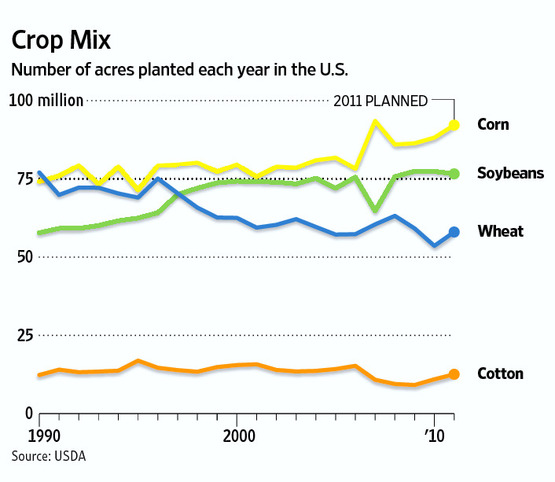
But where's the land coming from? According to USDA, the net increase for these (the four largest cash crops besides hay) will be about 10 million acres. That's nearly one third the size of North Carolina. Notice in the graph that increases for one crop are typically offset by losses in another. Most hay land isn't going to be suitable for these crops.
Two wild guesses:
1) Prospective plantings are a little too optimistic
2) The Conservation Reserve Program is going to have a hard time enrolling much land in its signups this year.
But I don't think these two things can account for 10 million acres.

But where's the land coming from? According to USDA, the net increase for these (the four largest cash crops besides hay) will be about 10 million acres. That's nearly one third the size of North Carolina. Notice in the graph that increases for one crop are typically offset by losses in another. Most hay land isn't going to be suitable for these crops.
Two wild guesses:
1) Prospective plantings are a little too optimistic
2) The Conservation Reserve Program is going to have a hard time enrolling much land in its signups this year.
But I don't think these two things can account for 10 million acres.
Tuesday, March 29, 2011
Cotton prices are going to fall
Cotton is the third most valuable crop in the US, after corn and soybeans.
Cotton prices have roughly doubled over the last year, perhaps a bit more than other staple agricultural commodities. The big difference with cotton is that it uses a much smaller share of the land base than corn, soybeans and wheat do. That makes it a lot easier to proportionately expand production when prices rise. And since it's a higher-value crop than corn, soybeans and wheat, that land expansion is going to happen, as described here in the New York Times today
Cotton prices have roughly doubled over the last year, perhaps a bit more than other staple agricultural commodities. The big difference with cotton is that it uses a much smaller share of the land base than corn, soybeans and wheat do. That makes it a lot easier to proportionately expand production when prices rise. And since it's a higher-value crop than corn, soybeans and wheat, that land expansion is going to happen, as described here in the New York Times today
... In the United States, the economics of growing cotton vary according to many factors, including regional differences and whether or not the land is irrigated. Farmers in several southern states said that at a cotton price of about $1 a pound, their profit could be roughly $200 to $500 more per acre than they could earn growing corn or wheat. For 1,000 acres planted in cotton, that means an additional $200,000 to $500,000 profit.
“It’s going to be cotton stalks everywhere,” said Travis Patterson, 44, a farmer near Spearman, who was irrigating one of his fields on a recent afternoon with help from his son Zane, 12, in preparation for planting cotton. “The landscape’s going to change,” he said, describing a countryside blanketed with the white of cotton rather than the more familiar green and gold of corn.It's going to be harder to expand production of corn, soybeans and wheat. Competition with cotton is just a small part of it. For these much larger crops there simply isn't much land available on which to expand production. So, I expect prices for cotton to fall quite a bit over the next year. I'm less sanguine about corn, soybeans and wheat.
Friday, March 25, 2011
AMS Briefing on Capitol Hill
This morning's slides. I believe slides with audio of the presentation will eventually be posted here.
Tuesday, March 22, 2011
Using quotas in procurement auctions
I have a new working paper with Daniel Hellerstein and Nathaniel Higgins (both with USDA) on the use of quotas in procurement auctions.
This is a new area for us. Our motivation came from thinking about the Conservation Reserve Program and a rapidly emerging literature on "payments for ecosystem services." Basically, the government or environmental interests or the carbon market or whatever wants to buy a lot of something--say carbon sequestration services, water quality benefits, wildlife habitat, etc.--from a large and extremely heterogeneous pool of sellers.
One issue surrounding the heterogeneity of sellers is that we need to put the environmental services provided across varied landscapes, locations, and situations on an equal footing, which requires some method of valuing the environmental benefits. That's a hard thing to do, but it's not new. And I think people are already doing about as good a job as could be expected. Or at least I don't think I've got anything to contribute in this area.
Aside from valuation, it seems to me the biggest challenges everyone has been worrying about essentially come down to price discrimination: The buyers of environmental services want to pay different prices to different sellers according to their opportunity costs for providing those services. I can see a lot of practical reasons for wanting to do this, even if doing so involves a little bit of inefficiency. I wrote about this a bit here.
So, how can one go about price discriminating if the buyer knows costs differ across sellers but they don't know how much they differ, or perhaps even who has high costs and who has low costs? Well, a simple thing to do is to just have a procurement auction and put a modest quota or limit on the share of offers accepted by any observationally similar group of sellers. This causes sellers within low-cost groups to compete with each other much more aggressively. And it causes all sellers to generally compete more aggressively because they realize sellers within low-cost groups are competing more aggressively.
It turns out that solving these kinds of auction theoretically is quite a bit of work. But if costs do in fact vary a lot across groups, quotas can save the buyer a lot of money. If groups are actually quite similar, quotas have no real benefit, but no real cost either.
We also ran some experiments and found somewhat greater savings from quota in the laboratory than in theory, and less of an efficiency loss verses standard pay-as-offered auctions.
I think there are many potential applications besides CRP or PES programs, so the paper is pitched more generally. I also figured out a simple but powerful new technique for solving Bayesian Nash equilibria in asymmetric auctions, but that would only be of interest to a more limited audience.
How much might this kind of auction save the Federal government if they used it for CRP? I don't think that question is strictly answerable given the available data. But I think it's highly plausible that it could eventually save hundreds of millions of dollars per year while simultaneously improving environmental outcomes. Part of this is because the way they currently go about price discriminating looks hugely inefficient (see here). It would be a lot simpler to implement than the current program, too.
Will they do it? I'm not going to hold my breath. But I'm going to shamelessly sell the idea, because I think it would implement exactly what they seem to be trying to achieve in a way that's simpler, would possibly be perceived as fairer, and is almost surely more efficient. If I could get them to do this, and it actually worked, I'd have concrete evidence that I earned my Wheaties. Other applications would just be icing on the cake.
This is a new area for us. Our motivation came from thinking about the Conservation Reserve Program and a rapidly emerging literature on "payments for ecosystem services." Basically, the government or environmental interests or the carbon market or whatever wants to buy a lot of something--say carbon sequestration services, water quality benefits, wildlife habitat, etc.--from a large and extremely heterogeneous pool of sellers.
One issue surrounding the heterogeneity of sellers is that we need to put the environmental services provided across varied landscapes, locations, and situations on an equal footing, which requires some method of valuing the environmental benefits. That's a hard thing to do, but it's not new. And I think people are already doing about as good a job as could be expected. Or at least I don't think I've got anything to contribute in this area.
Aside from valuation, it seems to me the biggest challenges everyone has been worrying about essentially come down to price discrimination: The buyers of environmental services want to pay different prices to different sellers according to their opportunity costs for providing those services. I can see a lot of practical reasons for wanting to do this, even if doing so involves a little bit of inefficiency. I wrote about this a bit here.
So, how can one go about price discriminating if the buyer knows costs differ across sellers but they don't know how much they differ, or perhaps even who has high costs and who has low costs? Well, a simple thing to do is to just have a procurement auction and put a modest quota or limit on the share of offers accepted by any observationally similar group of sellers. This causes sellers within low-cost groups to compete with each other much more aggressively. And it causes all sellers to generally compete more aggressively because they realize sellers within low-cost groups are competing more aggressively.
It turns out that solving these kinds of auction theoretically is quite a bit of work. But if costs do in fact vary a lot across groups, quotas can save the buyer a lot of money. If groups are actually quite similar, quotas have no real benefit, but no real cost either.
We also ran some experiments and found somewhat greater savings from quota in the laboratory than in theory, and less of an efficiency loss verses standard pay-as-offered auctions.
I think there are many potential applications besides CRP or PES programs, so the paper is pitched more generally. I also figured out a simple but powerful new technique for solving Bayesian Nash equilibria in asymmetric auctions, but that would only be of interest to a more limited audience.
How much might this kind of auction save the Federal government if they used it for CRP? I don't think that question is strictly answerable given the available data. But I think it's highly plausible that it could eventually save hundreds of millions of dollars per year while simultaneously improving environmental outcomes. Part of this is because the way they currently go about price discriminating looks hugely inefficient (see here). It would be a lot simpler to implement than the current program, too.
Will they do it? I'm not going to hold my breath. But I'm going to shamelessly sell the idea, because I think it would implement exactly what they seem to be trying to achieve in a way that's simpler, would possibly be perceived as fairer, and is almost surely more efficient. If I could get them to do this, and it actually worked, I'd have concrete evidence that I earned my Wheaties. Other applications would just be icing on the cake.
Thursday, March 10, 2011
Commodity Prices and the Fed
I think Mark Thoma nails this. What he describes is exactly the way I think about the issue but have been unable to articulate.
To answer the question in the title of this post, it's useful to think of an island with only two goods. One of the goods is non-renewable, but highly desirable. The other good is less preferred, but it is renewable (thinking of renewable and non-renewable energy resources, for example). The key is to distinguish between changes in prices that reflect changes in the relative scarcity of the two goods, and changes driven by increases in the money supply.
Over time, as the stock of the more desired good falls due to consumption, the price of this good will rise relative to the renewable good. Consumers will be hit by increases in the cost of living -- the same basket of the two goods purchased last year now costs more.
But is this the kind of increase in prices the Fed should respond to? No, the price increase -- and the increase in the cost of living -- reflects increasing scarcity of the desired good. The price of the two goods are changing to balance the relative supplies of the two goods. Unless the price of the non-renewable resource does not properly take account of the preferences of future generations -- and it may not -- or there is some other market failure, there is no reason for government to intervene to change the prices. If the prices are correct, they will allocate the resources optimally.
Now consider a different case. Suppose the central bank in charge of money -- sea shells of a particular type identified with the central bank's special mark -- and the money supply is being increased at a rapid rate. This will drive the prices of both goods up, but so long as the price of each good rises in proportion to the change in the money supply so that the relative price of the two goods is undisturbed, no problem. The price level will adjust to the number of sea shells in circulation, but since relative values remain intact, nothing will change.
However, suppose one of the two prices is sticky. It does not change very fast when the number of sea shells in circulation increases. In this case relative prices will be distorted as the number of sea shells increases, one price will rise faster than the other, and resources will be misallocated. In this case the Fed would want to do something about the inflation since it is having negative effects on the efficient allocation of the two resources. This is, essentially, the Fed's justification for activist policy.
A couple of notes. First, it's interesting to think about how technological change that improves the quality or lowers the price of the renewable good plays into this. Such a change could offset the increase in the cost of living that households face. Thus improving technology, not Fed policy, is the key to helping people on the island struggling with high prices.
To me right now, commodity prices look to be driven mainly by fundamentals. The clearest thinker I know when it comes to oil is Jim Hamilton, and he seems to think so too. Thus, inflation coming from commodity price increases is reflecting something real--an increase in relative scarcity. The kind of inflation the Fed needs to worry about is of a purely nominal nature.
Second, this is about the long-run and growth in demand. The central bank may still want to try to offset temporary price spikes, for example when sticky prices can cause problems that persist beyond the spike in the price of one of the two goods (e.g. a spike in the price of oil that leads to long-lived price distortions). But long-run growth that causes the price of one of the goods to rise by more than the other, i.e. relative price changes, is not something the Fed should try to neutralize.
Wednesday, March 9, 2011
It's always nice to have your research cited in testimony before Congress
In email this morning I learned that my work with Wolfram Schlenker was cited extensively by Christopher B. Field in his testimony before congress (PDF).
In today's New York Times our findings were obliquely referenced via Field. Apparently his testimony "piqued the interest of members on both sides of the aisle." The specific statistics cited in the New York Times come from our research results. While the NYT is citing Field, you can see from Field's testimony that it comes from our work.
One little quibble with Field's testimony. He testified as if these are going to be adverse effects to the U.S. Actually, US crop production getting hammered by climate change may be good for us. That's because we export a good share of our crops and demand is extremely inelastic. It's is quite likely that price increases will help farmers far more than the lower quantities hurt them. The gain in domestic producer surplus could be so large that there could be a net gain for the United States.
But this should inspire the opposite of complacency. It's the rest of the world, particularly the world's poorest, that would suffer.
Update: Maybe I'm being too oblique here. I'm NOT sanguine about these potential impacts. What I'm trying to do by pointing out the big price effects is to show that the economic impacts from climate change will often happen to people and places far different from the physical impact. When the Midwest takes a hit on corn yields, North Carolina hog and chicken farmers suffer while most Midwestern farmers gain, since prices more than compensate. With climate change, this kind of economic displacement of physical impacts will probably be common.
In today's New York Times our findings were obliquely referenced via Field. Apparently his testimony "piqued the interest of members on both sides of the aisle." The specific statistics cited in the New York Times come from our research results. While the NYT is citing Field, you can see from Field's testimony that it comes from our work.
One little quibble with Field's testimony. He testified as if these are going to be adverse effects to the U.S. Actually, US crop production getting hammered by climate change may be good for us. That's because we export a good share of our crops and demand is extremely inelastic. It's is quite likely that price increases will help farmers far more than the lower quantities hurt them. The gain in domestic producer surplus could be so large that there could be a net gain for the United States.
But this should inspire the opposite of complacency. It's the rest of the world, particularly the world's poorest, that would suffer.
Update: Maybe I'm being too oblique here. I'm NOT sanguine about these potential impacts. What I'm trying to do by pointing out the big price effects is to show that the economic impacts from climate change will often happen to people and places far different from the physical impact. When the Midwest takes a hit on corn yields, North Carolina hog and chicken farmers suffer while most Midwestern farmers gain, since prices more than compensate. With climate change, this kind of economic displacement of physical impacts will probably be common.
Monday, March 7, 2011
Covariances reveal differences between supply shocks and demand shocks
This is for all the inflation mongers out there who think that today's oil price spikes are a prelude to hyperinflation.
Up until a few weeks ago, demand factors were driving oil and other commodity prices. When oil prices went up, so did the stock market and interest rates. Aggregate demand shocks, the earlier drivers, were mainly good news about growth, and this drove up interest rates and the stock market. They also signaled higher prospective inflation, which I saw as good news. We could use a bit more inflation, given we remain well below target and there is lots of labor to sop up before wage increases (the main part of inflation) kick in.
Over the last couple weeks, prices have spiked more sharply, but for very different reasons, mainly the quickly unfolding events in the Middle East. Markets are speculating about a possible, if unlikely, major disruption in supply. While oil prices have spiked, other commodity prices have generally softened, and the stock market and long-term interest rates have declined. Anticipated downward shifts in supply are clearly bad news for the economy and growth.
And the decline in interest rates shows how little we should be concerned about hyperinflation.
Short-run inflation and perhaps even stagflation are real possibilities in this fragile economy. This is just a textbook shift in aggregate supply. Whether or not you're a Keynesian, the textbook says a supply shock to a fundamental resource will cause the price level to increase and output to decline. But it's not a monetary phenomenon. It's not the kind of thing that could kickstart a vicious inflationary spiral. Not with unemployment at 9%. This is bad news, not too much good news about an overheated economy. Markets realize this and that's why stocks and interest rates are down.
Hyperinflation remains a truly remote prognostication. The only risk here may be if we shutdown the government indefinitely and default on our debt. But that has nothing to do with oil prices either.
Update : I'm not the only one who thinks these kinds of changing covariances are interesting.
Up until a few weeks ago, demand factors were driving oil and other commodity prices. When oil prices went up, so did the stock market and interest rates. Aggregate demand shocks, the earlier drivers, were mainly good news about growth, and this drove up interest rates and the stock market. They also signaled higher prospective inflation, which I saw as good news. We could use a bit more inflation, given we remain well below target and there is lots of labor to sop up before wage increases (the main part of inflation) kick in.
And the decline in interest rates shows how little we should be concerned about hyperinflation.
Short-run inflation and perhaps even stagflation are real possibilities in this fragile economy. This is just a textbook shift in aggregate supply. Whether or not you're a Keynesian, the textbook says a supply shock to a fundamental resource will cause the price level to increase and output to decline. But it's not a monetary phenomenon. It's not the kind of thing that could kickstart a vicious inflationary spiral. Not with unemployment at 9%. This is bad news, not too much good news about an overheated economy. Markets realize this and that's why stocks and interest rates are down.
Hyperinflation remains a truly remote prognostication. The only risk here may be if we shutdown the government indefinitely and default on our debt. But that has nothing to do with oil prices either.
Update : I'm not the only one who thinks these kinds of changing covariances are interesting.
Ethanol and food prices, again
Last week I served on a panel for the RTEC and gave my usual spiel about ethanol and food prices.
In a nutshell:
1) Both supply and demand of staple grains are highly inelasitic. This means it doesn't take much of a shift in supply or demand to cause a big change in price.
2) The U.S. is hugely important in world grain markets. With the largest share of world production and a much larger share of world exports, we drive international prices for staple grains.
3) Ethanol uses about 1/3 of the U.S. corn crop, or about 5 percent of the calories produced, worldwide, of corn soybeans, wheat and rice--the key grains that feed the world. That's even with a bigger corn crop (and smaller soybean crop) that has been brought about by ethanol subsidies and mandates.
4) When prices go up, we in rich countries don't eat much less, since commodities are a trivial share of our food expenditures. Those consuming less are most plausibly the world's poorest. If not, who do you think is eating less due to the huge diversion from ethanol?
5) Yes, there are other and possibly larger factors affecting food prices: growth in China and other parts of the world, particularly growth in demand for meat, and bad weather. These factors accentuate the effects of ethanol; they don't diminish it. A big problem with all this stuff coming online at the same time is that it has drawn down inventories, making markets far more susceptible to other shocks.
I was challenged by the usual armchair reasoning that doesn't hold up under inspection. Yes, some of the grain used in ethanol production goes back to farmers in the form of distillers grains. But it cannot be used for all animals. It's 1/3 the calories, maybe less. The wet stuff is economical but very expensive to transport.
In the real world there are tradeoffs. You can't have your cake and eat it too.
One anecdote I wish I mentioned but didn't: In October, the USDA revised its crop forecast for corn downward by about 5% from the September forecast. This is a nice thing to look at because it provides something of a natural experiment--a large, clear, measurable unexpected shock to the market. This supply shock caused prices to go up nearly 10% on the same day.
Consider how large this small adjustment on quantity had on price. Now consider that this production shock was likely due to late season weather, a temporary phenomenon. Now consider that ethanol is a permanent shock that is about six times the size on an annual basis.
If you say you don't think ethanol is affecting prices for staple grains and soybeans, you are a fool or a knave looking to mislead.
In a nutshell:
1) Both supply and demand of staple grains are highly inelasitic. This means it doesn't take much of a shift in supply or demand to cause a big change in price.
2) The U.S. is hugely important in world grain markets. With the largest share of world production and a much larger share of world exports, we drive international prices for staple grains.
3) Ethanol uses about 1/3 of the U.S. corn crop, or about 5 percent of the calories produced, worldwide, of corn soybeans, wheat and rice--the key grains that feed the world. That's even with a bigger corn crop (and smaller soybean crop) that has been brought about by ethanol subsidies and mandates.
4) When prices go up, we in rich countries don't eat much less, since commodities are a trivial share of our food expenditures. Those consuming less are most plausibly the world's poorest. If not, who do you think is eating less due to the huge diversion from ethanol?
5) Yes, there are other and possibly larger factors affecting food prices: growth in China and other parts of the world, particularly growth in demand for meat, and bad weather. These factors accentuate the effects of ethanol; they don't diminish it. A big problem with all this stuff coming online at the same time is that it has drawn down inventories, making markets far more susceptible to other shocks.
I was challenged by the usual armchair reasoning that doesn't hold up under inspection. Yes, some of the grain used in ethanol production goes back to farmers in the form of distillers grains. But it cannot be used for all animals. It's 1/3 the calories, maybe less. The wet stuff is economical but very expensive to transport.
In the real world there are tradeoffs. You can't have your cake and eat it too.
One anecdote I wish I mentioned but didn't: In October, the USDA revised its crop forecast for corn downward by about 5% from the September forecast. This is a nice thing to look at because it provides something of a natural experiment--a large, clear, measurable unexpected shock to the market. This supply shock caused prices to go up nearly 10% on the same day.
Consider how large this small adjustment on quantity had on price. Now consider that this production shock was likely due to late season weather, a temporary phenomenon. Now consider that ethanol is a permanent shock that is about six times the size on an annual basis.
If you say you don't think ethanol is affecting prices for staple grains and soybeans, you are a fool or a knave looking to mislead.
New, small farms with young hip operators
At least anecdotally, the local and small farm movement seems to be taking hold.
It's hard for me to imagine how these young farmers will make it. Some people are willing to pay more for more healthful food that is locally grown. But my guess is that share of the market is pretty thin. Even if the movement grows, they will find it ever more difficult to compete with large-scale agriculture donning an organic label. This doesn't seem like the thing that's going to support very many local farms.
I hope they make it. I really do. But I'm doubtful.
In New Food Culture, a Young Generation of Farmers Emerges
...Mr. Jones, 30, and his wife, Alicia, 27, are among an emerging group of people in their 20s and 30s who have chosen farming as a career. Many shun industrial, mechanized farming and list punk rock, Karl Marx and the food journalist Michael Pollan as their influences. The Joneses say they and their peers are succeeding because of Oregon’s farmer-foodie culture, which demands grass-fed and pasture-raised meats.
...The Grange master, Hank Keogh, is a 26-year-old who, with his multiple piercings and severe sideburns, looks more indie rock star than seed farmer. Mr. Keogh took over the Grange two years ago.
He increased membership by signing up dozens of young farmers and others in the region. He had the floorboards refinished, introduced weekly yoga classes and reduced the average age of Grange members to 35 from 65.
The young farmers crowded around a table brimming with food they had produced — delicata squash, beet salad, potato leek soup and sparkling mead. On a separate table were two pony kegs of India pale ale....
...“Literally, four years ago, this was not happening,” Ms. Jones said, gesturing to the 30 farmers who congregated at the hall. “Now, everywhere you turn, someone’s a farmer.”I think we may have a better idea whether this is real or not when the 2013 census comes out. The numbers from the 2007 census convinced me of nothing.
It's hard for me to imagine how these young farmers will make it. Some people are willing to pay more for more healthful food that is locally grown. But my guess is that share of the market is pretty thin. Even if the movement grows, they will find it ever more difficult to compete with large-scale agriculture donning an organic label. This doesn't seem like the thing that's going to support very many local farms.
I hope they make it. I really do. But I'm doubtful.
Sunday, March 6, 2011
Public and Private Storage of Oil
I've been thinking and studying a lot about storage and commodity markets, mostly with regard to food commodities. A grad student, Nam Tran, is neck deep solving stochastic dynamic programing models. I'm pretty optimistic something good will come out of his dissertation--he's focusing on rice markets and the price spike in 2008.
Anyway, the theory for oil isn't all that different. In the news we're seeing a lot about the US strategic oil reserve. Obama is thinking about selling some of our reserves. Would this be a good idea?
The thing to recognize is that the recent price spike is coming from private markets building up their own reserves. Reserves have gone up about 4% since early January, perhaps a bit more depending on what the next report says. Markets are speculating that there may be an actual disruption of supply in the future. If that happens, prices will spike, and so it makes sense to store a little more in anticipation of that possibility. If that speculation is rational, markets are responding in a reasonable and efficient manner to a potential supply shock. If the speculation is irrational--if too much is being held off the market given the potential threat to supply--a release of pubic inventories may make sense.
It does look to me like Lybia's share of the oil market is too small to pose much of threat to supply. Other countries could easily make up a lot of the difference, and likely will in order to capitalize on higher prices while anticipating that disrupted supplies will come back online. But then problems in the Middle East could spread much further. This doesn't seem like the kind of uncertainty one pin down very precisely in an objective manner. Moreover, prices haven't gone up that much. Yet.
On the other hand, I have a hard time seeing the general point of our strategic oil reserve. I don't know that it serves much if any social good. This is because it's hard for me to see the market failure in private speculation and storage. While speculative bubbles seem to have occured in other places, I haven't seen any good evidence to support their existence in commodity markets (except maybe precious metals--a very different thing). Actually, commodity prices appear to behave in near textbook economic fashion. So, if the US is going to dump its public reserve and get out of the oil speculation business, now seems about as good a time as any.
One good thing about recent news: the more information they provide about what they will do and the circumstances in which they will do it will help private markets store more efficiently.
Anyway, the theory for oil isn't all that different. In the news we're seeing a lot about the US strategic oil reserve. Obama is thinking about selling some of our reserves. Would this be a good idea?
The thing to recognize is that the recent price spike is coming from private markets building up their own reserves. Reserves have gone up about 4% since early January, perhaps a bit more depending on what the next report says. Markets are speculating that there may be an actual disruption of supply in the future. If that happens, prices will spike, and so it makes sense to store a little more in anticipation of that possibility. If that speculation is rational, markets are responding in a reasonable and efficient manner to a potential supply shock. If the speculation is irrational--if too much is being held off the market given the potential threat to supply--a release of pubic inventories may make sense.
It does look to me like Lybia's share of the oil market is too small to pose much of threat to supply. Other countries could easily make up a lot of the difference, and likely will in order to capitalize on higher prices while anticipating that disrupted supplies will come back online. But then problems in the Middle East could spread much further. This doesn't seem like the kind of uncertainty one pin down very precisely in an objective manner. Moreover, prices haven't gone up that much. Yet.
On the other hand, I have a hard time seeing the general point of our strategic oil reserve. I don't know that it serves much if any social good. This is because it's hard for me to see the market failure in private speculation and storage. While speculative bubbles seem to have occured in other places, I haven't seen any good evidence to support their existence in commodity markets (except maybe precious metals--a very different thing). Actually, commodity prices appear to behave in near textbook economic fashion. So, if the US is going to dump its public reserve and get out of the oil speculation business, now seems about as good a time as any.
One good thing about recent news: the more information they provide about what they will do and the circumstances in which they will do it will help private markets store more efficiently.
Subscribe to:
Posts (Atom)
Renewable energy not as costly as some think
The other day Marshall and Sol took on Bjorn Lomborg for ignoring the benefits of curbing greenhouse gas emissions. Indeed. But Bjorn, am...

-
The other day Marshall and Sol took on Bjorn Lomborg for ignoring the benefits of curbing greenhouse gas emissions. Indeed. But Bjorn, am...
-
 The tragic earthquake in Haiti has had me wondering about U.S. Sugar policy. I should warn readers in advance that both Haiti and sugar pol...
 -
A couple months ago the New York Times convened a conference " Food for Tomorrow: Farm Better. Eat Better. Feed the World ." ...

