Substantive posting is probably going to remain thin for awhile.
I wanted to save this link to this short interview with Rudolph Penner, former director of the Congressional Budget Office under President Reagan about a new report that appears to look sincerely at budget options going forward. (Hat tip to Ezra Klein)
The situation does look pretty grim in the long run. It is bizarre to think we were worrying about budget surpluses less than a decade ago. This makes me wonder: how would truly effective health care reform coupled with faster-than-expected economic growth change things? Not that I'm especially optimistic about either of these things happening. But I'm curious to know how sensitive the projections are to assumptions about growth in health care costs and economic growth more broadly. The true budget picture going forward must be a highly uncertain one, something that does not come across in the interview [or, after a quick skim, in the report itself].
Sunday, February 21, 2010


Wednesday, February 17, 2010
An instructor's observation
I believe this phenomenon, which I have observed in every class I have taught, spanning several universities and colleges, from undergraduates to PhD students, is nearly universal: Most students pick a seat on the first day of class and stay in that seat throughout the entire semester.
Why?
I'd like to find a compelling economic explanation but I cannot. But failing an economic explanation, I'd be interested in any explanation that is compelling.
A somewhat related observation: It seems to me students sitting near the front learn more from lecture than students sitting near the back.
Saturday, February 13, 2010
Experimental Policy
Sorry for the thin posting recently--just very, very busy.
This is not a new idea, but it is one that I think receives much too little discussion. Everyone's got their juggernaut policy--their unstoppable idea that they think will make everything work right, or at least a lot better that it currently works. Sometimes ideas are put in place and sometimes they're not. Sometimes good ideas get corrupted along the way and morph into bad ideas. But in the end, it's almost always painfully difficult to evaluate the efficacy of policies good and bad because no one takes care to test the idea before adopting it fully. If not evaluated experimentally, there are inevitable claims that good policies were actually bad ones, that bad ones were actually good ones, but since the evidence is mucked up by all kinds of the other things that changed at or around the time the policy changed, it's really hard to know.
So what I'd like to advocate for here is an experimental approach to policy. Before implementing an untested idea, policies should be implemented on a trial basis and evaluated experimentally. The standard complaint with experimental approaches to policy are that they are unethical. I disagree. Or at least I believe they can be structured in ways that could make them both politically palatable and as ethical as any clinical trial of health treatments. Believe you me, we wouldn't have modern medicine if it weren't for experimental trials. So what's so unethical about saving a gazillion lives, among many other health benefits? If ethical concerns are your knee jerk reaction, hear me out and let me know how you feel in the comments.
How should we go about structuring policy experiments? Well, as anyone who's studied basic experimental design will tell you, the key is randomization. We need to make sure some participants experience the benefits (or costs) of new policy while others do not, but which group an individual, family, or firm is assigned must be random to ensure that differences in achievement are due to the policy not some other unobserved factor. When economic spillovers are possible, we need to make sure benefits or costs from one group don't spill over into another--this could be particularly difficult in some policy contexts.
A few concrete ideas may help to motivate the general idea.
One example is education. Some say we should give up on publicly administered schools and simply issue vouchers for private schools. I believe there are a number of experimental voucher programs currently underway. These programs obtain a list of willing participants, which is generally much longer than the available slots, and vouchers are randomly assigned to some portion of participants. To participate, one must agree to being tracked regardless of whether or not a voucher is received. Educational performance of those receiving vouchers and those not receiving vouchers can then be tracked over time. I'm no expert in this area but from what I've read, evidence on the efficacy of vouchers hasn't been especially encouraging.
Michelle Rhee, the District of Columbia's still-new Chancellor, seems to have shaken things up education wise. But given the way she's gone about implementing her new policies, I think it's going to be extremely difficult to tell whether she has or will actually improve things or not. If scores go up some will say it was due to gentrification or other factors. If scores go down Rhee will say it's because the best students left, or something else got in the way. In the end, we'll just never know.
There are, of course, zillions of ideas for how to improve education. Teacher training appears to be effective, but good evidence is limited. Some point to class size. Some say it's critical to "get the right teachers," but I haven't seen clear evidence on what constitutes a good teacher, how to detect one, or how to go about recruiting them. But whatever the idea, it surely could be tested in experimental schools that have clearly documented and implemented strategies. For the experimental design to be valid, assignment of students to schools would have to be random. This could be done in a way similar to the voucher program: Parents could voluntarily sign up for a program that would randomly assign their child to one of several experimental schools. Some would be randomly selected to stay in the status quo. But to participate, parents must agree to keeping their child in the program to which he/she is randomly assigned, and to having their child tracked. Since overall participation would be voluntary, I see no ethical problem, despite the random assignment.
This is, after all, how they do experimental trials for health treatments. It works. It saves lives.
What about health care? This would be a toughie given the problem of "adverse selection". Depending on how different plans were structured, some would choose the plan that was best for their particular circumstances, invalidating any evaluation of the policies. But suppose the Republicans put together a plan and the Democrats but together a plan and then the people could voluntarily sign up to be randomly assigned to one of the two plans. One third of the voluntary participants would be randomly assigned to the Democratic plan and one third to the Republican plan, and remaining third would be stuck with the status quo, along with all non-participants. We could then track health outcomes, costs and other outcomes under each plan and the status quo. Do this right and make it all very transparent and we might actually see some real information on the 6 o'clock news!
And then there is agricultural policy. That's supposed to be the topic of this blog, right?
Well, two areas where I've got a few ideas about how policy might be objectively improved pertain to the Federal Crop Insurance Program and the Conservation Reserve Program (CRP). These programs may be small potatoes compared education and health policy, but I still think its a big deal. In short, I think we could develop better ways of assigning premiums to farmers enrolling in crop insurance such that they would align more closely to their true risks. I think this would increase participation rates even if subsidies were lowered a bit. For CRP, I think signups could be structured in a way that would be easier, more transparent, less costly to the government, and would generate more environmental benefits. The details of how these things could be done are a little beyond the scope of this post. Another time maybe....
But surely other academics at Iowa State, UC Davis, UC Berkeley and other places have their own crazy ideas. So here's what I propose to RMA and FSA (that's USDA's Risk Management Agency and Farm Service Agency): To improve management and implementation of your various programs, put out a call for proposed changes to the various land grant universities. Take the top 3-5 proposals as judged by a peer review and test them experimentally using either a voluntary scheme or by randomly selecting counties or jurisdictions. Make sure the objectives are clear and make the whole process and outcomes transparent to everyone. If the experimental competition were done right, I think we could see amazing gains in efficiency.
Update: Besides, wouldn't you just love a politician who admitted he didn't have a clue what worked? And then said he'd get proposals from the best apolitical think tanks and just run an experiment? Imagine the humility!
Monday, February 1, 2010
The slow but steady dismantling of agricultural subsidies
I know a fair amount about historical agricultural policies since those are the data I tend to analyze. But I don't follow what's going on with agricultural policy on a day-by-day basis as much as I should. If you do want up-to-moment briefings on what's going on, the place to go is FarmPolicy.com, which should be blogrolled below.
Anyway, just a brief observation here to say that it looks to me like agricultural subsidies (except for ethanol) appear to be going away over time, slowly but surely. Even crop insurance funding is being cut back, one area of subsidy growth in recent decades (see this post for some nice background). Many of the beneficiaries of this government largess are the insurance companies rather than farmers. But farmers have a nice big premium subsidies, too. Budget pressure will likely help to widdle subsidies down even further, especially since farmers seem to be fairing better than most during this recession.
But let me emphasize, slowly but surely.
The one thing that might change that is climate policy. I can't tell if the ag. folks are dead set against cap-and-trade because (a) they are true die hard denialists; (b) they think they'll benefit from climate change because inelastic demand means their profits will soar when their crops get hammered; or (c) they're holding out for some serious subsidies.
Here's an idea for a short review paper I would like to write one day soon: measure the total value of agricultural subsides, both explicit and implicit (like those implicit in sugar import quotas and tariffs), and show how they have changed over time. It's not too hard to find data on most of these things over at http://ers.usda.gov/, but what would be interesting is to show how all subsidies combined, say as a share of the U.S economy, share of agriculture, and share of government expenditures, has evolved over the last 80 to 100 years. I don't know of a paper that puts all this in one place and shows this broad perspective. If no one does it in the next year or so I might just write it myself. Of course, loyal readers of GG&G would see most of the pretty pictures here first.
But at the moment I really have too many other things to do...
Sunday, January 31, 2010
Green Inc. at the New York Times tells us that cheaper renewable energy is a bad thing
Because it's coming from China. To be fair, they are careful not to explicitly pass judgment on the situation. But still. Here's the story and the money quote:
It gets worse:
There are probably some other tough underlying tensions here, like the fact that China is keeping its exchange rate too low. But there's no mention of that in this article, or in the linked article about Schumer.
I think the New York Times can and should do better.
These [China's] efforts to dominate renewable energy technologies raise the prospect that the West may someday trade its dependence on oil from the Mideast for a reliance on solar panels, wind turbines and other gear manufactured in China.Anyone over at Green Inc. see the difference between buying oil and buying capital equipment used to make energy from the wind and sun? Actually, forget that difference. Anyone over at Green Inc. think that we would be better off without Mideastern oil? It would be nice if the folks over at Green Inc. would provide at least a hint that they understand the basic gains from trade and then explain that to their readers.
It gets worse:
Excuse me. I just fell off my chair. Let me clarify: you're saying 20-40 percent more than coal is expensive? You're not counting externalities like air pollution and probable climate change, I presume? Besides, wasn't coal like 100 percent more expensive just 18 months ago? If that's right, wind looks inexpensive to me, but then you're telling me that my eyes deceive me and that wind is actually very expensive? My eyes must really deceive me because then you tell me renewables are getting cheaper very quickly:
“Most of the energy equipment will carry a brass plate, ‘Made in China,’ ” said K. K. Chan... President Obama, in his State of the Union speech last week, sounded an alarm that the United States was falling behind other countries, especially China, on energy... “I do not accept a future where the jobs and industries of tomorrow take root beyond our borders — and I know you don’t either,”...many Western and Chinese executives expect China to prevail in the energy-technology race. Multinational corporations are responding to the rapid growth of China’s market by building big, state-of-the-art factories in China. Vestas of Denmark has just erected the world’s biggest wind turbine manufacturing complex ....China’s commitment to renewable energy is expensive. Although costs are falling steeply through mass production, wind energy is still 20 to 40 percent more expensive than coal-fired power. Solar power is still at least twice as expensive as coal.
With prices tumbling, China’s wind and solar industries are increasingly looking to sell equipment abroad — and facing complaints by Western companies that they have unfair advantages. When a Chinese company reached a deal in November to supply turbines for a big wind farm in Texas, there were calls in Congress to halt federal spending on imported equipment.
“Every country, including the United States and in Europe, wants a low cost of renewable energy,” said Ma Lingjuan, deputy managing director of China’s renewable energy association. “Now China has reached that level, but it gets criticized by the rest of the world.”I can appreciate arguments for more stimulus spending. The first thing to do (so say a great majority of economists I've read) is give money to states so they don't have to continue cutting back on basic public services, laying people off, furloughs, and suffer all the associated negative multiplier effects. They might also build better/larger interstate transmission grids. Or repair our many dilapidated bridges. But preventing trade of this strongly mutually advantageous sort seems like a really bad idea.
There are probably some other tough underlying tensions here, like the fact that China is keeping its exchange rate too low. But there's no mention of that in this article, or in the linked article about Schumer.
I think the New York Times can and should do better.
The latest iThing
I feel I have to write something about this because I'm such a shameless mac lover. People tease me in the halls about my iphone and I dropped a lot of cash on my macbook pro. But I spend such an embarrassingly large amount of time on this thing--and love it thoroughly--that it was really worth it to me.
So. About the iPad.
I've long been a little tempted by the Kindle, especially the DX, but was obviously curious about what apple was cooking up. I thought the Kindle would be nice for times when I want to get away from things a little and just read without distractions. For this purpose there are two things I really like about the Kindle: (1) a very long battery life and (2) the paper-like screen that is not backlit and can be easily seen outdoors. Free and inexpensive wireless connection to books, newspapers and magazines is nice too.
Given what I really like about the Kindle, I'm not really tempted by the iPad. It looks very cool but if I really want to get away from things to read then I don't need the internet and email. And if I'm working or surfing or emailing, I'll probably have my laptop anyway.
Maybe I'll change my mind when I actually see and touch one but right now I'm not tempted. I'm just hoping competition from the iPad will push down the price of Kindles.
But I can see how people who aren't geeks like me, who don't always have their laptops with them anyway, might really like the iPad. Which makes me wonder: for all the people and tech companies in the world, why is Apple so much better at it than everyone else? Why aren't more CEOs like Steve Jobs? I'm pretty sure it's not because CEOs are paid too little. I know it's sacrilegious for an economist to suggest, but I think there may be more to this than incentives.
Friday, January 29, 2010
The U.S. Biofuel Mandate and the Supply and Demand for Calories
I'm buried with teaching and research and travel these days, so even fewer postings than usual.
Here are my slides for my talk today at Cornell. This is stuff I've been working on for awhile with Wolfram Schlenker at Columbia. The key conceptual contribution is showing how to use weather shocks to estimate the supply of agricultural commodities. We also estimate demand using the weather, which isn't new in concept, but surprisingly hasn't been done on a large scale.
We use our estimates to consider the effect of U.S. ethanol policy:
(1) about a one-third increase in the price of calories from raw commodities: corn, soybeans, wheat and rice.
(2) an annual reduction in calories used for food production equal to the annual caloric requirements of over 200 million people.(*)
While we do not yet estimate where the calories in (2) are coming from, we expect most of the demand response comes from poor countries due to a larger income effect.
(*) For rich people eating meat one calorie not used in food production is about five to 10 times the calories consumed by people; for poorer people living mainly on grains the ratio of calories produced to consumed is much closer to one.
Update: Sorry, these slides translated terribly when I uploaded to Zoho. I'll see if I can fix that. And I'll try to post a copy of the working paper too. I expect I'll be juggling a lot today so we'll see how it goes.
Update 2: Most of my day was filled with meetings so I didn't figure out a way to post the slides until very late. But I think this alternative works better than zoho. You can find a copy of the working paper on my personal website (here). That's not quotable yet, but this earlier meetings paper is.
Update 3: It seems the largest question/concern people have about this research is aggregation: we estimate supply and demand for the whole world and for the caloric content of all four key crops combined.
Why aggregate? Several reasons:
1. By aggregating we can cut directly to the questions that are most interesting and most important.
2. By aggregating we can show in a very clear and transparent manner the variations that allow us to identify supply and demand.
3. By aggregating we increase statistical power a lot.
4. If we disaggregate countries or crops, identification becomes difficult or impossible, and far less transparent. We have more intrumental variables (so more bias), fewer degrees of freedom (bigger standard errors and more bias), and far less transparency.
In short, aggregation allows us to simplify the problem to the point where we can get clear, defensible answers to the biggest questions.
What are the costs of aggregation?
Well, we cannot identify heterogeneity in supply response across crops and countries. This would be nice, and we do plan to try this in the future, but we're not going to have much statistical precision. And I don't see how it would change the aggregate numbers that are most interesting and most important.
Sunday, January 17, 2010
Haiti and U.S. Sugar Policy
The tragic earthquake in Haiti has had me wondering about U.S. Sugar policy. I should warn readers in advance that both Haiti and sugar policy are topics I know little about. All I really know about Haiti is that it shares a history with many similarities to other struggling Caribbean islands, with roots in colonial sugar plantations, rum and slavery, only much, much worse. And my knowledge of U.S. Sugar policy is somewhat superficial.
So, here's the basics of U.S. sugar policy. Like other agricultural policies, U.S. sugar policy got its start in 1934 during the Great Depression. With prices of agricultural commodities (and everything else) plummeting, the government wanted to support prices in an effort to support farmers' incomes. After all, back then, a lot more of us were farmers, and unlike today, most farmers were poor. A lot of what the government did back then, even if it had good intentions, probably did more harm than good. People were hungry too, and one thing they did was destroy crops and limit agricultural production in an effort to support prices, which didn't help people to eat. But these policies probably did help to support farm incomes. And to some extent they still do.
But an important thing to realize is that sugar was different. It was (and is) different from the other commodities because the U.S. imports a lot of it. Thus, to support prices, the government did not need to limit domestic production as much as it needed to limit imports. So, ever since the 1930s, the U.S. has supported a minimum price for sugar by placing a quota on the amount of sugar imports. (Two short-lived exceptions were in the early 70s and early 80s, when world prices spiked and the quota was lifted.) Restricting imports has kept domestic sugar prices higher and less variable than world prices, which has created considerable rents to the favored exporting nations with large quotas.
The price supports led to much greater domestic sugar production than there would have been otherwise, a lot of it around the Everglades in Florida, with some significant environmental problems as a consequence. The quotas and price supports also spurred the development of corn syrup which could be made from domestically produced corn.
Here's a picture showing U.S. and world sugar prices, adjusted for inflation:
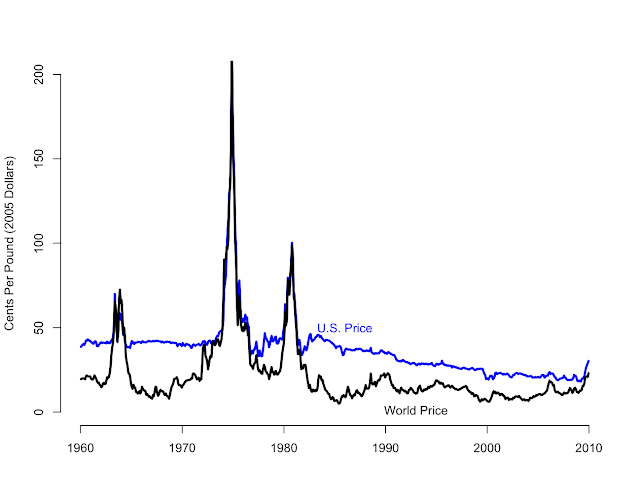
Europe has also supported sugar prices by limiting imports. In fact, the support prices in Europe have been similar or greater than those in the U.S. Many of the Caribbean islands have been beneficiaries of this quota-generated largess, with other less or unfavored nations left to market their sugarcane at world prices, which could be as little as one-third U.S. and European prices.
But beginning in 2005, Europe began winding down its sugar import restrictions. This has caused production to decline in Europe and those Caribbean nations that had favored export status to Europe at their elevated prices. It has also caused world sugar prices to rise. While U.S. sugar policy is alive and well it is under increasing pressure, in part due to rising sugar prices, pressure from food producers, but probably also due to trade liberalization in Europe.
So what does all of this have to do with Haiti? Well, one of the most fascinating and tragic dichotomies is that between the Dominican Republic and Haiti. By Caribbean standards, the Dominican Republic comparatively modern and wealthy while Haiti, in contrast, is one of Caribbean's and world's poorest nations. Yet the Dominican Republic and Haiti share the same island.
The Dominican Republic also possesses the largest share of U.S. sugar quota, equal to well over 20 times that of Haiti's. (See here)
And so I wonder: How much of the Dominican Republic's success relative to that of Haiti has to do with the fact that it received a much larger share of the U.S. sugar quota?
There's probably not a clear answer to this question. But it stands to reason that U.S. policy has at least something do with Haiti's larger challenges, which have, in turn, made them so vulnerable to natural disasters.
Update: Here is some background reading on sugar policy
So, here's the basics of U.S. sugar policy. Like other agricultural policies, U.S. sugar policy got its start in 1934 during the Great Depression. With prices of agricultural commodities (and everything else) plummeting, the government wanted to support prices in an effort to support farmers' incomes. After all, back then, a lot more of us were farmers, and unlike today, most farmers were poor. A lot of what the government did back then, even if it had good intentions, probably did more harm than good. People were hungry too, and one thing they did was destroy crops and limit agricultural production in an effort to support prices, which didn't help people to eat. But these policies probably did help to support farm incomes. And to some extent they still do.
But an important thing to realize is that sugar was different. It was (and is) different from the other commodities because the U.S. imports a lot of it. Thus, to support prices, the government did not need to limit domestic production as much as it needed to limit imports. So, ever since the 1930s, the U.S. has supported a minimum price for sugar by placing a quota on the amount of sugar imports. (Two short-lived exceptions were in the early 70s and early 80s, when world prices spiked and the quota was lifted.) Restricting imports has kept domestic sugar prices higher and less variable than world prices, which has created considerable rents to the favored exporting nations with large quotas.
The price supports led to much greater domestic sugar production than there would have been otherwise, a lot of it around the Everglades in Florida, with some significant environmental problems as a consequence. The quotas and price supports also spurred the development of corn syrup which could be made from domestically produced corn.
Here's a picture showing U.S. and world sugar prices, adjusted for inflation:

Europe has also supported sugar prices by limiting imports. In fact, the support prices in Europe have been similar or greater than those in the U.S. Many of the Caribbean islands have been beneficiaries of this quota-generated largess, with other less or unfavored nations left to market their sugarcane at world prices, which could be as little as one-third U.S. and European prices.
But beginning in 2005, Europe began winding down its sugar import restrictions. This has caused production to decline in Europe and those Caribbean nations that had favored export status to Europe at their elevated prices. It has also caused world sugar prices to rise. While U.S. sugar policy is alive and well it is under increasing pressure, in part due to rising sugar prices, pressure from food producers, but probably also due to trade liberalization in Europe.
So what does all of this have to do with Haiti? Well, one of the most fascinating and tragic dichotomies is that between the Dominican Republic and Haiti. By Caribbean standards, the Dominican Republic comparatively modern and wealthy while Haiti, in contrast, is one of Caribbean's and world's poorest nations. Yet the Dominican Republic and Haiti share the same island.
The Dominican Republic also possesses the largest share of U.S. sugar quota, equal to well over 20 times that of Haiti's. (See here)
And so I wonder: How much of the Dominican Republic's success relative to that of Haiti has to do with the fact that it received a much larger share of the U.S. sugar quota?
There's probably not a clear answer to this question. But it stands to reason that U.S. policy has at least something do with Haiti's larger challenges, which have, in turn, made them so vulnerable to natural disasters.
Update: Here is some background reading on sugar policy
Monday, January 11, 2010
Three blogs I'd like to write but don't have the time
1. Fake Scandal Real Scandal: It is the greatest American pastime to be cynical about big bureaucracies and individuals in power. Much of this cynicism is well justified. A lot of it isn't. Scandals about abuse of power, money or position sell newspapers and increase viewership and listenership. These stories pander to an illusive human characteristic that makes us skeptical of others, especially others of a different social, racial or ethnic class--an "us vs. them" mentality. This is why 60 Minutes, which has historically exposed some great scandals, is probably the most successful TV show in history. But the excess demand for scandalous stories combined with strategic political gamesmanship means that many so-called scandals are fake. Some news outlets are better at selling fake scandals than others and some people are more susceptible to falling for fake scandals than others. Then, of course, there are the real scandals, some of which never do get reported. If I had infinite time and infinite resources I would love to write a blog that dug into scandals to discern which ones are real, which ones are fake, and uncover the real scandals that get too little attention.
2. Who's Got the Inside Scoup: In Washington journalism, it's all about getting the salacious details about the lives and dealings of the politically powerful. Status is measured by how close one gets to the West Wing. Since access is valuable to journalists it usually comes at a price. For big time journalists from big-time venues and audiences, politicians/insiders may value of the exposure more than the journalist values the access, but this is rare. In most cases journalists must tacitly or explicitly offer something in return for access, like selling the insider's viewpoint or personal agenda. This tit for tat biases the news in ways that can be difficult to see. If I had infinite time and infinite resources I would love to write a blog that kept track of individual Washington journalists to trace their tit-for-tat trading of access for storyline. There would be an index for each major Washington journalist with a full history of their stories and a score assigned to each one ranking the extent to which they sell the spin of their stories for access to powerful people.
3. Greed Green and Grains: This would be a blog about policy issues surrounding economics, the environment and agriculture. It would summarize policy news as well as analysis and research findings from the academic literature in clear and thorough detail. An emphasis would be placed on developing vivid graphics that present the weight of the evidence in a compelling way. Since this is my area of greatest expertise it therefore has the least cost and greatest professional benefit, so it would be my first priority. If I had infinite time and resources this is the blog I'd write. Unfortunately scarcity prevents me from writing the quantity and quality I'd like to.
Sigh...
I will write something somewhat substantive relatively soon. I hope.
Thursday, January 7, 2010
Mortgage walkaways, good or bad?
We economists are indoctrinated into thinking first in positive rather than normative terms. That is, how DO people and markets behave, not how SHOULD they behave.
So. Should you walk away from your underwater mortgage?
I don't know. All I know is that if you're a rational economic agent you WILL walk away from your mortgage if the benefits outweigh the costs.
Or maybe not...
You see, the mortgage business seems to be counting hard on the idea that maybe you won't walk away from your mortgage even if you're hundreds of thousands underwater and it is in your material self interest to walk away. Not walking away saves the investment banks tons of money if you valiantly pay you mortgage even though it serves their profits over your economic interest. These are the same banks (and mortgage-backed securities holders, including the Fed) that took huge risks in lending to you in the first place, and had assumed you would walk away if things got as ugly as they currently are. Oh, did I mention those guys are still making gazillions?
It's kinda funny how the financial business plays the morality card when it suits their pocketbooks, no?
Anyway. I think it is true that many people go on paying their mortgage even when it is not in their material self interest. People do this mainly because they feel it is morally correct to do so. It's a little like taxes: cheating on taxes would pay for many people but they don't, just because they think it's the wrong thing to do.
What I'm really wondering is whether this phenomenon of people sticking it out with an underwater mortgage is is a good thing or a bad thing for broader economic recovery. You see, I think many banks are reticent to workout mortgages for people who are underwater and struggling because they feel if they lower the principal for some it will weaken the moral suasion they currently have over underwater mortgage holders who can go on paying, but probably shouldn't. This general reticence then keeps lots of people underwater and, more importantly, stuck in homes that are suboptimal for their particular circumstances. And this helps to keep the economy generally stuck in a rut. People simply cannot move to the locations, living situations and jobs that align best with their current circumstances.
Without attaching any morality to the situation, it seems to me that the general situation where people are unwilling to walk away from mortgages is slowing general economic recovery. It is adding a lot of nominal rigidity that we really could do without.
Like always, if I'm wrong about this someone please tell me why I'm wrong.
Update: Roger Lowenstein beat me to this storyline.
Saturday, January 2, 2010
Ron Lieber of the NYT says maybe the naughts weren't really naughts
But I think he takes his contrarianism too far.
He writes:
But then he goes on:
No, this isn't a 2nd-grade math class, it's the "Your Money" column at the New York Times.
Here's the graph:
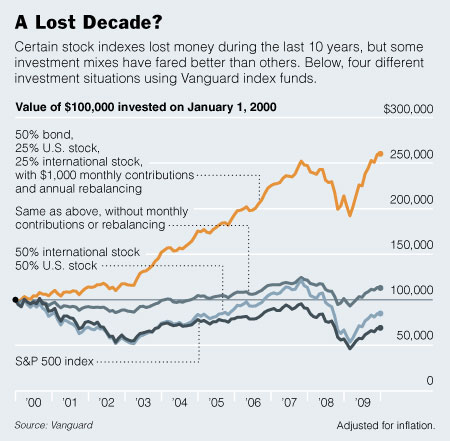
What is not made explicit is that most of the gain in the yellow line is just added savings.
If Lieber really wanted to show the benefits of diversifying through staggered purchases and re-balancing each year, then he should have plotted rates of return, not total balances. I find the way he's presented it misleading.
Yes, bonds did better than stocks this decade, partly because interest rates fell and bond prices move oppositely from interest rates. It would have been really nice if he at least showed the returns to bonds separately, because besides the adding of investment dollars, the biggest thing that separates the different lines is the fact that bonds did a lot better than stocks, a truly rare event.
The gains from diversifying purchases over time is, like the return to balance portfolio, almost naught this decade. That is also kind of unusual. But then Lieber doesn't really tell us that, does he? In fact, he kind of implies the opposite.
To steal a line from Brad Delong: Why can't we have a better press corps?
He writes:
If you invested $100,000 on Jan. 1, 2000, in the Vanguard index fund that tracks the Standard & Poor’s 500, you would have ended up with $89,072 by mid-December of 2009. Adjust that for inflation by putting it in January 2000 dollars and you’re left with $69,114.That's the right way to look at it.
But then he goes on:
But that is not how most real people invest. They don’t pour everything they have into just one type of asset and then add nothing to it for 10 years. Instead, they buy stocks of all sorts, and bonds and perhaps other things, too. And many millions of them dutifully add more money regularly, usually into a retirement account that they won’t touch for longer than a decade.
For those people, it was not a lost decade at all. Even those who started with a low six-figure balance could have doubled their total savings in the last 10 years.Wow! How does Rob Lieber say one could have doubled their savings? Well, he's not very clear about it, but essentially he says this could have been done by doubling the amount one has saved. You see, if one adds $120,000 to the $100,000 one already has, one has more than doubled their savings.
No, this isn't a 2nd-grade math class, it's the "Your Money" column at the New York Times.
Here's the graph:

What is not made explicit is that most of the gain in the yellow line is just added savings.
If Lieber really wanted to show the benefits of diversifying through staggered purchases and re-balancing each year, then he should have plotted rates of return, not total balances. I find the way he's presented it misleading.
Yes, bonds did better than stocks this decade, partly because interest rates fell and bond prices move oppositely from interest rates. It would have been really nice if he at least showed the returns to bonds separately, because besides the adding of investment dollars, the biggest thing that separates the different lines is the fact that bonds did a lot better than stocks, a truly rare event.
The gains from diversifying purchases over time is, like the return to balance portfolio, almost naught this decade. That is also kind of unusual. But then Lieber doesn't really tell us that, does he? In fact, he kind of implies the opposite.
To steal a line from Brad Delong: Why can't we have a better press corps?
Thursday, December 31, 2009
A year of blog-lighting
It's the New Year and baby GG&G is one year old!
It began on something of a lark, during last year's holiday break. Mainly I wanted to show my mother how easy it was. My mother is an expert in early child development and eduction and has tremendous knowledge and enthusiasm about her subject. She's also a great story teller. And she's always claimed she wanted to write one day, so I suggested blogging would be a great way for her to get started.
So far my attempt at leading my mother by example hasn't worked, but I haven't given up.
Visits and page views here at GG&G are gradually increasing and typically range from 50-100 unique visits and 75-150 page views a day. Sometimes, when Mark Thoma (who's probably responsible for 1/3-1/2 my visits) or some other higher-profile blogger links to GG&G, I can get 400 or more visits and over 600 page views. (Thanks Mark!) Besides Mark, I've been linked to by Grist, the Faceless Bureaucrat, Climate Feedback at nature.com (where I'm strangely blogrolled as "Other Voices - 'skeptics', industry, marginalized views"), Ezra Klein, the New York Times Room for Debate, Brad Delong, Andrew Leonard, Arnold Kling, and a few others. I did a few posts for other blogs, including two at the NY Times and one for ePerspective at FoodTechnology.com.
All in all I'd say this has been less time consuming and way more fun than I expected it would be. It's also a nice way to advertise some of my research. But what I like most is that it forces me to keep track of at least some of my random thoughts--an intellectual diary of sorts.
Although, looking back, I'm also more than a little embarrassed by many of my posts. I occasionally re-read some of them and see so many typos, missing words, bad phrasing, etc. In many cases my thoughts are much less complete or as well-organized as I'd like them to be. I don't try as hard as your average blogger or journalist to be catchy, clever, or especially concise. Nor am I a naturally talented writer.
I'd also like to see more comments. What can I do to inspire them? Come on folks, take me to task on all my outrageous claims. Or at least flog me for bad writing!
I know I could do better, but then that would take more time, and right now I have higher priorities. You know, that tenure thing is still hanging over my head and a few more journal pubs would help. And, of course, teaching calls--WAY more time consuming that you think it will be. Hopefully with practice and time I will improve on all fronts.
But I do think blogging is more than just a fad. I'm late to the game but this is still a growing phenomenon. And given the steady quality decline of traditional media, I believe academics and intellectuals will have an ever greater responsibility to communicate their ideas directly to the broader public. I kinda wish every academic had a blog; maybe some day that will happen. Hey, it's all about sharing ideas and getting information out there, right?
Anyway, Happy New Year!
Tuesday, December 29, 2009
On price-to-earnings and price-to-rent ratios
Standard metrics for assessing values of stocks and homes are the price-to-earnings ratio and price-to-rent ratio. For stocks, sometimes a price-to-dividend ratio is used. Also for stocks, since earnings and dividends can be highly volatile in the short-run, a longer-run average is used rather than current earnings or dividends.
Here's a recent chart from Calculated Risk showing the price-to-rent ratio for houses.

And here's a recent chart from Econbrowser showing the price-to-earnings ratio for stocks.

(Note that the first plot shows the index rescaled so that 1980 [1987] = 1. If it were not rescaled this way, the units on the vertical axis would look pretty similar to those for stocks.)
These are nice metrics both conceptually and empirically.
Conceptually, they say something about the rate of investment return. If the stock were infinitely lived and paid same earnings, then the net present value of the flow of earnings equals the price if future earnings are discounted at a rate equal to the inverse of the P/E ratio. For example, a P/E ratio of 20 means the current price is equal to forever receiving current earnings discounted at a rate of 5% (1/20). For houses it's much the same, since rent represents the earnings from a house.
Empirically, these ratios tend to revert to their means over the long run. Thus, if the P/E ratio gets way above its historical mean it can indicate a bubble. So when P/E ratio is above the historical mean, some say prices are too high and when the P/E ratio is below the historical mean some say it's a good buying opportunity. Over the long run (10-20 years), returns are in fact much higher the lower the P/E ratio, a fact pointed out by Robert Shiller some 30 years ago that has withstood test of time.
Okay, that's the standard story. The problem is that there are two other key factors to consider:
1) How much does one expect earnings to grow or decline in the future?
2) How do current interest rates compare to the historical average?
When examining the overall market, not an individual stock or individual house, I think (1) is a pretty small issue. In aggregate, earnings or rents tend to be pretty steady or mean-reverting--there's typically no good reason to expect the future trend to be much different than the past.
But (2) can be hugely important. After all, if you're not putting your money in stocks or a homes, where are you going to put it? If interest rates are very high, you need a higher return (lower P/E ratio) to make investing in a home or stocks worthwhile. If interest rates are low, a higher P/E ratio may still be a good investment opportunity.
The problem is that (2) gets unduly ignored. This matters right now because if you do not account for (2), home and stock prices still look a little high--the P/E ratios, while well off their peak bubble highs, are still a bit above historical averages. But if you account for the fact that interest rates are at historical lows, the P/E ratios look very attractive. One place this is captured is by the housing affordability index--it's about as high as it's ever been.
In my view the right way to gain a quick assessment of whether current prices make sense is to instead look at an index of the P/E ratio divided by the inverse of the 10-year T-bill rate (after all, stocks and houses should be long-run investments). I suspect that index would show today's index value to be quite low by historical standards, and thus a good time to buy.
If I find the time I'll try to put that index together on another day.
Update: Here is Calculated Risk making the argument that houses are NOT cheap. I disagree. In the case where interest rates do rise to 7% in a few years (not something the market expects at all), home prices fall, and the owner wants to move, s/he can always rent the house out for well above the mortgage payment are receive a decent income from the difference (assuming s/he's takes out 30-year fixed mortgage at today's low interest rates) while continuing to steadily pay down the principal. If interest rates rise to 7%, rents will rise too, and at today's price-to-rent ratio, rent is already close to the mortgage payment on the first day of the mortgage.
Maybe some homeowners wouldn't be willing or able to do this. But to those willing and able, buying a house at today's prices and interest rates represents a fantastic long-run investment opportunity. WAY better than cash, buying bonds (especially in you think interest rates will rise), and probably even better than buying stocks.
The only good reason not to buy right now is because you think prices will fall further. While that's a real possibility, it's also the same kind of thinking that led to the bubble in the first place.
Here's a recent chart from Calculated Risk showing the price-to-rent ratio for houses.


These are nice metrics both conceptually and empirically.
Conceptually, they say something about the rate of investment return. If the stock were infinitely lived and paid same earnings, then the net present value of the flow of earnings equals the price if future earnings are discounted at a rate equal to the inverse of the P/E ratio. For example, a P/E ratio of 20 means the current price is equal to forever receiving current earnings discounted at a rate of 5% (1/20). For houses it's much the same, since rent represents the earnings from a house.
Empirically, these ratios tend to revert to their means over the long run. Thus, if the P/E ratio gets way above its historical mean it can indicate a bubble. So when P/E ratio is above the historical mean, some say prices are too high and when the P/E ratio is below the historical mean some say it's a good buying opportunity. Over the long run (10-20 years), returns are in fact much higher the lower the P/E ratio, a fact pointed out by Robert Shiller some 30 years ago that has withstood test of time.
Okay, that's the standard story. The problem is that there are two other key factors to consider:
1) How much does one expect earnings to grow or decline in the future?
2) How do current interest rates compare to the historical average?
When examining the overall market, not an individual stock or individual house, I think (1) is a pretty small issue. In aggregate, earnings or rents tend to be pretty steady or mean-reverting--there's typically no good reason to expect the future trend to be much different than the past.
But (2) can be hugely important. After all, if you're not putting your money in stocks or a homes, where are you going to put it? If interest rates are very high, you need a higher return (lower P/E ratio) to make investing in a home or stocks worthwhile. If interest rates are low, a higher P/E ratio may still be a good investment opportunity.
The problem is that (2) gets unduly ignored. This matters right now because if you do not account for (2), home and stock prices still look a little high--the P/E ratios, while well off their peak bubble highs, are still a bit above historical averages. But if you account for the fact that interest rates are at historical lows, the P/E ratios look very attractive. One place this is captured is by the housing affordability index--it's about as high as it's ever been.
In my view the right way to gain a quick assessment of whether current prices make sense is to instead look at an index of the P/E ratio divided by the inverse of the 10-year T-bill rate (after all, stocks and houses should be long-run investments). I suspect that index would show today's index value to be quite low by historical standards, and thus a good time to buy.
If I find the time I'll try to put that index together on another day.
Update: Here is Calculated Risk making the argument that houses are NOT cheap. I disagree. In the case where interest rates do rise to 7% in a few years (not something the market expects at all), home prices fall, and the owner wants to move, s/he can always rent the house out for well above the mortgage payment are receive a decent income from the difference (assuming s/he's takes out 30-year fixed mortgage at today's low interest rates) while continuing to steadily pay down the principal. If interest rates rise to 7%, rents will rise too, and at today's price-to-rent ratio, rent is already close to the mortgage payment on the first day of the mortgage.
Maybe some homeowners wouldn't be willing or able to do this. But to those willing and able, buying a house at today's prices and interest rates represents a fantastic long-run investment opportunity. WAY better than cash, buying bonds (especially in you think interest rates will rise), and probably even better than buying stocks.
The only good reason not to buy right now is because you think prices will fall further. While that's a real possibility, it's also the same kind of thinking that led to the bubble in the first place.
Monday, December 28, 2009
Might Krugman's polemic prediction about Enron vs. 9-11 ever come true?
I look at our financial and economic system in dumbfounded awe as to how it all works. We shovel trillions of dollars into banks, stocks and mutual funds, rarely knowing the first thing about how well the underlying companies are managed or how profitable they are or what they are truly doing with our money. While I think I'm more informed than the average investor, I couldn't tell you which 10 CEOs are most responsible for my investments. I couldn't even tell you the top 10 companies!
I think most investors are like me. So this begs the obvious question: what keeps those CEOs from running off with all our money?!
The fact that I do invest shows I have remarkable confidence in our financial system. That confidence is based on history, the fact that firms and CEOs have been honest and transparent enough in their accounting and that, over the long run, the stock market has performed extremely well. The long sweep of history says I'm crazy not to invest.
But then I look at recent history and I wonder how the long history came to be. Honest and transparent are not adjectives that come easily to mind when looking at our modern financial system and events over the last decade.
This issue is in fact the lynch pin to modern capitalism. At a fundamental level what makes it all work is to having institutions that deal effectively with asymmetric information (the econ jargon). If one cannot see exactly what they are buying with their investment money, little investment will take place, and economies don't grow. So modern capitalism requires rock solid institutions that reduce information asymmetries and allow dollars to flow toward investments with the greatest potential returns.
This is why, back in 2002, Paul Krugman made what I think was his most polemic prediction ever:
His column today, a tribute the naughties, echos similarly to his 2002 prediction. He quotes Larry Summers from over a decade ago:
And here we are. Things didn't collapsed completely but it wasn't pretty. While we've begun to recover (barely) many problems still need fixing, particularly re-regulation of financial markets.
I still think Krugman overstepped when he made that prediction in 2002, not just because the Enron fallout blew over relatively quickly, but because the sweeping fallout of 9/11 has been so great. But today I do think there is a chance--a greater chance than I believed back in 2002--that Krugman's prediction might eventually turn out to be right after all.
But I've still got my money in stocks. Why? Because if things fall apart completely it won't matter where my money is sitting.
I think most investors are like me. So this begs the obvious question: what keeps those CEOs from running off with all our money?!
The fact that I do invest shows I have remarkable confidence in our financial system. That confidence is based on history, the fact that firms and CEOs have been honest and transparent enough in their accounting and that, over the long run, the stock market has performed extremely well. The long sweep of history says I'm crazy not to invest.
But then I look at recent history and I wonder how the long history came to be. Honest and transparent are not adjectives that come easily to mind when looking at our modern financial system and events over the last decade.
This issue is in fact the lynch pin to modern capitalism. At a fundamental level what makes it all work is to having institutions that deal effectively with asymmetric information (the econ jargon). If one cannot see exactly what they are buying with their investment money, little investment will take place, and economies don't grow. So modern capitalism requires rock solid institutions that reduce information asymmetries and allow dollars to flow toward investments with the greatest potential returns.
This is why, back in 2002, Paul Krugman made what I think was his most polemic prediction ever:
I predict that in the years ahead Enron, not Sept. 11, will come to be seen as the greater turning point in U.S. society.Many, including me, thought this was a bit much, even if Krugman made some good points in that old column.
His column today, a tribute the naughties, echos similarly to his 2002 prediction. He quotes Larry Summers from over a decade ago:
If you ask why the American financial system succeeds... at least my reading of the history would be that there is no innovation more important than that of generally accepted accounting principles: it means that every investor gets to see information presented on a comparable basis; that there is discipline on company managements in the way they report and monitor their activities.So, in 2002 Krugman was worried about the collapse of our financial institutions and saw Enron as an omen. He must have figured if our finanical institutions were to collapse, that would be more ominous that the 3-4000 killed on 9-11. And if our finanical institutions didn't collapse, they would somehow have to be reinvented and made more sturdy, which would be a major turning point itself.
And here we are. Things didn't collapsed completely but it wasn't pretty. While we've begun to recover (barely) many problems still need fixing, particularly re-regulation of financial markets.
I still think Krugman overstepped when he made that prediction in 2002, not just because the Enron fallout blew over relatively quickly, but because the sweeping fallout of 9/11 has been so great. But today I do think there is a chance--a greater chance than I believed back in 2002--that Krugman's prediction might eventually turn out to be right after all.
But I've still got my money in stocks. Why? Because if things fall apart completely it won't matter where my money is sitting.
Saturday, December 26, 2009
Obama isn't elusive
I'm disinclined to blog much about politics. But this column by the former blogger turned conservative NY Times columnist Ross Douthat kind of struck a chord in me.
To serve his cause--which I think is centered, broadly speaking, on a hope of a better human condition--Obama is willing to set ego aside and compromise to any extent necessary. I, for one, was always inspired by Obama, not by his oratorical eloquence or race (okay, maybe a little), but by the fact that he eschews ideology. He recognizes the world is complex and that special interests have many powers. He will stand up to those powers to the extent that he is able. But he's no fool. Given the significant political constraints it seems to me he trys as best as he can to further general well-being.
As an economist who views policy from a technocratic perspective, it seems to me Obama is the best we can ask for in a leader. The skills he combines with his noble objectives, intelligence and wise strategy of implementation, simply adds powerful ammunition to his worthwhile cause.
The painted facade of Obama's elusiveness comes from the ideologues who bristle that this egregious moderate might actually get something done, and in doing so shatter their fragile worldview. Or otherwise diminish the cause of their particular special interest.
That Obama is truly elusive to anyone is a testament only to the poor and declining quality of our media (we can't really blame journalists for this, but that's another story...). Don't buy sweeping generalized attacks of Obama or his presidency or silly conspiracy theories. The only way to judge this man's presidency is by the specific policies he proposes and signs into law, and then only in comparison to what other policies you think might be politically feasible.
Yeah, it's a pain in the a#$$ to follow all the details, but that's real life. Ignore everything else, no matter how salaciously interesting it may seem. And it's especially important to ignore polls about whether people approve or disapprove of proposed policies when it's clear they don't understand the policy being proposed.
Update: Maybe I'm being too vague here. The point is that Obama has bent over backwards to be the post-partisan centrist he claimed he would be. But it just doesn't get reported that way. Here's a clearer take with regard to health care.
Every presidency is the subject of competing caricatures. But almost a year into his first term, there’s something particularly elusive about Barack Obama’s political identity. He’s a bipartisan bridge-builder — unless he’s a polarizing ideologue. He’s a crypto-Marxist radical — except when he’s a pawn of corporate interests. He’s a post-American utopian — or else he’s a willing tool of the national security state...If one were to read traditional media and never listen to what Barack Obama has actually said or written, then Barack Obama would seem elusive. But if one actually listened to what he has said--and by any standard President Obama is particularly articulate are particularly non-evasive--then there is absolutely nothing at all elusive about him. He has done pretty much exactly what he said he would do. Douthat continues:
...In hindsight, the most prescient sentence penned during the presidential campaign belongs to Ryan Lizza of The New Yorker. “Perhaps the greatest misconception about Barack Obama,” he wrote in July 2008, “is that he is some sort of anti-establishment revolutionary. Rather, every stage of his political career has been marked by an eagerness to accommodate himself to existing institutions rather than tear them down or replace them.”Okay. But I don't think Lizza's prescient moment required deep analytical or perceptive insight. All of this has always been as plain as day from day one, if one were to listen to the man himself or any of his closest advisors. The only way not to see what Obama is--a smart, pragmatic, and charismatic individual with an open mind and unusually varied background that allows him to see many sides--is to ignore the causes, ideology and political constraints of those drawing the caricatures.
To serve his cause--which I think is centered, broadly speaking, on a hope of a better human condition--Obama is willing to set ego aside and compromise to any extent necessary. I, for one, was always inspired by Obama, not by his oratorical eloquence or race (okay, maybe a little), but by the fact that he eschews ideology. He recognizes the world is complex and that special interests have many powers. He will stand up to those powers to the extent that he is able. But he's no fool. Given the significant political constraints it seems to me he trys as best as he can to further general well-being.
As an economist who views policy from a technocratic perspective, it seems to me Obama is the best we can ask for in a leader. The skills he combines with his noble objectives, intelligence and wise strategy of implementation, simply adds powerful ammunition to his worthwhile cause.
The painted facade of Obama's elusiveness comes from the ideologues who bristle that this egregious moderate might actually get something done, and in doing so shatter their fragile worldview. Or otherwise diminish the cause of their particular special interest.
That Obama is truly elusive to anyone is a testament only to the poor and declining quality of our media (we can't really blame journalists for this, but that's another story...). Don't buy sweeping generalized attacks of Obama or his presidency or silly conspiracy theories. The only way to judge this man's presidency is by the specific policies he proposes and signs into law, and then only in comparison to what other policies you think might be politically feasible.
Yeah, it's a pain in the a#$$ to follow all the details, but that's real life. Ignore everything else, no matter how salaciously interesting it may seem. And it's especially important to ignore polls about whether people approve or disapprove of proposed policies when it's clear they don't understand the policy being proposed.
Update: Maybe I'm being too vague here. The point is that Obama has bent over backwards to be the post-partisan centrist he claimed he would be. But it just doesn't get reported that way. Here's a clearer take with regard to health care.
Tuesday, December 22, 2009
First Agricultural Economics Workshop at NBER
Jeffrey Perloff has done a fantastic job organizing the first ever NBER workshop on agricultural economics. Here's the program. I just booked my ticket and am really looking forward to it.
This was a difficult thing to do and many kudos to Jeff for all his efforts. Polite folks don't say it out loud, but the truth is that many econ folks see ag. econ. as the ugly stepchild of economics, and so it's quite a feat to have an ag. econ. grace the halls of the relatively exclusive NBER. I hope this helps to whittle down silly intellectual barriers.
This was a difficult thing to do and many kudos to Jeff for all his efforts. Polite folks don't say it out loud, but the truth is that many econ folks see ag. econ. as the ugly stepchild of economics, and so it's quite a feat to have an ag. econ. grace the halls of the relatively exclusive NBER. I hope this helps to whittle down silly intellectual barriers.
Monday, December 21, 2009
Rob Stavins is the best source for substantive review of all things related to climate policy
Here's his review of the Copenhagen summit.
Cochrane's tips for empirical work
A little while ago I stumbled upon this post by Greg Mankiw that provides great list of resources with advice for graduate students. I highly recommend all grad students read all of these, especially the first two by Don Davis and John Cochrane.
I'd like to emphasize Cochrane's tips for empirical work:
A common misnomer is that to worry about these issues somehow pits reduced-form or quasi-experimental empiricists against structural modelers. This is obviously false given Cochrane--a pretty structural guy--is the one making these points.
These are just basic tenets of good empirical work with observational data. As a new Associate Editor of AJAE (one of 20 or more), I plan to do my own tiny part in trying to enforce these tenets.
Late Update: The link on Mankiw's site is old. Here's (PDF) a link to all of Cochrane's writing tips.
I'd like to emphasize Cochrane's tips for empirical work:
These tips verge on “how to do empirical work” rather than just “how to write empirical work,” but in the larger picture “doing” and “writing” are not that different.
What are the three most important things for empirical work? Identification, Identification, Identification. Describe your identification strategy clearly. (Understand what it is, first!) Much empirical work boils down to a claim that “A causes B,” usually documented by some sort of regression. Explain how the causal effect you think you see in the data is identified.
1. Describe what economic mechanism caused the dispersion in your right hand variables. No, God does not hand us true natural experiments very often.
2. Describe what economic mechanism constitutes the error term. What things other than your right hand variable cause variation in the left hand variable?
3. Hence, explain why you think the error term is uncorrelated with the right hand variables in economic terms. There is no way to talk about this crucial assumption unless you have done items 1 and 2!
4. Explain the economics of why your instruments are correlated with the right hand variable and not with the error term.
5. Do you understand the difference between an instrument and a control? In regressing y on x, when should z be used as an additional variable on the right hand side and when should it be an instrument for x?
6. Describe the source of variation in the data that drives your estimates, for every single number you present. For example, the underlying facts will be quite different as you add fixed effects. With firm fixed effects, the regression coefficient is driven by how the variation over time within each firm. Without firm fixed effects, the coefficient is (mostly) driven by variation across firms at a moment in time.
7. Are you sure you’re looking at a demand curve, not a supply curve? As one way to clarify this question, ask “whose behavior are you modeling?”
Example: Suppose you are interested in how interest rates affect housing demand, so you run the number of new loans on interest rates. But maybe when housing demand is large for other reasons, demand for mortgages (and other borrowing demand correlated with demand for mortgages) drives interest rates up. You implicitly assumed stable demand, so that an increase in price would lower quantity. But maybe the data are generated by a stable supply, so that increased demand raises the price, or some of both. Are you modeling the behavior of house purchasers or the behavior of savers (how savings responds to interest rates)?
8. Are you sure causality doesn’t run from y to x, or from z to y and x simultaneously? Think of the obvious reverse-causality stories. Example: You can also think about the last example as causality: Do interest rates cause changes in housing demand or vice versa (or does the overall state of the economy cause both to change)?
9. Consider carefully what controls should and should not be in the regression. Most papers have far too many right hand variables. You do not want to include all the “determinants” of y on the right hand side.
(a) High R2 is usually bad — it means you ran left shoes = α + β right shoes +γprice + error. Right shoes should not be a control!
(b) Don’t run a regression like wage = a + b education + c industry + error. Of course, adding industry helps raise the R2, and industry is an important other determinant of wage (it was in the error term if you did #2). But the whole point of getting an education is to help people move to better industries, not to move from assistant burger-flipper to chief burger-flipper.
Give the stylized facts in the data that drive your result, not just estimates and p values. For a good example, look at Fama and French’s 1996 “Multifactor explanations.” In the old style we would need one number: the GRS test. Fama and French show us the expected returns of each portfolio, they show us the beta of each portfolio, and they convince us that the pattern of expected returns matches the pattern of betas. This is the most successful factor model of the last 15 years ...even though the GRS test is a disaster! They were successful because they showed us the stylized facts in the data.
Explain the economic significance of your results. Explain the economic magnitude of the central numbers, not just their statistical significance. Especially in large panel data sets even the tiniest of effects is “statistically significant.” (And when people show up with the usual 2.10 t statistic in large panel data sets, the effect is truly tiny!)
Of course, every important number should include a standard error.This kind of empirical logic was standard-fare training at Berkeley many years ago. But it is still rare among environmental economists and almost nonexistent among agricultural economists. Many of the standard fare "classics" in ag. econ have undefined errors in their models, obviously endogenous right-hands-side variables, and lack any discussion of the essential comparisons underlying the identification strategy. I won't even get started on instrumental variables.... The prevailing style seems to be one in which assumptions are typically stated but rarely defended rhetorically. Test statistics are often given but the weight of the evidence is rarely shown.
A common misnomer is that to worry about these issues somehow pits reduced-form or quasi-experimental empiricists against structural modelers. This is obviously false given Cochrane--a pretty structural guy--is the one making these points.
These are just basic tenets of good empirical work with observational data. As a new Associate Editor of AJAE (one of 20 or more), I plan to do my own tiny part in trying to enforce these tenets.
Late Update: The link on Mankiw's site is old. Here's (PDF) a link to all of Cochrane's writing tips.
Googling "Inflation targeting" and "fiscal stimulus"
I'm encouraged by a recent uptick in discussion about inflation targeting among some influential economists.
Brad Delong asks whether it's "time for some hand-forcing at the Fed." This in response to a very nice post by David Beckworth, which was partly in response to Bernanke's unconvincing answer to Brad Delong's question to Bernanke about why the Fed isn't targeting a 3% inflation rate.
Paul Krugman then compares Ben Bernanke to Montague Norman.
Mark Thoma still thinks the focus should be on fiscal stimulus rather than inflation targeting or quantitative easing (there are subtle differences betweeen IT and QE--see Krugman).
I can understand why economists (a characteristically conservative bunch) would be worried about announcing a new inflation target and vigorously enforcing it with bond purchases. Unhinging inflation expectations from a very stable 2.5 percent could have unanticipated consequences.
But aside from knee-jerk conservativism, I see no reason (ie., no compelling model) in which a modest increase in the inflation target could be bad thing. So I wonder, what is Ben Bernanke's loss function? What is the scenario in which changing the inflation target would be a bad thing? How bad would it be? And what odds does he place on inflation targeting being a bad thing as opposed to it being a good thing, as most models indicate it would be?
Bernanke may be the best person for the job as Chairman of the Federal Reserve. But with unemployment at 10 percent and likely to stay that high for a long time, Ben Bernanke owes us clear answers to these questions.
Anyway. I like the invigorated discussion of inflation targeting and quantitative easing vs. fiscal stimulus. Still, it is disappointing this discussion has come so late and remains so subdued.
How subdued? Well, today I took the pulse of "fiscal stimulus" and "inflation targeting" on Google News. "Fiscal stimulus," with quotes, gets 1,712 hits, 10,538 hits without. "Inflation targeting" gets 113 hits with quotes, 332 without .
These results are not surprising. But they do show a sad disconnect between modern macroeconomic thinking and what the public gets told through traditional media. That might change if Krugman were to start writing more about inflation targeting in his headline column rather than just his blog. With the economy likely to remain sluggish for awhile I expect this will happen eventually.
Sunday, December 13, 2009
Paul Samuelson
Paul Samuelson was among the most influential economists in modern history.
After Keynes and Friedman, at the moment I can't think of any economist with more sweeping and enduring influence. In some ways his contributions were deeper than Keynes and Friedman. He developed the modern structure of economics--not just how we think the economy works, but how think about how the economy works, particularly the way economists use mathematics.
He will be sorely missed.
Update: Krugman's tribute
Another update: Krugman summarizes some of Samuelson's biggest contributions. I did not know Samuelson was the source of some of these. Amazing...
Saturday, December 12, 2009
I have not seen a single cogent explanation for why uncertainty about climate change implies inaction is the optimal policy
Via Brad Delong, Mark Kleiman tells us that "If anyone tries to tell you that uncertainty about climate change is a reason for inaction, he’s either a fool or a scoundrel. Probably a bit of both."
That may be a little strong. But if there is a cogent explanation for why uncertainty means we should do nothing, I have no idea what it may be.
Brad Delong is a more precise. He writes:
In all other ways, uncertainty increases the rationale for action, mainly because the downside is far worse if we do nothing than if we do something reasonably aggressive.
Update: I should note that there may be non-negligible option values but these go the other way: they provide a reason for action rather than inaction. This is because inaction is a decision to keep putting the same amount of CO2 in the atmosphere, and this decision has very uncertain costs and benefits and is largely irreversible. That means there is some value to *not* emitting CO2 until we learn more about the costs and benefits. While these option values are almost surely larger than the option values associated with inaction, they are still very small given we are unlikely to resolve remaining uncertainties for a very long time.
That may be a little strong. But if there is a cogent explanation for why uncertainty means we should do nothing, I have no idea what it may be.
Brad Delong is a more precise. He writes:
There is one set of circumstances in which uncertainty is a reason for inaction: (a) the measures you would take would be expensive, (b) the measures you would take will be irreversible, and (c) you will get a lot of new information soon to help you judge the situation better.
That set of circumstances does not apply here.I agree. Because the one uncertainty-related rationale for doing nothing is an option value--the value of waiting to learn more about the best course of action. Option values are generally very small. They are especially small right now because (a) the amount of new information we're likely to obtain will be minimal and take a long time to obtain; (b) that new information is unlikely to change the optimal course of action by very much; and (c) any reasonable course of action is easily reversible or changeable. Any one of these puts the option value at approximately zero.
In all other ways, uncertainty increases the rationale for action, mainly because the downside is far worse if we do nothing than if we do something reasonably aggressive.
Update: I should note that there may be non-negligible option values but these go the other way: they provide a reason for action rather than inaction. This is because inaction is a decision to keep putting the same amount of CO2 in the atmosphere, and this decision has very uncertain costs and benefits and is largely irreversible. That means there is some value to *not* emitting CO2 until we learn more about the costs and benefits. While these option values are almost surely larger than the option values associated with inaction, they are still very small given we are unlikely to resolve remaining uncertainties for a very long time.
Friday, December 11, 2009


Tuesday, December 8, 2009
Where are the incentives on the demand side of Waxman-Markey?
Update: I really need to eat some crow here. The demand side incentives are in place on Waxman-Markey, so long as utilities pass through the value of permits to consumers in "lump-sum" fashion as the bill prescribes (see Stavins, with hat tip to 'R' in the comments of this post). Darn it all. My apologies. I now remember reading this post by Stavins. I'm going prematurely senile...
The key idea underlying cap-and-trade is to create a market price for carbon emissions that wouldn't otherwise exist. While this provides a useful incentive to cut carbon emissions, it also means higher energy bills for the consumer.
But a clever idea in the Waxman-Markey bill limits the price effect for consumers.** It does this by issuing a share of the tradeable carbon permits to local utility distributors. Local utility companies are regulated not-for-profit enterprises due to their status as a natural monopoly. Thus they are not free to charge consumers any price they wish. Instead they are required to charge prices than just cover their costs, which are reviewed by a local commission. By giving these local distributors carbon permits (which they would presumably sell to coal-fired power plants), it gives them an additional revenue stream to offset presumably higher wholesale prices. Thus, consumer prices may rise very little, if at all, even while wholesale price would rise under Waxman-Markey.
This is extremely clever from a political viewpoint. It is also helpful if you prefer progressive taxation: if the less well-to-do pay a larger share of their income on energy, higher energy prices would translate into higher "tax" burden from cap-and-trade, making the "tax" regressive. Giving local utilities carbon-permits keeps the tax burden on relatively progressive Federal income taxes. I don't have a real problem with these objectives.
But there is a downside to this. This approach effectively eliminates all demand-side [price] incentives for energy conservation. The beauty of cap-and-trade is that it puts a price on carbon no matter where it exists, which allows for all kinds of creative ways to avoid paying that price. Maybe it is true that the real gains long term are to be had in the way energy is generated. But right now the cheapest ways to reduce carbon emissions appear to be on the demand side of the market, in the form of greater energy conservation--better-insulated homes, more efficient appliances, smaller home, and so on...
While there are proposals for other kinds of tax-related incentives to insulate your home, replace windows, and so on, these stop-gap approaches don't have the beauty or robustness of price-based incentives. It's a bit more like command and control.
Is there another way? I think so. I think W-M could enforce some kind of increasing marginal price rule for local utilities. This is basically the opposite of what a monopoly would do. The idea is to charge a low price for the first X megawatts of energy each household consumes and then gradually increase the price as household consumption rises. This way household could pay the same average price as they normally would but potentially pay a very high marginal price, and thus have a stronger incentive to conserve. I think some local utilities do this but I wouldn't complain if all were required to do it, at least to some degree, under Waxman Markey. I think it would do a lot to lower the overall costs of reducing carbon emissions while keeping the effective tax burden reasonably progressive.
**Warning: I'm paraphrasing this from what I learned from talking with others who know more about this than I do. I haven't, alas, actually read Waxman-Markey. If you know something I don't please let me know in a comment.
Monday, December 7, 2009
Climate Change Really Shouldn't be a Big Deal
For all the media attention and research focus on climate change, and the potentially dramatic implications of warming currently predicted, it is kind of amazing how small a deal this really should be.
Why a small deal? No, I'm not a denialist. It's a small deal because the costs of curbing greenhouse gas emissions are probably very small if done in an intelligent way. And Waxman-Markey, while probably far from ideal policy, does seem to get a lot of the basics right. In fact, all anyone talks about these days are market-based approaches to solving the problem (carbon taxes or cap-and-trade), so I'm optimistic that if policy is implemented, it will at least get first-order efficiencies right. That is a huge victory for economics. But the longer we wait to do something the more expensive it gets.
Krugman, as usual, is able to clearly and concisely cover a lot of key issues. I think he's right on almost all accounts here. The science and the economics back up his assertions.
I trust the low-cost estimates because I know where they are coming from: MIT, Resources for the Future, and CBO. These are not institutions known for cooking the books to serve environmental causes. In contrast, the Heritage Foundation has a well-known (extreme?) agenda and always cooks the books to serve the interests that funds it.
Furthermore, as Krugman points out, model-based estimates almost always exaggerate costs rather than underestimate them. Costs are always exaggerated because every innovation or adaptation that the researchers cannot anticipate lowers the cost relative to the estimate.
So, like all policy issues, the question about climate change mitigation comes down to both costs and benefits. The benefits, while highly uncertain, could be high if current climate forecasts are correct (not something I would stake my life on). Furthermore, uncertainty is not our friend and a bad excuse for inaction. Think of climate change mitigation as an insurance policy, one with a very low premium.
If climate change mitigation is so cheap, then why the conflict? Ideology probably plays a role. But I imagine the larger reason is that oil and coal would lose, big time. In fact, the cheaper CO2 mitigation is, the more these interests lose. Why is that? Basic economics: If we can't cheaply reduce CO2-emissions, we'll have to do it by consuming less energy, which means much higher prices. If prices go up a lot then Big Coal and Big Oil get very rich. A cap-and-trade system would be almost like a government-enforced monopoly for BC and BO.
So, my hypothesis is that Big Oil and Big Coal (a.k.a, the climate skeptics, Pew, and Heritage) are fighting hard against climate change policy because they know or strongly suspect alternative energy sources are or will be cheap. And that will hurt their pocket books, because with a little time and innovation on the renewable energy front, all their oil and coal reserves will be worthless. So they have good reason to fight hard and fight dirty against climate policy. Not because it's bad policy. But because it's good policy.
100 Best Blogs for Socially Minded MBAs
Here's a pretty cool link. Greed, Green and Grains in number 20.
I don't know all of these blogs, but I like the mix and the way it is organized.
I don't know all of these blogs, but I like the mix and the way it is organized.
Sunday, December 6, 2009
A nice summary of various climate issues
Brian Angliss over at Scholars and Rogues has written a very nice summary of climate modeling and geo-engineering issues. Nominally it's about Levitt and Dubner's unfortunate combination of arrogance and ignorance. But even if you could give a hoot about Superfreakonomics, there's a lot of meat here, and useful links too.
Friday, December 4, 2009
Nature Editors on the climate/email controversy
Here's the link
Here's an interesting video by a history professor at UCSD that documents the history of the denialist movement. (Warning: It's long and somewhat academic).
Scientists may be tempted by the relentless goading of the denialists to get into to the media game but they really shouldn't. The scientific community does not play this game well. But the truth, whatever it is, gets out eventually. It's important for scientists not to muck up that processes by stooping to denialist tactics.
Nature 462, 545 (3 December 2009) | doi:10.1038/462545a; Published online 2 December 2009
Stolen e-mails have revealed no scientific conspiracy, but do highlight ways in which climate researchers could be better supported in the face of public scrutiny.
The e-mail archives stolen last month from the Climatic Research Unit at the University of East Anglia (UEA), UK, have been greeted by the climate-change-denialist fringe as a propaganda windfall (see page 551). To these denialists, the scientists' scathing remarks about certain controversial palaeoclimate reconstructions qualify as the proverbial 'smoking gun': proof that mainstream climate researchers have systematically conspired to suppress evidence contradicting their doctrine that humans are warming the globe.
This paranoid interpretation would be laughable were it not for the fact that obstructionist politicians in the US Senate will probably use it next year as an excuse to stiffen their opposition to the country's much needed climate bill. Nothing in the e-mails undermines the scientific case that global warming is real — or that human activities are almost certainly the cause. That case is supported by multiple, robust lines of evidence, including several that are completely independent of the climate reconstructions debated in the e-mails.
First, Earth's cryosphere is changing as one would expect in a warming climate. These changes include glacier retreat, thinning and areal reduction of Arctic sea ice, reductions in permafrost and accelerated loss of mass from the Greenland and Antarctic ice sheets. Second, the global sea level is rising. The rise is caused in part by water pouring in from melting glaciers and ice sheets, but also by thermal expansion as the oceans warm. Third, decades of biological data on blooming dates and the like suggest that spring is arriving earlier each year.
Denialists often maintain that these changes are just a symptom of natural climate variability. But when climate modellers test this assertion by running their simulations with greenhouse gases such as carbon dioxide held fixed, the results bear little resemblance to the observed warming. The strong implication is that increased greenhouse-gas emissions have played an important part in recent warming, meaning that curbing the world's voracious appetite for carbon is essential (see pages 568 and 570).
Mail trail
A fair reading of the e-mails reveals nothing to support the denialists' conspiracy theories. In one of the more controversial exchanges, UEA scientists sharply criticized the quality of two papers that question the uniqueness of recent global warming (S. McIntyre and R. McKitrick Energy Environ. 14, 751–771; 2003 and W. Soon and S. Baliunas Clim. Res. 23, 89–110; 2003) and vowed to keep at least the first paper out of the upcoming Fourth Assessment Report of the Intergovernmental Panel on Climate Change (IPCC).
Whatever the e-mail authors may have said to one another in (supposed) privacy, however, what matters is how they acted. And the fact is that, in the end, neither they nor the IPCC suppressed anything: when the assessment report was published in 2007 it referenced and discussed both papers.
If there are benefits to the e-mail theft, one is to highlight yet again the harassment that denialists inflict on some climate-change researchers, often in the form of endless, time-consuming demands for information under the US and UK Freedom of Information Acts. Governments and institutions need to provide tangible assistance for researchers facing such a burden.
The theft highlights the harassment that denialists inflict on some climate-change researchers.
The e-mail theft also highlights how difficult it can be for climate researchers to follow the canons of scientific openness, which require them to make public the data on which they base their conclusions. This is best done via open online archives, such as the ones maintained by the IPCC (http://www.ipcc-data.org) and the US National Climatic Data Center (http://www.ncdc.noaa.gov/oa/ncdc.html).
Tricky business
But for much crucial information the reality is very different. Researchers are barred from publicly releasing meteorological data from many countries owing to contractual restrictions. Moreover, in countries such as Germany, France and the United Kingdom, the national meteorological services will provide data sets only when researchers specifically request them, and only after a significant delay. The lack of standard formats can also make it hard to compare and integrate data from different sources. Every aspect of this situation needs to change: if the current episode does not spur meteorological services to improve researchers' ease of access, governments should force them to do so.

The stolen e-mails have prompted queries about whether Nature will investigate some of the researchers' own papers. One e-mail talked of displaying the data using a 'trick' — slang for a clever (and legitimate) technique, but a word that denialists have used to accuse the researchers of fabricating their results. It is Nature's policy to investigate such matters if there are substantive reasons for concern, but nothing we have seen so far in the e-mails qualifies.
The UEA responded too slowly to the eruption of coverage in the media, but deserves credit for now being publicly supportive of the integrity of its scientists while also holding an independent investigation of its researchers' compliance with Britain's freedom of information requirements (see http://go.nature.com/zRBXRP).
Here's the thing: Scientists, while human, are lousy at politics and media management. The denialist movement, in contrast, is very well funded by special interests and is extremely savvy at media relations. They got their start on the editorial pages of the Wall Street Journal and have backing of big oil and big coal. This is not a scientific debate; its a scientist vs. well-funded-media-hack debate (even though some of the hacks have worn scientist hats in the past).In the end, what the UEA e-mails really show is that scientists are human beings — and that unrelenting opposition to their work can goad them to the limits of tolerance, and tempt them to act in ways that undermine scientific values. Yet it is precisely in such circumstances that researchers should strive to act and communicate professionally, and make their data and methods available to others, lest they provide their worst critics with ammunition. After all, the pressures the UEA e-mailers experienced may be nothing compared with what will emerge as the United States debates a climate bill next year, and denialists use every means at their disposal to undermine trust in scientists and science.
Here's an interesting video by a history professor at UCSD that documents the history of the denialist movement. (Warning: It's long and somewhat academic).
Scientists may be tempted by the relentless goading of the denialists to get into to the media game but they really shouldn't. The scientific community does not play this game well. But the truth, whatever it is, gets out eventually. It's important for scientists not to muck up that processes by stooping to denialist tactics.
Tuesday, December 1, 2009
Research calls...
My semester free from teaching is quickly coming to an end.
And I'm in a panic.
Because the stack of unfinished papers on my desk is not out the door. Yet. So I'm scrambling to finish them before I have to teach again.
I'm putting the finishing touches on a really cool paper that measures the incidence and budgetary cost of moral hazard in the U.S. crop insurance program. I'm also finishing up a consulting project surrounding an environmental impact statement for the Conservation Reserve Program. And several other papers that need revision very soon.
Anyway. That's my excuse for light posting these days...
China approves GMO corn and rice
Here's the story at Bloomberg.
Interesting stuff, but I suppose this was just a matter of time. The same will happen in other developing countries, too, I suspect. Especially if prices keep going up, I suspect resistance to GMOs will vanish.
But (there's always a but...) I won't believe the yield gains until I see them. Why? China's yields have already grown more than anyone else's in the past 50 years. (Hopefully I'll post a plot showing that one day when I have some time.)
The reason that matters is that GMOs haven't really boosted yields in places where yields are already high. Mainly they just save labor and input costs, saving pesticide spraying and making herbicide spraying really easy. There have been some yield gains in the poorest developing countries and so there may be some gains in China. But given how much things have already improved there, I'm skeptical.
And the comparison in the Bloomberg article to U.S. yields is kind of silly. The reason our yields are way higher has at least as much to do with our soils, climate and irrigation systems as anything else. While I'm far from the biggest expert in this area, I'm quite sure that GMOs will not, by themselves, come close to closing the yield gap between China and the U.S.
Subscribe to:
Posts (Atom)
Renewable energy not as costly as some think
The other day Marshall and Sol took on Bjorn Lomborg for ignoring the benefits of curbing greenhouse gas emissions. Indeed. But Bjorn, am...

-
A couple months ago the New York Times convened a conference " Food for Tomorrow: Farm Better. Eat Better. Feed the World ." ...
-
Some of the worst water quality problems result from nutrient leaching and runoff from agricultural lands. Nitrogen and phospho...
-
 Economists like to emphasize how people and businesses will adapt to climate change. On a geological scale the world is warming very...
