There's been a lot of talk about bubbles in commodity prices, including food commodities like corn, wheat and soybeans. I've been critical of this, as have a few others who I admire. Now there's a lot of talk about farmland values and I've been asked a couple times whether I think there's a farmland bubble.
My answer: I don't know. It's hard to get enough data on farmland prices, the nature of the transactions, and whether we have reckless lending and leverage that would be the telltale signs of excessive speculation. It's not just that there are so few farm transactions. It's also that much of the data we do have is made utterly useless due to USDA's antiquated definition of a farm (more on this some other time).
Perhaps most importantly, farmland is a durable good that cannot easily be reproduced, and buying and selling it involves huge transactions costs. These features probably make farmland susceptible to a bubble, far more so than nondurable and easily tradeable commodities like corn. Possibly even more than houses. But they also make its value potentially sensitive to fundamental forces, like low interest rats and high commodity prices. Calling a bubble is tough business; if it were easy, bubbles wouldn't exist.
Before getting into land pricing fundamentals, I'm going to try to clarify why price bubbles in consumable non-durable commodities are so rare. The trick here is to follow the path of how a speculative expectations could drive the market, and then check to see how powerful are the natural corrective forces keep bad expectations from becoming self-fulfilling.
The usual story is that Wall Street brokerage houses and various annuities are now investing in commodity indexes. This basically means a lot of outside money is buying commodity futures that promise to buy so much of a commodity delivered on a particular day and location, and rolling them over to the next contract just before they expire. This is an easy way to invest in commodities without ever really holding the stuff physically. Indexes do this with lots of commodities and different delivery dates simultaneously.
Now, suppose all this money were to come flooding into commodity futures and the other side of the market---those selling commodity futures---did not immediately adjust their activities, and so futures prices began to rise. At this point, people working close to the ground in these markets, especially those with access to storage facilities, would see higher futures prices and might be inclined to sell at those prices rather than today's. To be sure they had enough product to sell at that higher future price, they would begin to hold more inventories. But if those in the product market started holding more inventories, they would then be keeping product off the market, thereby driving up current prices as well.
Now, as current prices increased, the incentive to store product and capitalize on higher future prices would be diminished. And equilibrium will settle out for some basis, which is the difference between the current spot price and the futures price, where inventory holdings would make sense given the cost of storage.
One thing to note here is that spot prices and futures prices do generally move up and down together, due to just the phenomenon described above. While the basis does change over time, it changes far less in absolute terms than does the overall price level.
So how could speculation continue to drive up prices? We would need to have continuing cycles like the one described above, where futures prices would be driven up by bullish market expectations, which would drive up futures prices, and commodities would continue to be withheld from the market and stored. If bullish expectations for higher future demand or lower future supply did not materialize, even greater inventories would have to be accumulated to maintain high prices.
Now, if all these expectations were false or misguided, it would be tempting for those storing all the corn, soybeans or oil to dump their inventories. Furthermore, the people closest to the ground and seeing where the supply and demand come from, would be the ones to make this call. They would have everything to gain, and little to lose by selling short. And if outside investors could do the basic math and find that all the price increases were simply coming from higher inventory holdings, a few might quickly become bearish. After all, if inventories are transparent to the market, this wouldn't be very difficult thing to discern. Some more would simply need to be more willing to sell futures than buy them.
Finally, keep in mind that worldwide inventories for any of the consumable commodities rarely exceeds more than a small fraction of one year's consumption. In a commodity equilibrium, these inventory holdings essentially comprise a relatively short-run gamble (or insurance) for the day when a big positive demand shock or negative supply shock causes prices to spike, giving occasional big rewards to storers (and speculators), while ultimately serving to calm price volatility.
Contrast this story with what happened in houses or the technology stock market bubble in the late 1990s. Gold might be a similar case, different from other commodities because it is durable and not consumable (we don't burn it or eat it). In these cases the time horizon of the investors is many decades. The gamble was that dividends in the form of rents would rise somewhat faster rate going forward. Or that interest rates trending lower, raising the present value of the future stream of dividends by a lot. Another story---credible at the time---was that the magic of modern finance (insurance, options, derivatives, etc.) and modern Federal Reserve policy was to reduce the cost of bearing risk, thereby limiting risk premiums. Add these fundamentals---which can, in principle, cause huge change in the value of long-lived assets---to a general euphoria and unguarded optimism and you have the makings of a bubble. To really get things going, add nearly unlimited borrowing capacity, shady lenders, and an ability to highly leverage ones positions. Then add middle men who gain on the upside but do not lose on the downside of the gambles they've made and can hide their true positions, sometimes even from themselves, in a blizzard of options and credit default swaps.
Thus, I think the biggest difference between consumable commodity prices and long-lived assets are the time horizon of the investment. They also are thickly traded markets with low trading costs. It's a lot easier to dump a position in commodities than it is to dump a house. Stocks also have low trading costs and that is a key reason whey stock-market bubbles are likely rarer than home-price bubbles. The third issue is leverage: the ability to buy a house or buy stocks using other people's money. I haven't seen this kind of thing in consumable commodity markets, at least not on the same scale.
Now things may be different for farmland values. Here we have a market that shares many characteristics of houses. We also have very low and declining interest rates that would make real assets like farmland seem especially attractive. In principle, very high prices might be justified given the right combination of expectations going forward. So, to understand whether these expectations are reasoned decisions or frothy hopes of blind speculators, I think we need to know something more about those who are buying farmland. Are they highly leveraged? Who's lending, and on what terms?
The last time I had access to decent data (when working at USDA) it looked like few farmers were highly leveraged. Most of the major operators leased their land on annual contracts at very reasonable rates. Their crops were mostly insured (at subsidized rates). Most of the land that farmers did own appeared to be owned free and clear. Major debts were for operating costs. And the landowners leasing the land out were a widely mixed variety of former farmers, their families and outside investors, who likely held land as a small part of a much larger and more diverse portfolio. Owners were not highly leveraged.
Now, it's been a few years since I've been able to look at that kind of data and perhaps the fundamentals have changed. In housing the fundamentals changed fast between around 2004 and 2006. I don't have access to the mirco data on farm balance sheets, the nature of the farmland mortgage lending market, or even good farmland price data to get a good sense of where things stand right now.
Also if you've followed this blog you'll know I'm reasonably bullish on food commodity prices. A couple years of record crop harvests could bring prices down a fair amount. But I'm not especially optimistic about that. And demand growth could eat record harvests real fast. So maybe high farmland values are worth it.
Tuesday, November 8, 2011


Thursday, November 3, 2011
Ezra Reviews Suskind, and Obama
I've long been a fan of Ezra Klein. He's got amazing talent, especially for someone so young. But this is the best I read from him:
Obama’s Flunking Economy: The Real Cause
Obama’s Flunking Economy: The Real Cause
Saturday, October 22, 2011
I'm No Paul Krugman. But...
I really like this post:
The first goal is to match his clarity.
If I ever manage that, then I'll work on my wit.
But, And, WhyHis wisdom about writing is something I strive toward.
Every once in a while I get correspondence from someone chiding me for the way I write — in particular the informality. I received one the other day complaining about sentences that begin with “but” or “and”. There is, however, a reason I write this way.
You see, the things I write about are very important; they affect lives and the destiny of nations. But despite that, economics can all too easily become dry and boring; it’s just the nature of the subject. And I have to find, every time I write, a way to get past that problem.
One thing that helps, I’ve found, is to give the writing a bit of a forward rush, with a kind of sprung or syncopated rhythm, which often involves sentences that are deliberately off center.
More broadly, the inherent stuffiness of the subject demands, almost as compensation, as conversational a tone as I can manage.
My bible in all this is George Orwell’s Politics and the English Language. I recommend, in particular, reading his translation of good English, from the King James Bible, into bad modern English. The original:
I returned and saw under the sun, that the race is not to the swift, nor the battle to the strong, neither yet bread to the wise, nor yet riches to men of understanding, nor yet favour to men of skill; but time and chance happeneth to them all.The translation:
Objective considerations of contemporary phenomena compel the conclusion that success or failure in competitive activities exhibits no tendency to be commensurate with innate capacity, but that a considerable element of the unpredictable must invariably be taken into account.Economics writing can all too easily end up sounding like the second version. You might even say that it wants to sound like that. So you have to make a real effort to ensure that it doesn’t.
The first goal is to match his clarity.
If I ever manage that, then I'll work on my wit.
Friday, October 21, 2011
Greenhouse Gas Emissions, Biofuels, and Strategic Trade
For a long time Nobel Prize-winning economist Thomas Schelling has argued that implementing climate change policy involves an extraordinarily challenging bargaining problem between people in different parts of the world. Besides the well-known commons problem, the essential issue is that today's rich countries will bear most costs of curbing CO2 emissions while today's poor countries will reap most benefits.
Coming from this vantage point, US stubbornness in international attempts to price carbon emissions or otherwise curb them makes a lot of sense. We are rich enough to easily cope with a warmer climate. Furthermore, since we're the world's biggest exporter of agricultural commodities--which lie on the front line of climate impacts--we're likely to gain if warming damages crop yields. Prices are extremely sensitive to quantities and so price increases will more than compensate for yield losses. Our incentive to curb emissions is therefore weak at best.
But biofuel policy, however ridiculous from an efficiency standpoint, could be wonderful for the US from a strategic trade perspective. It's a twofer: We get to exploit our monopoly power as a world's greatest exporter of agricultural commodities while exploiting our monopsony power as one of world's greatest importers of oil (has China passed us yet?). Using biofuels in place of some oil imports helps to keep the price of oil we do import lower. And using ethanol as an implicit means to restrict the quantity of agricultural exports drives up prices for the remaining exports.
I'm skeptical whether biofuels reduce GHG emissions at all. It's not just that it takes so much energy to produce the stuff. It's that, by driving up prices, it affects land use in both the US and around the world. Since land use and agriculture generally cause somewhere between 10 and 30 percent of CO2 emissions (these estimate vary a lot), it's not hard to see how biofuels may actually increase emissions. (See Searchingner et. al)
But reducing carbon emissions is not the point. The point is to manipulate trade in order to exploit US market power. The WTO wouldn't let us do this explicitly. But doing it with biofuels is ingenious. Never mind the destruction we're causing to the rest of the world.
Update: I suppose I should acknowledge that this interpretation of events unlikely presents deliberate methodical strategy on the part of any individual or interest group. But I think it is the effective result of our political economic system that has, more-or-less followed from private interests.
Update 2: R, in the comments, gets at just the issues that motivated this post. I was trying to understand why agriculture seems so favored, especially relative to energy interests, in the political economy of biofuels and everything else. For example, there's lots of talk about ending the ethanol subsidy but no talk of ending the mandate to produce some 15 bil./gal. per year of ethanol. That would basically keep the implicit subsidy for agriculture but make the fuel companies pick up the tab rather than the U.S. government.
Of course there's the Iowa caucuses. And there's still two senators in every low-population agricultural state. But more importantly, the masses really don't like high gas prices and (in the U.S.) they hardly notice the price of corn. So keeping fuel prices a bit lower and agricultural prices a bit (or even a lot) higher, probably does suit the broader political economy.
So, does all this really amount to a good thing? I don't think so. For three reasons: (1) I think serving US interests in a very narrow and immediate sense could bite us hard in the future, which is something that is beginning to dawn on national (food) security wonks; (2) I think it's morally wrong to disregard the harm we do to those in other countries, especially if that harm exceeds our gain; (3) I've recently had the chance to learn more about so-called "life-cycle analysis" or LCA, which underlies the various renewable fuel standards. If one scratches the surface, LCA begins to look ridiculously complex, and the only conclusion is to put a price on the freaking carbon already.
More on LCA another day....
Wednesday, October 19, 2011
The New Neoclassical Synthesis?
Perhaps it's the desperation of the times. Perhaps it's just my own wishful thinking. But the so-called New Monetarists seem to be gaining a lot of credence and I think that is a very good thing.
It's been a long time coming, but I think they fully deserve it, and none too soon. The so-called New Monetarists: Scott Sumner, David Beckworth, Nick Rowe, among others, have been making a lot of sense for a long time. These are the kind of people and the kind of thinking that should be leading the intellectual right.
So let's have the Fed start targeting nominal GDP already.
Update: I briefly commented on this idea almost a year ago. And I've occasionally written about the very similar idea of inflation targeting almost since I started this blog. While I sympathize most with views that we should do both fiscal and monetary stimulus right now, I also think that nominal GDP targeting, if done on a continual basis, might do a lot to prevent future major recessions and generally calm business cycles. In other words, it could greatly reduce and possibly eliminate the need for future fiscal stimulus, which is something you'd think conservatives would broadly support. I'm sure some of them do.
Monday, October 17, 2011
On the Non-Keynesianism of the New Nobels
Here's a great article about the latest economics Nobel winners, Thomas Sargent and Christopher Sims.
Sargent and Sims are famous for their work connecting expectations, economic dynamics and statistical methods. Some seem to have called this "anti-Keynesian" because the classic textbook model by Keynes/Hicks (IS/LM) is a static model devoid of expectations about the future.
Today nearly all macroeconomic modelling takes expectations and dynamics into account. If one assumes expectations are perfectly rational and assumes prices are not "sticky" then Keynes/Hicks predictions of monetary and fiscal policy effectiveness fall apart. So, it's not surprising that conservative-leaning economists point to these early findings from the 70s, most famously associated with Lucas and Prescott.
Except that, empirically, fiscal and monetary policies do affect the economy. And, theoretically, this can happen just by putting sticky prices back into the mix and keeping the new sophisticated dynamics. So it's sticky prices and monetary issues sit at the core of Keynesian business cycle insights, not the absence of dynamics and expectations. It therefore seems wholly inappropriate to call this an "anti-Keynesian" Nobel. Indeed, as Sims notes in the article, even Mr Keynes wrote a lot about the importance of expectations.
Now, many critique the idea that expectations are fully rational and question where sticky prices come from. And there are legions of articles that weigh into these issues. But taken as a whole, the essential insights of Keynes and IS/LM are alive and well. This Nobel, given for the wonderful tools that Sargent and Sims developed, is beside the point.
Friday, October 14, 2011
Krugman Is So Right And The Austerians Are So Wrong
Over time, I'm feeling Krugman's pain more and more...
Another way to say the same thing--I think--is that the government can stimulate the economy by taxing and spending the same amount (preferably on useful things). We can therefore stimulate the economy without changing the deficit and so Ricardian equivalence is beside the point. This is because the government is spending the full marginal dollar and individuals' marginal propensity to consume will be less than one, and this is surely true even under Ricardian equivalence. Because the wealthy have a low MPC, this stimulative effect would likely be largest if the taxes were on the relatively wealthy.
This is exactly what Robert Shiller advocates:
(Ack... Here's the link. I removed the embedded video because it played automatically).
Shiller is right for the same reason Krugman is right. But with 10 year T-bill rates hovering a little over 2 percent it seems to me stimulus would work out even better without off-setting tax increases (for the time being).
Balancing the budget in the long run--which we will have to do--is mainly about controlling medicare costs. We'll probably need some more tax revenue as well, and perhaps even reform of the tax code to make it fairer and simpler. But all these issues are of minor importance relative restoring full employment and growth as soon as possible.
We're throwing away about a trillion dollars a year, $2.7 billion every day, or $1.9 million every minute, due to this Little Depression. And that doesn't count the human toll of long-run unemployment.

Update: Mark Thoma blogs about Robert Shiller's and his own similar proposal for making the most of our economic winter.
Update 2: A commenter writes "Ricardian equivalence breaks down with distortionary taxation (capital tax, wage etc..) .... Any Macro-economist with half a brain knows that."
As I understand it, the idea of Ricardian equivalence applies regardless of how distortionary taxes may be. It's an application of the permanent income hypothesis: If the government spends more without taxing more, tax payers will nonetheless adjust their spending plans immediately to account for the anticipated future tax.
There are lots of reasons Ricardian equivalence probably doesn't hold (the next generation will pay the tax, credit constraints, simple lack of foresight, etc.). But the point here is that, even if you have Ricardian equivalence, stimulus is still theoretically expansionary. This is because the government spends everything in the short-run (that's what stimulus is) and the rational taxpayer smooths the burden over his or her entire life.
Now, juxtapose the commenter's apparent misunderstanding of Ricardian equivalence, the whole point of the post, the apparent admission that s/he is a macroeconomist, and "Any Macro-economist [sic] with half a brain knows that," and one can begin to appreciate Krugman's despondency:
The Critics Of Modern Macro Are Wrong
It’s even worse than they think.
John Kay has a rant that I largely agree with. Yet he says this:
The debate on austerity versus stimulus, in academic circles, is in large part a debate about the validity of a property called Ricardian equivalence, which is observed in this type of model. If government engages in fiscal stimulus by spending more or by reducing taxes, people will realise that such a policy means higher taxes or lower spending in future. Even if they seem to be better off today, they will be poorer in future, and by a similar amount. Anticipating this, they will cut back and government spending will crowd out private spending. Fiscal policy is therefore ineffective as a means of responding to economic dislocation.and proceeds to talk about the unrealism of Ricardian equivalence.
But the fact is that even if you believe in Ricardian equivalence, it doesn’t tell you that fiscal policy won’t work. Let me post this yet again:
It’s one thing to have an argument about whether consumers are perfectly rational and have perfect access to the capital markets; it’s another to have the big advocates of all that perfection not understand the implications of their own model.
Sigh... I fear a lot of PhD economists don't understand this stuff.So let me try this one more time.....
Another way to say the same thing--I think--is that the government can stimulate the economy by taxing and spending the same amount (preferably on useful things). We can therefore stimulate the economy without changing the deficit and so Ricardian equivalence is beside the point. This is because the government is spending the full marginal dollar and individuals' marginal propensity to consume will be less than one, and this is surely true even under Ricardian equivalence. Because the wealthy have a low MPC, this stimulative effect would likely be largest if the taxes were on the relatively wealthy.
This is exactly what Robert Shiller advocates:
(Ack... Here's the link. I removed the embedded video because it played automatically).
Shiller is right for the same reason Krugman is right. But with 10 year T-bill rates hovering a little over 2 percent it seems to me stimulus would work out even better without off-setting tax increases (for the time being).
Balancing the budget in the long run--which we will have to do--is mainly about controlling medicare costs. We'll probably need some more tax revenue as well, and perhaps even reform of the tax code to make it fairer and simpler. But all these issues are of minor importance relative restoring full employment and growth as soon as possible.
We're throwing away about a trillion dollars a year, $2.7 billion every day, or $1.9 million every minute, due to this Little Depression. And that doesn't count the human toll of long-run unemployment.
Update 2: A commenter writes "Ricardian equivalence breaks down with distortionary taxation (capital tax, wage etc..) .... Any Macro-economist with half a brain knows that."
As I understand it, the idea of Ricardian equivalence applies regardless of how distortionary taxes may be. It's an application of the permanent income hypothesis: If the government spends more without taxing more, tax payers will nonetheless adjust their spending plans immediately to account for the anticipated future tax.
There are lots of reasons Ricardian equivalence probably doesn't hold (the next generation will pay the tax, credit constraints, simple lack of foresight, etc.). But the point here is that, even if you have Ricardian equivalence, stimulus is still theoretically expansionary. This is because the government spends everything in the short-run (that's what stimulus is) and the rational taxpayer smooths the burden over his or her entire life.
Now, juxtapose the commenter's apparent misunderstanding of Ricardian equivalence, the whole point of the post, the apparent admission that s/he is a macroeconomist, and "Any Macro-economist [sic] with half a brain knows that," and one can begin to appreciate Krugman's despondency:
The fact that these guys don’t even get the implications of their own models right tells us that the problem runs deeper than believing too much in abstract math. At some level it has to be political: they want to declare government policy ineffectual so badly that for all their vaunted modeling mojo they can’t be bothered to think it through, or listen to other people who point out their error.Update 3: It occurs to me why conservative economists may have goofed here. Conservatives typically advocate for stimulus in the form of tax cuts rather than spending increases. And when they do this, some economists, like John Taylor, always like to argue that tax cuts need to be permanent in order to have a substantial effect, drawing on the idea of Ricardian equivalence. And in this context, Ricardian equivalence would in fact negate the stimulative effect of temporary tax cuts. But the converse isn't true: Ricardian equivalence does not negate the stimulative effect of temporary spending increases. So, perhaps conservatives were carelessly applying Ricardian equivalence of their favored form of stimulus (tax cuts) to all forms of stimulus.
On the Fallacy of Speculation-Driven Commodity Price Spikes
Update: Mark Thoma has also has nice piece linking to the new report by the Federal Reserve.
Kay MacDonald over at Big Picture Agriculture has a nice post on the role of speculation in world commodity prices.
Kay is absolutely right: commodity prices--both oil and food--appear to be overwhelmingly about fundamentals and not about excessive speculation. Most economists I know and respect who study this stuff agree with Kay (and me) about this. Bubbles may sometimes happen in some markets. But I think bubbles are vanishingly rare in markets of consumable, non-durable commodities.
A lot of good people have tried to explain this and have offered evidence: Jim Hamilton at UCSD, Scott Irwin at UI, Mark Thoma at UO, Paul Krugman, and many others, not to mention yours truly. Just consider for a moment that, when prices spike, people are still buying and consuming most of this stuff. Inventories only account for a small fraction of one year's production.
Also, during the vast majority of the times when prices spike, inventories decline. It's impossible to have a bubble with declining inventories. Now, it could make sense for both prices and inventories to spike at the same time. That can happen if people anticipate an imminent spike in demand or an imminent decline in supply (e.g., a possible oil export embargo). While this situation might be hard to distinguish from a bubble, I think in most historical examples the evidence suggests that such expectations were reasonable when they happened.
Below is a graph Nam Tran, one my graduate students, recently put together recently for food. It shows inventories and the caloric-weighted average price of corn, soybeans, wheat and rice, the four biggest food crops in the world that comprise roughly 75 percent of the caloric base. Note that production is growing rapidly over time, so that, relative to the size of the market, inventories (storage) have actually declined markedly since the mid 1980s. It seems pretty clear to me that prices are first and foremost a function of inventories.

Update: Here is a plot for a follower who does not agree with my characterization of inventories of oil. It shows US inventories less the strategic petroleum reserve and oil prices. Inventories were stable to declining when oil prices spiked. When the financial crisis hit in October 2008, growth prospects fell through the floor immediately, and then inventories started to grow. This looks like textbook commodity prices to my eyes. The data can be downloaded from the Energy Information Administration (http://www.eia.gov/).

Thursday, October 13, 2011
Homes Look Cheap
Wow. Over 30 years median rent has increased 300% (nominally) and the median mortgage payment has increased less than 20% (also nominally).
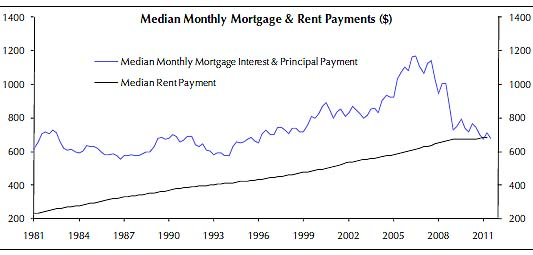
As Catherine Rampell says, this is a little bit misleading because down payments and maintenance costs have probably increased on par with rent, or perhaps even a bit more. Perhaps the mix of homes has changed a little, making medians less comparable.
But still. If you're investing for the long term, it's hard to see how buying a home wouldn't have a good return.
The fact that no one is buying suggests to me that we live in a fear-driven economy that is seriously detached from economic fundamentals. This is a bizarre, severely credit-constrained equilibrium or no equilibrium at all.
Update: Martin Feldstein has an interesting idea to keep home prices from falling further.
Ideology and Economics
The other day I posted about Art Pope and the New Yorker article that exposed his vested influence on NC state politics and our own economics department here at NCSU.
All this, a commenter, plus the general divisiveness of the times, has me thinking about how ideology affects economics, even when money isn't buying influence. Most of us shape our ideological views at a young age and events rarely change them much. That's probably as true for economists as it is for everyone else. And since so much of economics has implications for policy and politics, our ideological leanings can easily influence our views about how the economy works.
So how can we objectively analyze how our economic system works given our deeply imbued ideologies?
Short answer: We can't; but we can and ought to try very hard.
Long answer:
First, I think one needs to acknowledge that one has an ideology. I've long tried to eschew ideology, and in that vein lean heavily toward empiricism. But to pretend one is fully objective basically advertises the fact that one is not.
Second, one ought to consider carefully what one's ideological adversaries say and write.
Third, one ought to try to anticipate what one's ideological adversaries might say or write in response to our own analysis, and directly address those specific anticipated points in advance. Don't bury these issues with a slight of hand or a math trick--address them head on, and acknowledge when the other side has a point.
Fourth, one ought not take one's ideological adversaries' positions out of context or otherwise mis-characterize them (which means you must truly try understand them---the second point).
Fifth, one ought to consider the facts or evidence that would be necessary to convince you that your own position or analysis is wrong and that of your ideological adversaries is right. If you cannot imagine what that evidence might be then there is a good chance ideology is clouding your analysis and judgement.
Sixth, spend some time on research about which your ideology does not point toward any particular answer, and draw on this experience when researching more, er, sensitive topics.
And finally, a few links that inspired this post.
Ayn Rand's philosophy of "Objectivism" (Art Pope's worldview, I think)
Paul Krugman: "Everyone Has an Ideology"
Exchange between Paul Krugman and Russ Roberts: "I Am Not Your Mirror Image"
(It's important to follow the links in this last post.)
Wednesday, October 12, 2011
How to Feed the Planet Without Destorying It
I just heard this story on NPR's All Things Considered, which is ostensibly about this new article by Jonathan Foley and a hefty team of coauthors.
What they do is describe a five things we need to do to feed the world--which means roughly doubling global food production--without destroying it.
The five things are:
1. Stop cutting down forests to grow crops or establish grazing lands for livestock.
2. Increase productivity in places that currently have low productivity, particularly Africa and Eastern Europe.
3. Use water and fertilizer more efficiently
4. Reduce food waste
5. Eat less meat.
Their recommendations seem to make sense. But, as Tom Hertel said in the NPR story, these are not strategies that get implemented by design. World agriculture is an insanely big thing that uses about 40 percent of the world's land area. It's hard to talk about these big picture goals without talking about the mechanisms that get you there.
People do what they do today in large part because of (a) prices (b) tastes and preferences and (c) institutional constraints. We use water inefficiently because it, or the energy used to extract it from the ground, is insanely subsidized in many places. We eat meat and waste food in rich countries because, to us, food is incredibly cheap. Leaders of some relatively poorer countries waste food by holding large inventories (some of which spoils) to guard against food price spikes, which can provoke widespread hunger and insecurity. We use fertilizer inefficiently because there are few regulations that make farmers pay for the nutrient runoff that poisons the water. And getting the relatively rich to eat less meat might be difficult, as a taste for meat seems deeply ingrained in our psyches; if we can afford it we eat it.
It's good to have this paper to lay out the broad perspective. And their solutions, such as they are, reflect some reasonable goals. What's a lot less clear is how we achieve those goals given today's prices, tastes and institutional constraints.
Economists might recommend some regulatory strategies to curb deforestation and pollution from inefficient fertilizer applications. Higher food prices may encourage more efficiency. But higher prices probably means a lot more hungry people. If the point is to feed the world, we need to keep prices low.
Also, the politics involved with implementing the obviously beneficial policies--like pollution taxes--is daunting. And other problems, like reforming water rights and pricing so farmers have an incentive use more efficient irrigation techniques, face impossible legal challenges that vary widely from country to country and watershed to watershed. Increasing productivity in developing countries is as difficult as development policy itself.
Maybe the growing mountain of evidence that meat is unhealthy will encourage the rich to eat less of it. I'd like to think people would voluntarily eat less meat and thereby keep food affordable in less developed nations. But that seems like more wishful thinking than viable strategy.
These are tough challenges. At least more people are paying attention to them.
The End of Farm Subsidies?
There's been some talk from the Obama administration about ending farm subsidies.
Here's a story from a week ago at The Salt, NPR's food blog.
These subsidies have been tough to justify for a very long time now. Today's budget pressure (aka "The Pain Caucus" or "Austerity Now!") just might be able to break them. But don't hold your breath. These subsidies have been around since the Great Depression and while they've gently declined over time in importance, they've been tough to kill.
And the biggest subsidy of all is the implicit subsidy to grain farmers comes 50 cents/gallon given for corn-derived ethanol and the associated mandates. There's some talk of ending the subsidy, but not the mandate. And as long as the mandate is in place farmers will get their artificially high grain prices. It won't show up on the government books but it would remain just as distortionary.
I also hear the crop insurance subsidies will be expanded further, hence the reference to the "safety net" in the NPR article.
Friday, October 7, 2011

Subscribe to:
Posts (Atom)
Renewable energy not as costly as some think
The other day Marshall and Sol took on Bjorn Lomborg for ignoring the benefits of curbing greenhouse gas emissions. Indeed. But Bjorn, am...

-
A couple months ago the New York Times convened a conference " Food for Tomorrow: Farm Better. Eat Better. Feed the World ." ...
-
Some of the worst water quality problems result from nutrient leaching and runoff from agricultural lands. Nitrogen and phospho...
-
 Economists like to emphasize how people and businesses will adapt to climate change. On a geological scale the world is warming very...
