A transcript is below; video here. Hat tip to Ruben Lubowski and Climate Progress.
TRANSCRIPT:
I feel particularly honored to have been asked to deliver the first Stephen Schneider lecture. Steve was a friend and a colleague, and an inspiration, who spoke eloquently and convincingly about questions with which I have struggled for my entire career and which I am going to address today: What is a useful and proper role for scientists in the public arena? How can we best discriminate where the boundary lies between expert knowledge, and values or political opinion, and how can we properly honor that line? What can we expect in the way of reception for our interventions and how can we increase their efficacy?
At the same time, I feel a bit sheepish about this task, because I’m sure some of my recommendations will sound obvious and trite to you, like Polonius’ “to thine own self be true”, although hopefully not that trite. In addition, while I intend to keep war stories to a minimum, I am after all a practitioner of public involvement rather than an academic expert on it, so my own experience is most of what I have to offer and I hope that suffices. Finally, I’m sure I have violated some of the recommendations I am about to put forth many times, many times. Involvement in the public arena is complicated.
This talk is structured as follows: first, I raise three questions which might be asked by any of us who are skeptical about scientists becoming involved in the public arena. I hope my answers will convince you that such involvement is sensible and to some degree inevitable. Second, noting that such involvement doesn’t mean all of us aspire to become a Carl Sagan or a Jim Hansen, I’ll propose a couple of broad principles and five potential options for involvement, each quite distinct, along with some advice on how to navigate each. Third, I’ll strike four cautionary notes, emphasizing the difficulties you will encounter if you chose to “go public”. By way of wrapping up, I’ll channel some advice from Steve himself.
But let me begin by providing some scholarly context for understanding Steve’s philosophy of how scientists could, should, and actually do engage with the public. There is a substantial literature on these questions, going back to CP Snow and probably earlier, and more recently including the views of Naomi Oreskes, Sheila Jasanoff, and Roger Pielke, Jr. The dilemma highlighted by CP Snow provides both a convenient jumping off point for this lecture and also a useful way to understand why Steve Schneider’s views were so central to our current concerns. So let me remind you of Snow’s argument in his 1959 lecture The Two Cultures, which if you hadn’t heard before, you probably did hear about during last year’s 50th anniversary of the event, which generated a lot of discussion in the pages of this community’s publications.
Why dredge up CP Snow’s argument again? Partly because his statement of the science-society communications problem was so clear, but also because, in a broad sense, the key challenges for the human endeavor on which he believed science should focus, remain unresolved, have grown even more complex, and were also at the center of Steve Schneider’s professional career. Furthermore, and in hindsight, Snow’s proposed solutions to the communications problem were not sufficient to overcome the complexity of the communications terrain, and how to navigate this terrain is after all the main subject of this talk.
In The Two Cultures, Snow, a physicist and novelist, issued a diatribe against Britain’s educated elite of the 1950s which foreshadows with remarkable prescience today’s perceived crisis in the public’s supposed lack of understanding of science, and the potential consequences of this shortfall, particularly in debates over the environment. Peel away the class critique of The Two Cultures and a deep fear over the incapacity of people to comprehend, and of government to tackle, the key issues of global resources and global equity, is revealed, broadly the same debate we are in the midst of now and which so engaged Steve. This pessimism sits side by side with optimism about technological possibilities for fixing these problems, if only science were heeded and mobilized.
Snow identified the key problem but misjudged the solution by failing to anticipate the complexity of the current world. Snow based his analysis on a juxtaposition that no longer is valid: the culture of physics providing one model of influential thought, and high-brow culture providing the other. Today, the physics model for scientific progress, which I’ll caricature as neat laws describing everything imaginable, deduced by geniuses and verified or falsified by experiments, seems relevant to a smaller and smaller set of public issues. Gradually, the model is being replaced by the more complex and uncertain way of thought characteristic of problems in geosciences, biology and environment. In these arenas, fact and value are sometimes harder to separate; and so it is not coincidental that these fields generate many of today’s political conflicts as well. Furthermore, culture among the influential is no longer particularly high-brow, so generalist versus expert is probably a better description of the current dichotomy.
The quandary is this: How can a society of generalists govern itself when most of the issues of the day are highly technical? Many solutions to this conundrum have been proposed by scientists: one is Snow’s idea of merging the scientific and popular cultures through improved education; another is a public-policy technocracy dominated by scientific elites, in some ways, the French model. Of course, these proposals cover only half the existing spectrum of opinion. Some people of faith might argue that science’s role in people’s education and public decisions ought to be entirely secondary.
Specifically, Snow argued that the scientific revolution was the last phase of the industrial revolution, and he saw the industrial revolution as a mixed bag. It brought general improvement but wide disparities. Snow’s argument anticipated the rise of China, the shifting of the economic balance among nations, and the importance of the global implications of seemingly local problems, particularly the population problem. He imagined science, integrated into education and politics, as the font of all solutions. And he saw scientists as wiser, more reliably ethical, and more inclined to an optimistic and activist view of human possibilities, than are others.
What Snow could not have appreciated is the limitations of science in the face of the complexity of the problems he had highlighted, and the resulting existence of a contested zone where values, judgment, and science fight it out for controlling influence over policy decisions. He also seemed blind to the limited ability of scientists to explain their own work so that their role in public education was in fact problematic to implement. Some scientists are fearful of treading into the contested terrain at all, while others do so but experience great difficulty in distinguishing its boundaries, and separating expert knowledge from value-laden, subjective judgments.
These fears and difficulties should not be surprising: many scientists loathe ambiguity as a permanent state because it is their job, our job to resolve it. Inability to do so is seen by us as either failure, or that we are dealing with substance that is beyond our expertise. Scientists like to deal with problems by draining them of values and ambiguity, and isolating “the facts”, and I think this accounts for the limitations of Snow’s vision. Politics and policy must inevitably reinsert the latter complexities. Scientists are in their hearts control freaks, but control is simply not possible to exert over such problems.
The human complexity of dealing with these issues, which Snow overlooked, was Steve Schneider’s favorite playground. In other words, Steve was a CP Snow for the post-modern era.
I’ll return to Steve’s views at the end of my talk, after outlining the conundrum that scientists face in considering involvement in the public arena: first, by addressing why participation in the public arena can’t be easily avoided; next by suggesting some ideas, based on my own experiences, which may help you formulate your own guidelines so that you can better calibrate your own participation.
Involvement in the public debate over public policy is a common and accepted role for scientists in many disciplines. In the sciences related to public health, it’s taken for granted that experts will talk loudly in public about the implications of their research for public policy, whether in regard to smoking, or diet, or HIV. There is also a remarkable track record of geoscientists taking a lead role in the public arena, and actually affecting public policy, in directions that many of us are grateful for.
Sherry Rowland’s public role on ozone depletion stands out, as do the contributions of Jim Hansen, Steve Schneider, and Bob Watson on climate. In other arenas, one can point to Hans Bethe and Henry Kendall at one end of the belief spectrum, or Edward Teller at the other. Some of these people mostly translated science for the wider public, others endorsed specific policy initiatives. I agree with the views of many of these scientists, and strongly disagree with others. One cannot prove that the world followed a better, or even a different course, due to their interventions. But I think the quality of public discourse and the information reaching policy makers was better for their interventions, taken as a whole.
Despite such examples, Jim Hansen has asserted that by and large, members of our community are reticent, hesitant to speak out about the implications of their research, and when they do, they take a cautious approach. By and large, he’s probably right, and I too would like to see my colleagues have more to say because I think they (you) have a lot to offer. But it’s not easy to do so in a satisfying way; the messages are easily misunderstood; our interventions are sometimes unhinged from our expertise in a way that is not helpful to the listener (after all, reticence is sometimes the right choice). Also, it’s not clear when, who or if, anyone is listening.
Finally, I assume that this audience holds a spectrum of views on the particulars of any scientific problem, which, like global warming, is characterized by large uncertainty, and I invite those in the audience who might have disagreements with me, to pay attention anyway, because you may well chose to engage in the public arena, and if so, you will face the same problems as I do.
Still, a scientist who doubts the necessity of such involvement might ask the following questions:
Question 1: Public involvement takes time. Can’t I stay in my office or lab while policy-makers and the public wrestle over what to do about the various technological problems we face?
Alas, I’m afraid this is increasingly difficult to do and if followed by the community as a whole, would be highly irresponsible. Science is not wholly owned by governments but it does draw a large fraction of its support from governments. I’ll return to the question of individual ethical obligation a bit later. For now, let me just say that this financial support means that science as an enterprise, if not individual scientists, owes something in return: the least we can do is be available to interpret our research findings, and if possible, explain their implications for society. But there is also a pragmatic reason to get involved: If we do not, we leave Congress, for example with the option of seeking explanations from those less competent to offer these up. Alternatively, we can be proactive about it and define the meaning and significance of our own work, rather than letting others do it for us.
Perhaps, if policy were linearly related to science, abstinence would be a plausible approach.
Question 2: Can’t we just make clean, scientific statements in English, and leave it at that?
Even if we could make clear and direct explanations of our work absent ambiguity yet honoring all our beloved caveats, interaction with the public is a dialogue, not a monologue. Even the “cleanest” statements demand elaboration once the inevitable follow-up questions begin to role in.
Let me provide an example in the form of a famous statement in the IPCC’s Fourth Assessment report, a statement renowned and highlighted in the report for its clarity and simplicity: “Warming of the climate system is unequivocal”.
What precisely about warming is unequivocal: that it has been occurring? That it will occur in the future? That the entire problem we call “global warming” is unequivocal in all aspects?
These are all questions that a reasonably intelligent person could raise when reading such a statement unless they also absorbed the minutiae of explanations and modifications which accompanied it in the report. In fact, the UN climate negotiators recently tripped on this very issue when they wrongly asserted that the statement meant that not only the fact that earth had warmed, but the attribution of this warming to human activity were both unequivocal.
We cannot simply drop our pearls of wisdom and expect others to deconstruct them. That much is our job.
Every time we emphasize or de-emphasize a point, assign likelihood to an outcome or refrain from doing so, we are exercising expert judgment about what is important and what is not. Similarly, every time we say an outcome “may” happen rather than it “may not”, or that it’s opposite may or may not occur, we are making such judgments. And those judgments are partly subjective because in many cases a different expert might justifiably have a different view and express it differently. Uncertainty goes hand-in-hand with subjective judgments, and with the necessity of making them.
For an entertaining example of this point, I urge all of you to see the movie “Fair Game”, and listen closely to the scene where former vice presidential aide Scooter Libby explains to a CIA analyst why words like “maybe” and “maybe not” matter in expressing expert judgment.
Question 3: OK, I’ll acknowledge that someone has to do the dirty work, but I’m not so good at communication. So I’d prefer to let everyone else take this on.
Wrong again. Ask some of our colleagues who never tried to be public figures or never said anything even mildly controversial but who nevertheless became collateral damage in so-called Climategate, the CRU email episode, just because they were recipients of mostly anodyne emails, sent by others.
To be blunt, science and scientists are now part of an unavoidable and contentious public discussion. This is no longer 1983 when the National Academy of Sciences could issue a monumental report on climate change and have it go virtually unnoticed. Climate and related issues are characterized by very high socioeconomic stakes: that’s the main reason why so much research money (relatively) is spent on them and why they generate so much public controversy. That’s life as it is and as it will be, for the foreseeable future. We as a community and as individuals can either try to frame that discussion, and be prepared for involvement, or let others who are less interested in scientific truths set the terms of the public discussion.
I am encouraged that institutions like AGU are eager to do more to defend and explain science, and are puzzling over and experimenting with approaches for doing so. But it’s not the institutions per se that carry the weight. In the end, it’s up to the individuals who constitute them, YOU.
Question 4: Am I obliged to get involved?
As I noted already, I am sure that the community as a whole has an obligation to society to be informative about the meaning and implications of its research findings, assuming society wants to hear such information. I am confident in this view because I understand that the public, through the taxes it pays, supports a large portion of our research, including for many, our salaries. Surely, there is some obligation in return that goes beyond merely working away in our offices or laboratories. I feel strongly that the obligation on the community as a whole is implicit.
But what about our individual obligations? Any involvement means lost research time. There is a credible argument that the world is better off with most of us just doing research and foregoing involvement. Still, we can’t all be free-riders or our community would have fallen down on its overall obligation. For me, it’s enough that people, through their leaders, through the media, and through individual requests, want the information. I am happy to provide it. And if they want my judgment about what to do about these problems, then I will provide that too, and try to be clear about which is which. In the end, each of you needs to decide for him/herself.
But there are two related and less contentious aspects of this obligation at which our community is failing miserably. First, we do little if anything to advise young scientists on the social and ethical context of the world into which they are about to enter: what are the implications of their research for other human beings, what constitutes honest representation of their research beyond the rules of professional review and publication, how might others use their research and how should they think about this transaction? NSF now requires instruction in research ethics, but that only scratches the surface. Are there any major research universities that require graduate students in our fields to take courses which would give them a complete framework for thinking about the obligations I have discussed, or the public context in which their scientific views will be received, interpreted, and utilized?
Our second failure is the inadequacy of the response to threats to individuals in our community. Our professional societies respond vigorously to threat to the community as a whole, as when the federal research budget is reduced. But they have had great difficulty figuring out how to address such attacks on individuals, or whether they have a role to play at all. But this is sort of the inverse of the free-rider problem: the individual lamb can be sliced off from the group and devoured and the group can ignore it but eventually, the whole heard is cut to shreds. AGU, NAS, AAAS, and the rest of our professional organizations need to learn how to differentiate reasonable complaints which call for a due process approach that can strengthen our enterprise, like the establishment of the committee to review IPCC by the Inter Academy Council, from unreasonable, unfair, and abusive attacks, which if met with silence, threaten to undermine the independence of science.
I hope I have convinced you that participation in the public arena is both desirable and to some degree unavoidable. If so, what are your options for involvement? And what are sensible guidelines for behavior in this arena? Let me provide some suggestions, based on my own experiences. The taste for, aptitude for, and utility of involvement in the public arena varies widely from scientist to scientist. So let’s consider a wide range of options:
Option 1: You can very publicly take sides, for instance in an election, based specifically on what you see as the policy implications of your research.
This is one end of the spectrum, and many of us individually have publicly and loudly supported candidates, including Presidential candidates. In a less-noticed way, many scientists sign onto collective campaign endorsements. It is argued by some that there is a price to pay for such activity, but the only one I’ve seen is that it is likely to rule you out for a political appointment if your candidate loses. But if getting such a job is not your objective, then why worry? But clearly, this end of the spectrum is not to everyone’s taste.
Concern also comes from an entirely different direction: that visible participation by scientists qua scientist in the political process dilutes the credibility and independence of science. I don’t know if we have proof on the latter point either way, but I merely note that scientists have long taken partisan positions as individuals, and I know of no evidence that it has done any damage to our collective reputation. An analog in a different arena is provided by Eisenhower’s running for President which some argued would be problematic for the image of the military. Was it? Closer to home, was former Senator and Senate Majority Leader Bill Frist’s emphasizing his credentials as a doctor problematic? In both cases, I think not. What was problematic for Frist was when he departed from his sound expert judgment as a doctor and began to make implausible pronouncements which he backed by his credentials, i.e., his TV diagnosis of Terry Schiavo.
My ground-rule here is clear: if you are going to use scientific arguments as a rationale for taking partisan positions, make sure you aren’t simple using your science as a cover for what are really political, not scientific judgments. In other words, make sure you feel comfortable in your scientific skin.
Option 2: You can take sides publicly on the policy implications of your research, including actively lobbying for particular policy proposals (by visiting representatives in Washington, writing letters to the editor, posting blogs, etc., or just answering questions from the media).
Again, there is no reason not to participate in this way. Scientists do it all the time. The least controversial example in our community occurs when scientists testify on Capitol Hill in favor of additional research funding. This is surely a political act based on scientific, as well as other, judgments and motivations. More controversial interventions, but also with a long pedigree, occur when scientists back particular initiatives related to their scientific findings, for example cap-and-trade, or carbon tax, or fuel-economy standards. In my lifetime, it’s been done by Edward Teller or Henry Kendall on nuclear arms control, or various biologists on stem cell research, or Paul Ehrlich on family planning, or Gene Likens on acid rain, or dozens of the people in this room on climate change. The public discourse is richer for these interventions, not poorer.
But I also argue for caution here. My ground-rule (and most decidedly Steve’s) is this: the further from your expertise you wander in making judgments about policy, the shakier ground you are on, and the more humility and caution is called for. It’s one thing to argue that within scientific uncertainty, warming of a given amount would cause a particular level of damage. But it’s a value judgment, not a scientific one, to argue that emissions reductions which could avoid the damage are necessary. And it is far outside the expertise of most people in this room to assert that one or another type of policy initiative is appropriate for getting there.
I do not argue that one should avoid such value-judgments, but like Steve, I think it’s important to be clear in your own mind, and to the public, which sort of judgment you are making. We are all entitled to our value judgments, our personal risk assessments, and they should be a key factor in public policy. But we are not entitled to make value judgments or political or policy judgments in areas where we are not experts, like politics or economics, and try to pass them off as following automatically from our scientific expertise.
I would like to be able to say that we should stop speaking as experts when we venture into terrain where we feel uncomfortable as experts. But for some reason, this approach has not worked very well. Some of our colleagues seem unaware of where their expertise ends, and they haven’t been willing to do the hard homework necessary to extend their expertise enough to justify their positions.
There is one measure of expertise which, though conservative, is a good guideline: have you published in the field: I am trained in atmospheric chemistry but have taught myself and have published peer reviewed papers on glaciology, so I feel that I can speak to reporters as an expert on the role of ice sheets in sea level rise. But this wasn’t always the case: Fifteen years ago, I became concerned about the fate of the ice sheets. I wasn’t an expert on this subject, so I generally avoided commenting on whether the ice sheets were stable or not. After all, if you are a heart specialist, and someone asks your view on his kidney problem, should you answer the question, or tell them to consult a kidney specialist? The media can be lazy about doing due diligence in selecting whom to ask, but we shouldn’t be lazy in deciding whether to answer.
So, I did my homework, spending an entire year reading everything I could get my hands on about Antarctica and Greenland, going back to the literature from IGY right up to the present, and eventually publishing a review paper on the subject. I I felt qualified to make some judgments, publicly. But reporters are often rushed, and a scientist’s ego sometimes forecloses the option of handing off a media opportunity to a colleague.
Still, just because you’ve published in the peer review literature doesn’t mean you have a license to say whatever comes to mind on a subject, even about its scientific aspects. If you know your view on a scientific point is anomalous or incomplete, say so. Half-truths and statements out of context are sometimes the worst form of public deception. Being asked to venture expert opinions is intoxicating, but you need to keep your head while doing it. If someone sticks a microphone in front of you, it’s awfully hard to keep quiet, but sometimes that’s the right thing to do.
There’s another way to handle the issue of boundaries. If you know you’re passing the limits of your core expertise, and you still feel compelled to venture an opinion, perhaps in order to paint a complete picture, then rely on what IPCC has said, or what an NRC panel has said in addressing the issue. This problem always arises: for example, when experts in the physical climate try to add perspective by mentioning impacts or when impacts experts are tempted to discuss the comparative benefits of emissions abatement and adaptation. You needn’t keep mum, or give such a pinched answer that it’s useless to others. Instead, you can seek at least a modicum of comfort by relying on the “scripts” which assessments by these organizations have produced for our community. Even if it differs from your personal view, at least these assessments have a logic and a pedigree behind them.
Likewise, we are not entitled to assert or imply special status to our value judgments because they relate indirectly to areas of our expertise. If a doctor expressed a view on whether people subject to capital punishment via death by injection felt pain and suffered, we would tend to cede this terrain as within their expertise. But surely none of us would hesitate to express a value judgment about capital punishment in front of a doctor due to the doctor’s holding such expertise, nor would we necessarily honor the doctor’s judgment on whether capital punishment is ever justified. Likewise, we should not hesitate to express value judgments about matters bordering on our expertise, but neither should we expect others to accept our judgments as having any higher value than theirs. And we should not pretend our values are a necessary outcome of our expert understanding. Often, they are not.
Options 1 and 2 clearly involve advocacy, but you can eschew advocacy, and still participate usefully. You can do as IPCC does, and avoid forwarding particular policy positions. Indeed consider these options:
Option 3: You can simple talk to reporters, for instance offering useful insights into what is the state of the science, and what are its implications (as far as you know them).
But be aware of the point I made earlier: emphasis embodies subtle judgment, and there is a wide range of opinion about climate change once we get down into the details. As more of us speak in public, there will be more public disagreements on some issues. For example, some of you believe that collapse of the MOC, if the world undergoes a moderate warming, is a serious risk, while others don’t.
Some of you think the case for ice sheet instability is strong, others do not. IPCC has expressed views on this: some of us accept the IPCC view in general but not on particular details. While I am deeply committed to the IPCC process, I certainly disagree on some important judgments, not just the way they were communicated but on the substance, with regard to sea level rise for example. Regardless of the claims of some of our colleagues, IPCC is not a monolith and dominant views in our community are not enforced on others. What is frowned upon is not a divergent view, but the refusal to accept evidence-based arguments, the dishonest search for a back door when the front is block by overwhelming proof.
So be prepared for public disagreement, and welcome it. But also be prepared to call out the misuse of science or of stonewalling in the face of evidence.
And there is a price to pay in speaking with the media, even just to venture scientific judgments. You will receive some nasty emails (as I’ll discuss later), or worse. You will, to some extent, lose control of your time. Once you decide you are willing to speak with the media and your name appears in public, you will be called on more and more. At some point, everyone needs to draw some boundaries in order to get their day job done. But the media are fickle, and there will be times when you have something pertinent to say and no one will ask you. You need to be psychologically ready for that, too.
There are other complexities. Steve made a career of explaining how wrong the media can get the story, even when you say it clearly. But the flip side is also true: few of us know how to deliver a scientific statement correctly but in language that the average consumer of information can understand. Usually, it can be done, but not always. If in doubt, I would choose correct over clear. But having to make such a choice never feels good.
And if you are called out of the blue by the media, think things through before you answer. There is absolutely no reason to believe that your first thought is your best thought. The smartest answer I ever gave a reporter was “I’ll call you back”.
Option 4: You can participate in IPCC, AGU, AAAS, or other outreach activities.
There is safety in numbers, and also the opportunity to step back and facilitate direct interventions by others. This is a critical task for the community as a whole, the avenues are expanding, and if you feel more comfortable participating in this way, then that’s the route you should take.
Of course, there’s always
Option 5: One can choose not to comment on the science except to an academic audience, refuse to sit on an expert panel where your judgments can be widely disseminated, avoid talking to anyone else about controversial issues or even refuse to comment on an applied aspect of your research.
Alas, even then you are not “safe”. As the CRU email episode shows, these days to be immune from being dragged into the public arena, one has to avoid research in any area which might conceivable have an application in the real world, and unplug entirely to boot!
No matter which of the first four routes you choose, it’s important to maintain perspective because participation isn’t always very rewarding, often doesn’t produce a tangible product, and doesn’t automatically translate into effectiveness.
All that science and scientists can demand in our society is to set the stage for dealing (or not) with a problem. After that, we have a citizen’s right to express an opinion and some other citizens may think our opinions have special value due to our presumed understanding of the interface between science and policy. But other expertise, value judgments, and politics dominate the rest of the policy evaluation and action spectrum, so while we have a right to be annoyed and outraged if the science itself is distorted or lied about, we have no particular right as scientists to throw a temper tantrum if the policy outcome isn’t what we wanted it to be.
Furthermore, while the general public holds scientists in relatively high regard (not much competition), many are wary on the details. Amid the welter of a bad economy, unemployment, college tuition, illness, divorce, and who knows what else, along comes an “expert” telling you, “I have a magic black box, and out pops the answer and it says “if you don’t do X,Y, or Z, it’s the end of the world”. The automatic reaction is to disbelieve and rankle at such expert “command authority”. When a car mechanic or widget maker or doctor offers us a judgment, we demand explanations: why should scientists seek a special immunity due to their expertise? We are not a priesthood; we are fallible. We are just a contributor, albeit an important one, to a larger public discussion.
Based on these general points, here are some specific suggestions for using your time efficiently and effectively, while keeping your expectations aligned with potential outcomes:
1. Think about your audience in advance and be ready for people not to listen to, or not to hear your message.
Different audiences are receptive to different aspects of what you want to say, so always know whom you are speaking with and what your objective is. In particular, scientific arguments won’t always work, even one-on-one: receptiveness to expertise is selective, preconditioned by the listener’s views on a constellation of subjects.
Not surprisingly, recent research in social psychology, political science, and public opinion (and I note in particular the work of Skip Lupia of Michigan, Jon Krosnick of Stanford, and Tony Leiserowitz of Yale) indicates that the average citizen has limited interest or time for delving into technical subjects, whether health care reform, or nuclear arms control agreements, or global warming. Rather, they often look to the views of surrogate experts or opinion leaders who presumably have enough resources to evaluate and assess the relevant information, and make an informed judgment. But there are lots of potential surrogates on an issue like climate change, and people will often pick the one who aligns generally with their world view. Al Gore provides a noteworthy example. He did his homework and he had access to a big megaphone, so many peoples’ views on global warming were influenced by his, particularly those to the “progressive” side of the political center. But if he moved the meter with people on the right, it may have overall reinforced their skepticism, because they were attuned to other surrogates. Various biases of this sort operate from both ends of the spectrum and shape the uptake of technical information.
In other words, with many people, science is part of a world-view woven from many components. Discordant threads aren’t easily accommodated: often they are simply removed.
But the situation is not hopeless by any means. I’m a so-called progressive, but I have convinced more than a handful of very accomplished, smart, conservative and wealthy individuals to accept the scientific consensus on climate change. I did this by sticking to the science, and not giving them political or moral lectures. In fact, many of their political and moral principles are 180 degrees opposite mine, but they happened to be interested in the environment or conservation. Particularly if you feel you are on a moral crusade, you may feel such people are not your target audience and that’s fine. But if they are, you might consider putting aside the moral principles while you serve up the science. It is sometimes possible to accept the latter without agreeing on the former. We don’t all share the same values, and it might be more difficult to shift a person on both facts and values at once.
One of our problems today is that people only chat about subjects like this with people they already expect to believe them. Very possibly, you will make the biggest difference by speaking with others whom you know have a fundamentally different world view. If you disagree with the Wall Street Journal editorial representation of science, then take the opportunity when you’re in the same space as someone who probably reads those editorials to engage them, even if you think their general political values are vastly different. Make them doubt their view of the science; don’t hide yours. In other words, cocktail parties can be more important places for education than universities.
2. No matter how non-partisan and “scientific” is your intervention, expect to be vilified; but never return the favor.
Here are some excerpts from emails I received after recent TV or radio interviews; they are not the worst I’ve heard: for example, some of our colleagues have been recipients of direct threats, which I have not. But I hope these do help to inoculate you, should you decide to venture out into public:
“First of all I must say that you look like Bozo the Clown”, followed by vulgar references to my moustache.
“I suppose most of us can’t expect much from (VULGAR REFERENCE TO MY INFERRED ETHNIC BACKGROUND), like you. Except that you are so (EXPLECTIVE) ugly.”
Or the one with a subject line “Commie Maggot”:
“Commie Maggot ….. DIE SLOW, DIE HARD.”
Among the other risks you will encounter for “going public” is that you will be accused of misconduct and even subject to legal inquiry. Since Michael Mann, a victim of such attacks, is speaking tomorrow, I’ll leave this subject largely to him. But I want to note, as I alluded to before, that keeping your head low is no longer a guarantee of safety. For example, many of you know that earlier this year, Senator James Inhofe, acting as minority leader of the Senate Committee on Environmental and Public Works, published a list of 17 scientists who were “key players” in the “CRU controversy” and who “violated fundamental ethical principles governing taxpayer-funded research and, in some cases, may have violated federal laws”, then warning that “The next phase of the Minority’s investigation will explore whether any such violations occurred”.
The apparent criteria for winning a spot on the list are that you have been involved in IPCC and also received one of the thousands of stolen CRU emails (even if you never responded to any of them)! The list includes several scientists who are not known for making public pronouncements, and others who are beyond reproach, like our colleague Susan Solomon.
So there’s no use being intimidated and hiding rather than speaking your expert mind if you really want to do so. Ultimately, so-called “good behavior” may reduce your exposure, but won’t completely remove your vulnerability to the hazard.
3. Don’t hide your biases; think them over in advance and lay them out.
We all have them, explicit and implicit. I worked for an advocacy organization, EDF, for 21 years and I am still consulted for scientific advice by its staff. This relationship, like other consulting, brings along the possibility of conflict of interest when I make my judgments and express my views on certain subjects. I try hard to separate my judgments about policy matters from this relationship and I think I succeed. But I owe the listener the information so they can weigh its importance. Accordingly, the relationship is mentioned prominently on my CV, my bios, my web page. I urge all of you to be transparent about the existence of such relationships in your own professional lives.
But there are other biases, subjective ones, harder to identify and articulate. I discussed these a few minutes ago. There is no good answer to how to deal with these, except to be aware of the difference between facts and value judgments, to try to listening to yourself when you speak, and hear yourself as someone with a differing world view might hear you.
Years ago, I asked one colleague why he thought climate sensitivity was almost certainly closer to 1.5 degrees Celsius than three or four or five, as the NAS then had it. Rather than giving me physical evidence, he said he just didn’t believe that humans could affect the climate that strongly. That’s fine, but it’s a belief that should be stated at the outset, not hidden in the weeds.
4. Keep it civil; don’t let differences ruin collegiality
I’ve goofed a few times in my public utterances, and I try to learn from each mistake. After having briefed a high White House official in an administration long ago on the subject of ozone depletion, I described him to a reporter as “semi-ignorant” because he had made a naïve comment to me belittling the importance of the issue. When my remark was published in a major newspaper, an opportunity to further educate an influential leader had been lost to me, and I regret it to this day.
I once got into a figurative food fight on TV with a colleague, attacking each other rather than each other’s scientific assertions. You could hear the remote controls all over TV-land going click as viewers moved to another channel, and another educational opportunity was lost.
Science should be on the record; but ad hominem attacks are counterproductive and almost always out of order.
The worst outcome would be to sacrifice our norms due to the pressure; pressure not just from our enemies to keep quiet, but from our friends who are eager to solve the climate problem. Our norms are ours. They may evolve over time to accommodate the modern context, but their essence should be stable, and we should not sacrifice them for short term gain.
Over the next couple of years, each of us as individuals may need the collective “us” as a community more than ever. There may be more attacks, there may be more mistakes. But the worst outcome would be if we let these divide us as individuals, and at the same time, separate us from the very special norms and values which, as scientist, we all share.
Finally, let me close with some of Steve’s words, provided indirectly. I asked his wife and colleague, Terry Root, what Steve would have advised if he were giving this speech. This is what she told me, and if you slept through the past 45 minutes, this is really all you need to remember anyway:
1. The truth is bad enough
2. Integrity should never be compromised
3. Don’t be afraid to use metaphors
4. Distinguish when speaking about your values (as a member of the human race) and when speaking as scientist
5. Don’t let fear (of deniers) keep you from working on the most important problems facing society
Let me end with the way Steve ended many of his emails after relating one of his own experiences with the public arena and policy makers, a combination of exasperation and hope:
“!@#$%”…oh well”
….Stephen Schneider, often
Wednesday, December 22, 2010


Sunday, December 19, 2010
NGDP targeting with a futures market
Scott Sumner has been advocating nominal GDP targeting by the Fed for some time now. He's recently added more meat to that idea by tying the target to a Fed-backed futures market.
This is a slight twist on inflation targeting, which seems theoretically sound but requires a credible commitment by the Fed to keep monetary policy loose well after the economy recovers. That could be a tough commitment to make, especially with Ron Paul as the new overseer.
I don't know that I fully understand Scott's idea, but I think it basically takes care of the commitment problem by creating huge arbitrage opportunities to the market if a target NGDP isn't reach. Which basically means we'll either get the inflation or we'll get the growth, and probably a little of each, since it is very hard for me to see how we won't get a lot of real aggregate demand growth with a bit more inflation. This is because, with a bit of inflation, nominal debt burdens will decline, asset values will increase (re, houses) and people will be able to spend more, in real terms. If we reach the target in real terms, well that's obviously good news too.
In other words, good bye business cycle.
On the surface, it seems like a compelling idea. It seems like there should be a gaping hole in this somewhere. But I can't figure out what it is.
The Fed would still have a management job of gradually adjusting target NGDP according to growth in economic potential. But that seems like a pretty easy thing to do and the policy would be fully transparent.
A few links:
Sumner
Brad Delong [1, 2]
Bill Woolsey
Arnold Kling
Kling's skepticism doesn't strike me as compelling. Some of the other commentary looks very intelligent, but I have to think a lot more to understand them, and I don't have time for that right now %-)
Somehow I think this idea is going to bubble around for a while. It makes some sense and has the air of a nice ideological compromise. (Unlike the not-so-nice, hold-your-breath Money for Everyone! compromise that Obama just signed.) It would provide necessary stimulus, which appeals to liberals, but fairly modest and nearly automated government management of the money supply.
This is a slight twist on inflation targeting, which seems theoretically sound but requires a credible commitment by the Fed to keep monetary policy loose well after the economy recovers. That could be a tough commitment to make, especially with Ron Paul as the new overseer.
I don't know that I fully understand Scott's idea, but I think it basically takes care of the commitment problem by creating huge arbitrage opportunities to the market if a target NGDP isn't reach. Which basically means we'll either get the inflation or we'll get the growth, and probably a little of each, since it is very hard for me to see how we won't get a lot of real aggregate demand growth with a bit more inflation. This is because, with a bit of inflation, nominal debt burdens will decline, asset values will increase (re, houses) and people will be able to spend more, in real terms. If we reach the target in real terms, well that's obviously good news too.
In other words, good bye business cycle.
On the surface, it seems like a compelling idea. It seems like there should be a gaping hole in this somewhere. But I can't figure out what it is.
The Fed would still have a management job of gradually adjusting target NGDP according to growth in economic potential. But that seems like a pretty easy thing to do and the policy would be fully transparent.
A few links:
Sumner
Brad Delong [1, 2]
Bill Woolsey
Arnold Kling
Kling's skepticism doesn't strike me as compelling. Some of the other commentary looks very intelligent, but I have to think a lot more to understand them, and I don't have time for that right now %-)
Somehow I think this idea is going to bubble around for a while. It makes some sense and has the air of a nice ideological compromise. (Unlike the not-so-nice, hold-your-breath Money for Everyone! compromise that Obama just signed.) It would provide necessary stimulus, which appeals to liberals, but fairly modest and nearly automated government management of the money supply.
Thursday, December 16, 2010
Science Confronts Politics
 I haven't read the book Merchants of Doubt by Naomi Oreskes and Erik Conway, although this is something I've been meaning to do and intend to do very soon. The book concerns the remarkable influence of a few very well organized scientists, backed by some powerful and deep-pocketed special interests, dedicated to sowing doubt in the public's mind about the reality of human induced climate change, that smoking causes cancer, and many other issues. Way back I posted a talk by Oreskes with a similar theme. Below is a very long but very good video of a lecture she gave more recently at the University of Rhode Island. Don't miss the question and answer at the end.
The issue here is one that is larger than climate change itself. It concerns the relationship between scientists and the general public, how people come to trust (or not) what scientists have to say, what "truth" is, and especially the role of media in communicating often disparate scientific findings to the general public.
The overarching challenge is that scientific findings can have powerful political consequences. When this happens, scientific findings, no matter how persuasive, accepted, and settled within a scientific community, are going to receive significant push back from political interests, some perhaps even donning impressive scientific titles, as Oreskes has carefully documented.
Most scientists, however, are typically poor politicians and often poor communicators. They simply don't see it as their job to wade into lengthy political battles. Biology professors don't want to spend all their time explaining the theory and evidence of evolution on Fox News and being grilled and panned by Bill O'Reilly. Perhaps they feel this is below them; more pointedly they likely view political debates as distractions from their serious work of finding better answers to real scientific questions.
The one thing the climate wars (and others) of the last 30 years have illustrated is that scientists cannot resign themselves to political apathy. If they do, it is science itself, and broad progress of humankind that science has fostered, that will be the ultimate victim.
The last time I posted a talk by Oreskes I wrote:
Scientists may be tempted by the relentless goading of the denialists to get into to the media game but they really shouldn't. The scientific community does not play this game well. But the truth, whatever it is, gets out eventually. It's important for scientists not to muck up that processes by stooping to denialist tactics.My earlier view was naive. While scholars should not attempt to mislead or misinform or push narrow ideological agendas, they do need to actively engage in spreading their research findings and implications to the broader public. They do need to engage with media with and eye toward clear, transparent and positive communication. They need to anticipate and take into account that political interests will often be aligned against them, and be prepared to cope with those attacks. They cannot simply sit back and wait for the real information to get out there one way or another. They need to present the evidence themselves in the clearest and most transparent ways possible, and to broad audiences way beyond the journals. We need biology professors with excellent communication and debating skills talking with Bill O'Reilly on Fox News about the theory of evolution.
Because, at the end of the day, everything is political.
Wednesday, December 8, 2010
QE2, The Tax Cut Deal, Interst Rates and Bond Vigilantes
So, after Obama announced his tax cut deal with Republicans, bond prices fell and interest rates spiked.
Does this spike reflect bad expectations of impending inflation and crowding out by US debt? Or does it reflect expectations of greater growth in response to tax cut stimulus?
The news headlines are all over the place. To my eyes, they are also inconsistent with each other. For example, on the first page of Google News we have the following headlines:
This is easy to sort out if one looks what simultaneously happened to the dollar, stock prices, gold, silver and possibly oil. The dollar and stock prices went up; gold and silver went down. That's a tell tale sign that the news contained in the tax cut deal was greater stimulus-induced growth, not impending doom.
If the bond vigilantes were attacking, we'd see the dollar crash and precious metals spike at the same time interest rates spiked. I'd be surprised if that happened.
I rather expect there is a little too much optimism and that rates will fall again soon.
Update For commodity prices, expectations of greater US growth can be a mixed bag. On the one hand, this increases the value of the dollar, which tends to reduce commodity prices; on the other hand, greater demand growth means higher commodity prices. I think these have been the two essential factors driving commodity prices.
So, in looking for evidence of bond vigilantes, I think it's best to look at whether interest rates are varying positively or negatively with the dollar.
Does this spike reflect bad expectations of impending inflation and crowding out by US debt? Or does it reflect expectations of greater growth in response to tax cut stimulus?
The news headlines are all over the place. To my eyes, they are also inconsistent with each other. For example, on the first page of Google News we have the following headlines:
TREASURIES-Prices fall for second day on deficit fears
US STOCKS-Financials, semiconductors help Wall St advance
Oil Down as Supplies of Gasoline, Other Fuels Grow
and the clincher:Gold, Silver Tumble as Dollar Gains, Curbing Demand for Alternative Assets
This is easy to sort out if one looks what simultaneously happened to the dollar, stock prices, gold, silver and possibly oil. The dollar and stock prices went up; gold and silver went down. That's a tell tale sign that the news contained in the tax cut deal was greater stimulus-induced growth, not impending doom.
If the bond vigilantes were attacking, we'd see the dollar crash and precious metals spike at the same time interest rates spiked. I'd be surprised if that happened.
I rather expect there is a little too much optimism and that rates will fall again soon.
Update For commodity prices, expectations of greater US growth can be a mixed bag. On the one hand, this increases the value of the dollar, which tends to reduce commodity prices; on the other hand, greater demand growth means higher commodity prices. I think these have been the two essential factors driving commodity prices.
So, in looking for evidence of bond vigilantes, I think it's best to look at whether interest rates are varying positively or negatively with the dollar.
Tuesday, November 30, 2010
Bipartisan drive to end ethanol subsidies
I try to refrain from getting too normative on this blog. And when I do, I try to point out alternative viewpoints. But there are times when there just doesn't seem to be two sides to the story. Which brings me to ethanol subsidies and mandates, which seem like a really bad idea on almost all fronts.
It's nice to see my views have some bipartisan support.
I can see arguments in favor of subsidies for research and development for biofuels. But since long-run prospects presently seem limited, I gather these subsidies should be modest relative to, say, subsidies for R&D on battery technology and renewable energy sources such as solar, wind, and ocean currents.
I can see how ethanol probably does make some sense as an un-subsidized gasoline additive. Even without further subsidies, I suspect ethanol would be significant fuel for awhile, albeit larger than it would have been had ethanol never been subsidized.
But I cannot see any good reason for the policy currently in place. Not unless oblique and inefficient transfers of wealth from taxpayers to relatively rich corn farmers, ADM, and Monsanto can be considered a pubic good.
It's nice to see my views have some bipartisan support.
I can see arguments in favor of subsidies for research and development for biofuels. But since long-run prospects presently seem limited, I gather these subsidies should be modest relative to, say, subsidies for R&D on battery technology and renewable energy sources such as solar, wind, and ocean currents.
I can see how ethanol probably does make some sense as an un-subsidized gasoline additive. Even without further subsidies, I suspect ethanol would be significant fuel for awhile, albeit larger than it would have been had ethanol never been subsidized.
But I cannot see any good reason for the policy currently in place. Not unless oblique and inefficient transfers of wealth from taxpayers to relatively rich corn farmers, ADM, and Monsanto can be considered a pubic good.
Sunday, November 28, 2010
Where are the $100 bills?
The basic story of depression economics is that mass unemployment, especially when combined with disinflation, is a symptom of disequilibrium.
In technical terms, it is said that an excess demand for money or safe assets is necessarily counterbalanced via Walras Law by excess supply of labor and production capacity, which we see in the forms of excess unemployment and recession.
In lay terms, this kind of disequilibrium means there is a lot of money lying on the ground--profit opportunities that are simply not being exploited. So, all we need to do to revive the economy is pick up those $100 bills.
Sounds easy. So where are they?
They probably lie in investment opportunities that are not being exploited for a complex set of reasons, perhaps fear being chief among them. With interest rates as low as they are, firms make nothing by sitting on cash, so $100 bills are lying where any profitable investment may be, no matter how small returns may be.
I see big profit opportunities in real estate, particularly in some parts of the country. When I travel I like to look up real estate prices on zillow.com and compare them to rental rates on craigslist to get a feel for the local price to rent ratio. While I haven't found a scientific way of doing this carefully, it is clear that these ratios are very attractive for buying in some cities.
The places that look best are low-to-moderate-income areas where home prices boomed and busted the most, like inland areas of California, Las Vegas, and some parts of Florida. In these places one can easily buy a home and rent it out for about 1/10 the purchase price. If, going forward, both rent and prices increase with inflation, that's a 10% real return, which is phenomenal at any time, let alone when the next best opportunity is a precarious stock market or zero interest in the bank. Places that don't look so good for investment include San Francisco, New York (especially Manhattan), and wealthier areas of DC.
I think this pattern fits what Paul Krugman has been saying about debt: as credit has tightened, savers need to spend more to make up for spending cutbacks by debtors; otherwise GDP declines. The savers generally tend to be wealthy, which can make it difficult for them to invest in lower income areas that are less familiar to them, but posses the investment opportunities. And with investment opportunities scattered among zillions of modestly priced homes that need rehabilitation, upkeep and management, it can be a tough business to get into. In contrast, locals in moderate-income areas could save a lot of money by buying rather than renting, but they can't because no one will lend to them.
It may sound crazy, but now is the time for subprime lending.
The obvious way for savers to invest in homes at an arms length is by lending to deeply indebted locals. To do this, one needs to step away from old credit models governed by FICO scores to find households that simply got burned in the crash but are likely worthy borrowers going forward. For example, if some institution were to agree to lend to families walking away from current, deeply underwater mortgage so they could buy another, much less expensive home at today's prices, both the new lender and the current underwater homeowner would gain immensely. I suspect that's a lot of people and a lot of free $100 bills.
Why isn't this happening already? I suspect it's because most of the current lending institutions fear walkaways more than they are tempted by lending opportunities, and they fear that trying to exploit the opportunities would cause more walkaways. So, for this to happen, it would take new lending institutions that are not currently holding a lot of underwater mortgages. It would also require careful analysis to develop reasonable new lending criteria.
If this did happen, I think we'd start seeing a lot more mortgage write downs, short sales, and fewer foreclosures. And with these things, higher home values in the most depressed areas, more consumer spending, more jobs, and broader economic recovery.
There must be other kinds of $100 bills lying around. I see lots of public goods, like education, where the potential returns are phenomenal. But here I'm wondering about $100 bills in private markets that simply aren't being picked up because the institutions that would normally help savers to exploit those opportunities are broken or don't exist.
In technical terms, it is said that an excess demand for money or safe assets is necessarily counterbalanced via Walras Law by excess supply of labor and production capacity, which we see in the forms of excess unemployment and recession.
In lay terms, this kind of disequilibrium means there is a lot of money lying on the ground--profit opportunities that are simply not being exploited. So, all we need to do to revive the economy is pick up those $100 bills.
Sounds easy. So where are they?
They probably lie in investment opportunities that are not being exploited for a complex set of reasons, perhaps fear being chief among them. With interest rates as low as they are, firms make nothing by sitting on cash, so $100 bills are lying where any profitable investment may be, no matter how small returns may be.
I see big profit opportunities in real estate, particularly in some parts of the country. When I travel I like to look up real estate prices on zillow.com and compare them to rental rates on craigslist to get a feel for the local price to rent ratio. While I haven't found a scientific way of doing this carefully, it is clear that these ratios are very attractive for buying in some cities.
The places that look best are low-to-moderate-income areas where home prices boomed and busted the most, like inland areas of California, Las Vegas, and some parts of Florida. In these places one can easily buy a home and rent it out for about 1/10 the purchase price. If, going forward, both rent and prices increase with inflation, that's a 10% real return, which is phenomenal at any time, let alone when the next best opportunity is a precarious stock market or zero interest in the bank. Places that don't look so good for investment include San Francisco, New York (especially Manhattan), and wealthier areas of DC.
I think this pattern fits what Paul Krugman has been saying about debt: as credit has tightened, savers need to spend more to make up for spending cutbacks by debtors; otherwise GDP declines. The savers generally tend to be wealthy, which can make it difficult for them to invest in lower income areas that are less familiar to them, but posses the investment opportunities. And with investment opportunities scattered among zillions of modestly priced homes that need rehabilitation, upkeep and management, it can be a tough business to get into. In contrast, locals in moderate-income areas could save a lot of money by buying rather than renting, but they can't because no one will lend to them.
It may sound crazy, but now is the time for subprime lending.
The obvious way for savers to invest in homes at an arms length is by lending to deeply indebted locals. To do this, one needs to step away from old credit models governed by FICO scores to find households that simply got burned in the crash but are likely worthy borrowers going forward. For example, if some institution were to agree to lend to families walking away from current, deeply underwater mortgage so they could buy another, much less expensive home at today's prices, both the new lender and the current underwater homeowner would gain immensely. I suspect that's a lot of people and a lot of free $100 bills.
Why isn't this happening already? I suspect it's because most of the current lending institutions fear walkaways more than they are tempted by lending opportunities, and they fear that trying to exploit the opportunities would cause more walkaways. So, for this to happen, it would take new lending institutions that are not currently holding a lot of underwater mortgages. It would also require careful analysis to develop reasonable new lending criteria.
If this did happen, I think we'd start seeing a lot more mortgage write downs, short sales, and fewer foreclosures. And with these things, higher home values in the most depressed areas, more consumer spending, more jobs, and broader economic recovery.
There must be other kinds of $100 bills lying around. I see lots of public goods, like education, where the potential returns are phenomenal. But here I'm wondering about $100 bills in private markets that simply aren't being picked up because the institutions that would normally help savers to exploit those opportunities are broken or don't exist.
Saturday, November 27, 2010
Adapting to a Changing Climate
I just saw this nice article in The Economist on adapting to climate change.
It's also nice that they cite my work with Wolfram Schlenker.
It would be so much easier to adapt to climate change if there weren't so much income inequality. This article does a nice job of clearly spelling out all of those challenges.
It's also nice that they cite my work with Wolfram Schlenker.
It would be so much easier to adapt to climate change if there weren't so much income inequality. This article does a nice job of clearly spelling out all of those challenges.
KIPP
I've been in DC for the holiday weekend and thinking about urban schools. So, I just read Work Hard Be Nice by Jay Mathews, in which he chronicles the remarkable work of David Levin and Mike Feinberg and their development of KIPP charter schools.
For anyone interested in improving schools and learning, you've got to read this book. It's inspiring.
A few thoughts:
(1) The youth and vigor of Teach for America teachers clearly helps. But it's also clear that Levin and Feinberg would have gotten nowhere without the mentorship of highly skilled and experienced master teachers that had strong connections to the communities where they honed their skills, especially Harriet Ball, but many others as well. It seems to me that continued efforts to find and learn from similar master teachers should be a big part of ongoing efforts in school reform.
(2) It seems a key reason white boys and girls with privileged backgrounds could succeed in teaching in poor, ethnic neighborhoods was because they went to extraordinary effort to reach out to the parents and community in a personal way.
(3) As fairly clearly chronicled in Chapter 46, more careful work needs to be done to measure the actual effectiveness of the KIPP schools in comparison to other schools. While it's clear these guys are onto something big, there are some troublesome selection issue surrounding some performance measures. Somehow some way they need to get some kids randomly assigned to KIPP and suitable controls so as to track actual progress. And someone needs to follow up with students that dropped out of KIPP and back into regular public schools or other charter schools. Furthermore, I wonder how much of KIPP's success can be traced to the selectivity of their teachers. If KIPP teachers taught somewhere else would they have be just as successful? How can we measure the success of KIPP as an institution, greater than the sum of its parts?
(4) If some charter schools like KIPP are this effective, why are we not seeing broader differences between charter schools and public schools? Is it just a matter of time? Or is KIPP truly unique?
For anyone interested in improving schools and learning, you've got to read this book. It's inspiring.
A few thoughts:
(1) The youth and vigor of Teach for America teachers clearly helps. But it's also clear that Levin and Feinberg would have gotten nowhere without the mentorship of highly skilled and experienced master teachers that had strong connections to the communities where they honed their skills, especially Harriet Ball, but many others as well. It seems to me that continued efforts to find and learn from similar master teachers should be a big part of ongoing efforts in school reform.
(2) It seems a key reason white boys and girls with privileged backgrounds could succeed in teaching in poor, ethnic neighborhoods was because they went to extraordinary effort to reach out to the parents and community in a personal way.
(3) As fairly clearly chronicled in Chapter 46, more careful work needs to be done to measure the actual effectiveness of the KIPP schools in comparison to other schools. While it's clear these guys are onto something big, there are some troublesome selection issue surrounding some performance measures. Somehow some way they need to get some kids randomly assigned to KIPP and suitable controls so as to track actual progress. And someone needs to follow up with students that dropped out of KIPP and back into regular public schools or other charter schools. Furthermore, I wonder how much of KIPP's success can be traced to the selectivity of their teachers. If KIPP teachers taught somewhere else would they have be just as successful? How can we measure the success of KIPP as an institution, greater than the sum of its parts?
(4) If some charter schools like KIPP are this effective, why are we not seeing broader differences between charter schools and public schools? Is it just a matter of time? Or is KIPP truly unique?
Friday, November 26, 2010
The Problem with Fenty and Rhee
Awhile back I suggested that Fenty lost his mayoral reelection bid mainly because schools had not performed nearly as well as had been billed in the popular press (and is still being billed--Michelle Rhee has been on Opera and even has a movie coming out).
The reality of the mayoral contest was not about those for and those against school reform. Rather, it was between those who only heard the rhetoric and believed it versus those who actually had kids in the schools and believed their lying eyes.
What Rachel Levy describes here fits much more closely with first-hand accounts I've heard:
It's a shame Rhee made such a mess of things and wasted so much money in the process.
I, for one, am a big fan of school reform and high-powered pay-for-performance incentives for teachers, even though I'm not fan of Rhee. While I'm no expert on education, it seems Rhee wasn't either; and worse, she didn't take the time to talk to those who were experts. Nor did she do her homework on the unique aspects of the District.
Going forward, the one specific thing I can constructively comment about is the IMPACT evaluation. It seems way too complex, haphazard, and easily corruptible. More importantly, it's untested. I'd prefer evaluations that placed far more weight on standardized tests, imperfect though they may be, since there are practical solutions to the most egregious problems, as I suggested here. Specifically:
1) Evaluate students based on performance on standardized tests in the subsequent grade or class.
2) Randomly assign students to teachers.
3) Use student performance in the previous class as a baseline, so that only "value added" measures of student performance are attributed to any given teacher.
More explanation following the link.
The reality of the mayoral contest was not about those for and those against school reform. Rather, it was between those who only heard the rhetoric and believed it versus those who actually had kids in the schools and believed their lying eyes.
What Rachel Levy describes here fits much more closely with first-hand accounts I've heard:
Here's what a lot of people are saying about Michelle Rhee as they sort out her legacy as chancellor of Washington D.C. public schools: Her policies were right on target and she moved city schools forward, but her big problem was simply that she didn’t play well with others. This assessment is wrong. Her reforms weren’t good policy, and criticism that her hard-charging style stifled her own well-intentioned reforms, such as is made here, misses the point.
Rhee's ideas about how to fix the ailing school system were largely misinformed, and it's no wonder: She knew little about instruction, curriculum, management, fiscal matters, and community relations. She was, to be sure, abrasive; she and Mayor Adrian Fenty, admitted as much here. But as education historian Diane Ravitch has said, "It’s difficult to win a war when you’re firing on your own troops.”
Rhee is the national face of the new brand of education reformer, so evaluation of her leadership is important not just for Washington D.C. but for the democratic institution of American public education.
Various reviews of her tenure have recently been written. This well-written and comprehensive report by Leigh Dingerson in Rethinking Schools, called "The Proving Grounds: School ’Rheeform’ in Washington, D.C" chronicles the history of D.C. public schools, Rhee’s belligerent approach to teachers, administrators, and parents, her connection to right-wing conservatives, the lack of attention given to curriculum and instruction, and the problems with her teacher-evaluation tool, IMPACT.
Not all of Rhee’s critics are liberal defenders of teachers unions; in this article in The American Spectator, Roger Kaplan makes several great points about problems with Rhee’s reign. Bill Turque, the fantastic education beat reporter for the Metro section of the Washington Post, published this succinct summary detailing the Rhee administration’s accomplishments and failures.
As a graduate of D.C. public schools and a former D.C. teacher, I offer my critique, point by point.
-0-
Rhee arrived in Washington D.C. in c. in 2007 with extraordinary power to do what she wanted. In fact, she only had her boss, Fenty, to answer to, and he never challenged her. Shortly after she started as chancellor, she met with the professionals and community leaders who had a long history of working to improve D.C. schools and promptly decided she didn’t have anything to learn from them. The die was cast.
Rhee never displayed an understanding of the city’s particular history--of political disenfranchisement, taxation without representation, and paternal federal control.
To the city’s black community, D.C. schools were a source of empowerment, autonomy, and even pride, for that community. People’s parents and extended families were educated and employed by D.C. schools. From Dingerson:
"The vast public sector employment created by the federal government helped establish a significant black middle class that supported its public schools. Many African American parents and grandparents remember their schools as neighborhood institutions and gateways to success."
Rhee paid no respect to members of the community whose elders had helped to build and fill the school system she was charged with leading. And that helped turn sentiment against her and Fenty.
-0-
A common refrain echoed by Fenty and his supporters is, "I know there were mistakes, but look at how Rhee has gotten people excited about urban public education."
Michelle Rhee did get a lot of people to pay attention to public education. Who? Many of them are unelected billionaires and conservative ideologues without any education expertise who have donated vast amounts of money to programs that have no basis in research. Some seek to privatize the public school system.
Rhee also drew some people into the profession of teaching, Who? Freshly minted graduates from highly selective colleges, teaching amateurs, most of whom don’t want to become professional teachers and who know very little about inner-city communities.
-0-
Rhee has been credited with improvements to the physical conditions of school facilities, but since June 2007, all capital planning, construction, renovation, and major repairs of D.C.P.S. school buildings have been the responsibility of the Office of Public Education Facilities Modernization, which is an agency separate from D.C. schools.
Facilities maintenance was moved from D.C. schools to the facilities modernization office in 2008. One of the reasons the office has been able to make so many improvements to public school facilities is that Fenty and the D.C. Council increased the schools’ capital budget to amounts unheard of prior to the takeover of the school system by the mayor in 2007.
-0-
Rhee and Fenty and their supporters claim -- and some critics even agree -- that under her leadership, test scores went up. But here, too, things aren’t what they seem.
First of all, standardized tests should only be used as one of many teaching tools, so test scores should certainly not be the only standard by which we measure student achievement or teacher effectiveness. Standardized tests may tell you something about the students who are taking the test, but virtually nothing about who is teaching the students taking the test. What’s more, an emphasis on standardized tests is problematic because standardized test-based content makes for lousy curricula.
As Kaplan puts it, "The substantive issue is whether it serves a useful educational purpose to turn schools into fill-the-bubble-test cram boxes instead of teaching content-rich courses."
...and...
"No one who has looked seriously at the way achievements in math and reading are assessed under the No Child Left Behind rules believes you can judge a district on the basis of scarcely a couple of years. The D.C. schools implemented reforms aimed at improving scores, anyway, in 2006, so at most Miss Rhee should claim credit for staying with them, notwithstanding her stated plan to break with business as usual."
Furthermore, according to Dingerson (and she has the data and analysis to back this up thanks to seven-year D.C math teacher and 2010 finalist for D.C. Teacher of the Year, Chris Bergfalk):
"There have been dramatic drops in standardized assessment scores, and, on closer analysis, the highly touted increases in D.C. National Assessment of Educational Progress (NAEP) scores are a reflection of the changing demographics of the schools, not the result of any real improvement in the quality of education provided to D.C.’s poorest and neediest students."
Finally, in this timeline of events that was developed from a series of Washington Post articles and a July 2009 D.C. schools press release, former D.C. math teacher Guy Brandenburg shows that there were questions raised about possible cheating on the D.C. Comprehensive Assessment System tests. Though asked to investigate by Deborah A. Gist, then the state superintendent of education for the District of Columbia, the Rhee administration failed to do so.
-0-
Rhee emphasized teachers over the practice of teaching. There was no focus on what or how teachers were teaching. Wrote Dingerson:
"It is worth noting that, as a so-called ’education reformer,’ Rhee has not focused on content or pedagogy. There have been no initiatives to improve teacher induction or strengthen instructional practice. The focus has remained on management and staffing, and the tone has been judgmental rather than supportive."
And Kaplan wrote:
"The core of the matter is not this or that lapse of judgment or a clumsy manner with people. She is said to be abrasive, texts even while in the midst of formal meetings. Well, you can put that down to an American get-to-the-point spirit. However, Miss Rhee never bothered to explain just what all this reform and professional development and search for ’excellent’ teachers is supposed to mean. She did not explain it to the parents. Or to anybody.”
Rhee displayed questionable knowledge of teaching practices in this stunningly inappropriate account told during a Welcome to Teachers address ( I highly recommend listening to this) of taping shut the mouths of her inner-city Baltimore students such that she caused them to bleed.
Rhee was having a classroom management crisis in her classroom and chose to respond in an unprofessional and crude way. Similarly chose narrow and crude solutions to the crisis in D.C. schools.
Although Rhee’s teacher evaluation system called IMPACT has been touted by some as "ground-breaking," it’s a flawed instrument. Valerie Strauss, a long-time education journalist at The Washington Post, discusses the flaws of IMPACT in this post on this blog.
"IMPACT is actually a collection of 20 different evaluation systems for teachers in different capacities and other school personnel. In its first iteration, teachers were to be evaluated five times a year by principals and master teachers who went into the classroom unannounced for 30 minutes and scored the teacher on 22 different teaching elements. They were, for example, supposed to show that they could tailor instruction to at least three ’learning styles,’ demonstrate that they were instilling student belief in success through "affirmation chants, poems and cheers," and a lot more. It was so nutty to think that any teacher would show all 22 elements in 30 minutes that officials modified it. Now the number is a still unrealistic 10 or so. Some teachers, fearing that their professional careers were being based on an unfair system, got someone in the front office to alert them to when the principal or master teacher was to show up, according to interviews with a number of teachers who spoke on the condition of anonymity. Then they would send difficult kids out of the classroom, and, in some cases, pull out a specially prepared lesson plan tailored to meet IMPACT requirements. Meanwhile, some teachers never got five evaluations, apparently because a number of master teachers hired to do the jobs quit, according to sources in the school system."
Many teachers deemed "ineffective" by IMPACT were actually solid, experienced teachers, while others who were deemed "effective" were some of the weakest teachers in their schools.
-0-
The ultimate questions to ask about Rhee are not about whether she was liked or disliked, nice or mean.
They are, instead: Did she have sound and informed ideas about curriculum, fiscal and personnel management, education, and the craft of teaching? Were her policies and reforms effective? Did they improve the quality of public education in the District of Columbia? Did she adequately serving the communities and families she was hired to serve?
The answer to those questions is "no."
Rhee’s successor, Interim Chancellor Kaya Henderson was Rhee’s right hand woman. Henderson is similarly inexperienced (a few years of teaching in Teach for America before going into administration) and holds carbon-copy ideas about education to her former boss.
Rhee supporters are pleased, saying that she will continue the reforms but is more likely than Rhee to be collaborative. But collaboration and consensus would require that Henderson compromise on the reform narrow, ideological, and inflexible platform.
Is Henderson prepared to give up her ideology or will she continue along the same path as Rhee, but just be kinder along the way?
We’ll be watching.
It's a shame Rhee made such a mess of things and wasted so much money in the process.
I, for one, am a big fan of school reform and high-powered pay-for-performance incentives for teachers, even though I'm not fan of Rhee. While I'm no expert on education, it seems Rhee wasn't either; and worse, she didn't take the time to talk to those who were experts. Nor did she do her homework on the unique aspects of the District.
Going forward, the one specific thing I can constructively comment about is the IMPACT evaluation. It seems way too complex, haphazard, and easily corruptible. More importantly, it's untested. I'd prefer evaluations that placed far more weight on standardized tests, imperfect though they may be, since there are practical solutions to the most egregious problems, as I suggested here. Specifically:
1) Evaluate students based on performance on standardized tests in the subsequent grade or class.
2) Randomly assign students to teachers.
3) Use student performance in the previous class as a baseline, so that only "value added" measures of student performance are attributed to any given teacher.
More explanation following the link.
Wednesday, November 24, 2010
Leonardt on Cultivating Chinese Consumption
This is a nice article by Leonardt.
But somehow it all seems too long and complicated for the reality of the situation.
The main obstacle for China, and a big one for the U.S. and the rest of the world, is explained in a single paragraph.
That would be good for China. And everyone else.
But somehow it all seems too long and complicated for the reality of the situation.
The main obstacle for China, and a big one for the U.S. and the rest of the world, is explained in a single paragraph.
...By buying large amounts of United States Treasury bonds (and, to a lesser extent, Japanese and European bonds), China has kept its currency artificially low. The renminbi has roughly the same value today as it did in 1990, relative to a basket of other currencies, which is remarkable considering how much faster China’s economy has grown than the world economy. The low renminbi holds down the price of Chinese-made goods in other countries, increasing exports. But it also means that foreign-made products are more expensive within China than they would otherwise be. In effect, China’s government is deliberately reducing the buying power of its own consumers to subsidize its exporters.Lower prices and they will spend.
That would be good for China. And everyone else.
ideaHarvest, another agricultural economics blog
Barrett Kirwan, another agricultural economist and good friend and colleague, has started a blog called ideaHarvest
It's now added to the blogroll.
It's cool to see other assistant professors jump into this.
But despite what some might say, this is still risky business for untenured blokes like us.
It's now added to the blogroll.
It's cool to see other assistant professors jump into this.
But despite what some might say, this is still risky business for untenured blokes like us.
Monday, November 22, 2010
Additivity and Payments for Ecosystem Services, Take Two
Awhile back I wrote a couple vague posts about PES and additivity (also, here). I am going to try to clarify my thinking a little. All of this comes in response to a great workshop on payments for ecosystem services, sometimes called payments for environmental services, that was held in Chapel Hill a couple weeks ago. The workshop was hosted by the Property and Environment Research Center, a Libertarian think tank based in Bozeman, MT. PERC is headed by Terry Anderson who has long espoused "free market environmentalism." His broad thesis is that, with well-defined property rights, private markets can solve environmental problems more efficiently and effectively than government regulation.(**)
While PERC has what some might consider fringe Libertarian underpinnings, for this workshop they corralled a broad group of interesting participants with varied (or non-) ideological leanings. It was also relatively small, with lots of time set aside for discussion. As James Salzman said at the meeting, PES is an interesting concept that can bring together people with very different ideological leanings.
My role was a small one: I just served as a discussant for one of the papers. I used my five minutes to present my basic thinking on the so-called problem of making payments for ecosystem services "additive," which really underlies the paper I discussed, and several others. My simple diagrammatic analysis is below, followed by a brief description.
In my view, attempts to make PES additional--that is, pay only for ecosystem services that would not have been provided otherwise--are really attempts at price discrimination. Now, the term "price discrimination" has derisive overtones that it really shouldn't. We see price discrimination everywhere and there are some really positive aspects to it. Consider how much plane ticket prices vary across passengers on a typical flight. Price discrimination often allows people to enjoy a good or service that otherwise wouldn't, especially in monopolistically competitive markets. But price discrimination is the term we're stuck with, because that's what's in all the textbooks.
The challenge with price discrimination, in all contexts, is that it's basically impossible to do perfectly. In the context of PES, perfect price discrimination would have all payments for provision of ecosystem services just equal landowners' opportunity cost for participating, not a penny more.
Now, since you cannot discriminate perfectly, there are going to be inefficiencies. The trick is to figure out how to minimize those inefficiencies, which takes things to the beautifully intricate world of contract theory and mechanism design. Paul Ferraro has a couple nice papers summarizing this theory in the context of PES.
To make all of this more concrete, let's take a real world example, the Conservation Reserve Program, which is arguably the world's largest PES program. CRP pays farmers annual rental payments to establish conservation practices on land formerly planted with crops. Last time I checked, annual payments totaled around $1.8 billion to retire some 34 million acres (about the size of North Carolina).
How does CRP price discriminate? Several ways. First, farmers cannot enroll land in CRP unless it has been cropped for three of the previous five years (or has already been enrolled in CRP). In effect, owners of uncropped land have zero opportunity cost for providing much of the environmental services associated with that land, so CRP excludes uncropped land since it costs those landowners nothing to provide environmental services, even though there is positive marginal social value to the services provided.
Second, while CRP uses a competitive auction-like environment for enrolling land, landowners opportunity costs vary widely across participants, so the government price discriminates by putting a county and soil-specific maximums on the on rental rates that farmers can request. Getting these maximums right can be tricky, as I've noted previously. But the essential idea here is price discrimination.
Third, the competitive nature of the CRP bidding mechanism encourages landowners to make offers that are somewhat closer to their opportunity costs. However, these incentives are limited, since landowners will still tend to make offers that tend toward the expected equilibrium price, not their opportunity costs for participating. I'm in the midst of putting the final touches on a long overdue paper that considers new procurement auction mechanisms that might price discriminate more effectively than standard auctions.
The broader point is that addititivity, or lackthereof, really has no direct bearing on the efficiency of PES programs, but rather the distribution of rents that derive from them. The more price discriminating the PES program, the more "buyers" will gain and the less sellers (typically landowners) gain. What's really interesting, however, is that from the buyers' point of view, price discrimination is really necessary. Otherwise, they may find themselves paying largely for environmental services that would have been provided anyway. And while social surplus may grow, the implicit transfer from buyers to sellers is larger than the total increase in surplus.
While I think this illustration of the problem does a lot to clarify some difficult tensions, it certainly doesn't provide any clear answers. It's always hard to figure out how to split a pie. And, in this case, there are almost certainly going to be tradeoffs between the size of the pie and how it is split.(##) But this is not going to be the usual inequity verses efficiency tradeoff one usually envisions. For example, some poorer countries with lots of rain forest could gain the most from a relatively more competitive (and less additive) market for carbon offsets.
Clearly, the largest problem involved with developing a true market for ecosystem services is corralling the broad, diverse and typically non-excludable interests that make up the "buyers" or consumers of ecosystem services. The large transactions costs associated with corralling these interests is the obvious challenge to Coasian solutions that do not involve government. In my view, this standard challenge is exacerbated further by the difficult tensions between efficiency and rent distribution. Because, if buyers could corral their broad and diverse interests and establish new trade for ecosystem services, they may see that such efforts would ultimately be self-defeating.
(**) This idea follows a classic paper by Coase. Where PERC may be more fringe than mainstream economists concerns where "property rights" ultimately come from. Many economists (myself included) think that government often needs to play a larger role in defining and protecting property rights. Terry Andersen and PERC seem to have a relatively narrow view of property rights, one in which the law and government might be involved with enforcing private contracts, but very little beyond that. But where individual economists draw the box around the government role in defining property rights seems to me like mushy territory.
(##) Economists like to fantasize about lump sum transfers as a way to have the largest possible pie and then split it, but in reality that almost never happens.
While PERC has what some might consider fringe Libertarian underpinnings, for this workshop they corralled a broad group of interesting participants with varied (or non-) ideological leanings. It was also relatively small, with lots of time set aside for discussion. As James Salzman said at the meeting, PES is an interesting concept that can bring together people with very different ideological leanings.
My role was a small one: I just served as a discussant for one of the papers. I used my five minutes to present my basic thinking on the so-called problem of making payments for ecosystem services "additive," which really underlies the paper I discussed, and several others. My simple diagrammatic analysis is below, followed by a brief description.
SLIDES HERE:
In my view, attempts to make PES additional--that is, pay only for ecosystem services that would not have been provided otherwise--are really attempts at price discrimination. Now, the term "price discrimination" has derisive overtones that it really shouldn't. We see price discrimination everywhere and there are some really positive aspects to it. Consider how much plane ticket prices vary across passengers on a typical flight. Price discrimination often allows people to enjoy a good or service that otherwise wouldn't, especially in monopolistically competitive markets. But price discrimination is the term we're stuck with, because that's what's in all the textbooks.
The challenge with price discrimination, in all contexts, is that it's basically impossible to do perfectly. In the context of PES, perfect price discrimination would have all payments for provision of ecosystem services just equal landowners' opportunity cost for participating, not a penny more.
Now, since you cannot discriminate perfectly, there are going to be inefficiencies. The trick is to figure out how to minimize those inefficiencies, which takes things to the beautifully intricate world of contract theory and mechanism design. Paul Ferraro has a couple nice papers summarizing this theory in the context of PES.
To make all of this more concrete, let's take a real world example, the Conservation Reserve Program, which is arguably the world's largest PES program. CRP pays farmers annual rental payments to establish conservation practices on land formerly planted with crops. Last time I checked, annual payments totaled around $1.8 billion to retire some 34 million acres (about the size of North Carolina).
How does CRP price discriminate? Several ways. First, farmers cannot enroll land in CRP unless it has been cropped for three of the previous five years (or has already been enrolled in CRP). In effect, owners of uncropped land have zero opportunity cost for providing much of the environmental services associated with that land, so CRP excludes uncropped land since it costs those landowners nothing to provide environmental services, even though there is positive marginal social value to the services provided.
Second, while CRP uses a competitive auction-like environment for enrolling land, landowners opportunity costs vary widely across participants, so the government price discriminates by putting a county and soil-specific maximums on the on rental rates that farmers can request. Getting these maximums right can be tricky, as I've noted previously. But the essential idea here is price discrimination.
Third, the competitive nature of the CRP bidding mechanism encourages landowners to make offers that are somewhat closer to their opportunity costs. However, these incentives are limited, since landowners will still tend to make offers that tend toward the expected equilibrium price, not their opportunity costs for participating. I'm in the midst of putting the final touches on a long overdue paper that considers new procurement auction mechanisms that might price discriminate more effectively than standard auctions.
The broader point is that addititivity, or lackthereof, really has no direct bearing on the efficiency of PES programs, but rather the distribution of rents that derive from them. The more price discriminating the PES program, the more "buyers" will gain and the less sellers (typically landowners) gain. What's really interesting, however, is that from the buyers' point of view, price discrimination is really necessary. Otherwise, they may find themselves paying largely for environmental services that would have been provided anyway. And while social surplus may grow, the implicit transfer from buyers to sellers is larger than the total increase in surplus.
While I think this illustration of the problem does a lot to clarify some difficult tensions, it certainly doesn't provide any clear answers. It's always hard to figure out how to split a pie. And, in this case, there are almost certainly going to be tradeoffs between the size of the pie and how it is split.(##) But this is not going to be the usual inequity verses efficiency tradeoff one usually envisions. For example, some poorer countries with lots of rain forest could gain the most from a relatively more competitive (and less additive) market for carbon offsets.
Clearly, the largest problem involved with developing a true market for ecosystem services is corralling the broad, diverse and typically non-excludable interests that make up the "buyers" or consumers of ecosystem services. The large transactions costs associated with corralling these interests is the obvious challenge to Coasian solutions that do not involve government. In my view, this standard challenge is exacerbated further by the difficult tensions between efficiency and rent distribution. Because, if buyers could corral their broad and diverse interests and establish new trade for ecosystem services, they may see that such efforts would ultimately be self-defeating.
(**) This idea follows a classic paper by Coase. Where PERC may be more fringe than mainstream economists concerns where "property rights" ultimately come from. Many economists (myself included) think that government often needs to play a larger role in defining and protecting property rights. Terry Andersen and PERC seem to have a relatively narrow view of property rights, one in which the law and government might be involved with enforcing private contracts, but very little beyond that. But where individual economists draw the box around the government role in defining property rights seems to me like mushy territory.
(##) Economists like to fantasize about lump sum transfers as a way to have the largest possible pie and then split it, but in reality that almost never happens.
Friday, November 19, 2010
Eggertsson and Krugman
I don't know how many economists have been reading the new paper by Eggertsson and Krugman. I just gave it a once over. I didn't check the math that wasn't obvious but I could see how the equations fit together, and the intuition made sense.
For me, anyway, this model adds a whole lot of clarity to the current situation, many past recessions, and macroeconomics in general. I feel it is destined to be a classic.
The backward bending AD curve is really interesting.
One thing they didn't mention: The idea of a threshold level of debt that changes in "the Minsky moment" melds very nicely not only with standard models of asymmetric information (a la Stiglitz and Weiss) but also with the well documented empirical link between risk premiums and business cycles. When risk, or at least perceived risk, goes up, threshold debt levels naturally decline in asymmetric information models.
The model needs more dynamics. It would also be nice if the model included both risky and safe assets. But it seems unlikely that these will change anything substantive.
For me, this makes the link between micro and macro in way that actually makes sense.
Update: By "makes sense" I mean that the model uses a mechanism that draws a more plausible link between the non-bailout of Lehman Brothers, the financial collapse, and the ensuing recession. Awhile back I speculated that a better model would draw more explicit link between micro asymmetric information models (like Stiglitz and Weiss, which shows how credit rationing occurs) and aggregate demand shocks.
To me anyway, this makes way more sense than real productivity shocks or stochastic laziness as the principal driver of business cycles. If one were to try and generalize this model by Eggertsson and Krugman, I can imagine there being real shocks in perceived uncertainty that then feeds back into macroeconomy through deleveraging cycles. So, the source of recessions need not be actual productivity shocks, just some increased uncertainty about the future, which may or may not have anything to do with fundamental productivity. Even political uncertainty would do. The real economic effect comes later through the develeraging cycles.
Update: Nick Rowe has a very nice review of the article.
For me, anyway, this model adds a whole lot of clarity to the current situation, many past recessions, and macroeconomics in general. I feel it is destined to be a classic.
The backward bending AD curve is really interesting.
One thing they didn't mention: The idea of a threshold level of debt that changes in "the Minsky moment" melds very nicely not only with standard models of asymmetric information (a la Stiglitz and Weiss) but also with the well documented empirical link between risk premiums and business cycles. When risk, or at least perceived risk, goes up, threshold debt levels naturally decline in asymmetric information models.
The model needs more dynamics. It would also be nice if the model included both risky and safe assets. But it seems unlikely that these will change anything substantive.
For me, this makes the link between micro and macro in way that actually makes sense.
Update: By "makes sense" I mean that the model uses a mechanism that draws a more plausible link between the non-bailout of Lehman Brothers, the financial collapse, and the ensuing recession. Awhile back I speculated that a better model would draw more explicit link between micro asymmetric information models (like Stiglitz and Weiss, which shows how credit rationing occurs) and aggregate demand shocks.
To me anyway, this makes way more sense than real productivity shocks or stochastic laziness as the principal driver of business cycles. If one were to try and generalize this model by Eggertsson and Krugman, I can imagine there being real shocks in perceived uncertainty that then feeds back into macroeconomy through deleveraging cycles. So, the source of recessions need not be actual productivity shocks, just some increased uncertainty about the future, which may or may not have anything to do with fundamental productivity. Even political uncertainty would do. The real economic effect comes later through the develeraging cycles.
Update: Nick Rowe has a very nice review of the article.
Thursday, November 18, 2010
Energy, food and clothing expenditures as share of total expenditures
I haven't posted a graph in awhile, so here is one I just made for a presentation I will give today.
The plot shows the percent of household consumption expenditures on food, clothing and footwear, and energy (NIPA accounts, downloaded from EconStats: http://www.econstats.com/nipa/ ).
The grey bands are recessions.
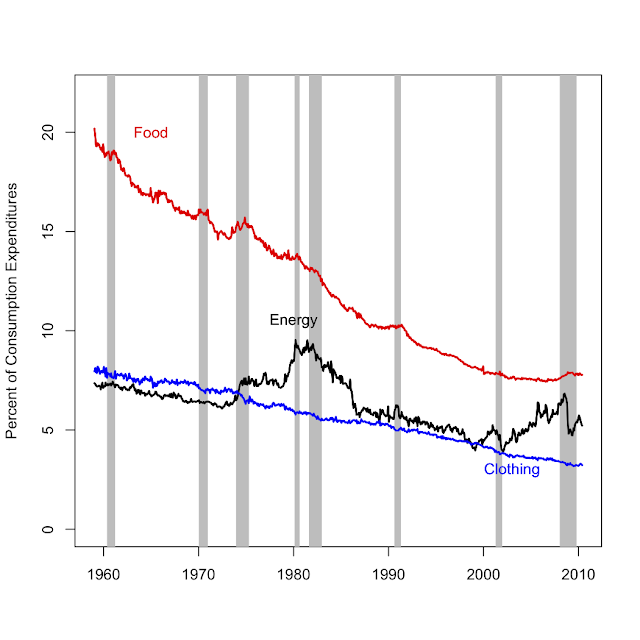 There's not too much to say about this that isn't obvious. Volatile energy prices explain the fluctuations in energy consumption shares, and these are often associated with recessions. Food and clothing shares have shown a steady trend down, as production efficiency has increased and prices have fallen [relative to income]. Demand is relatively inelastic which means the consumption share has declined with [relative] price, even though per-capita quantities have increased (the obseity problem, larger closets, etc.) The smoothness of food and clothing expenditures also attest to inelastic demand and perhaps the monopolistically competitive nature of retail businesses that sell these products. That is, retailers probably absorb much of the fluctuations in costs. Finally, notice how the food share increases a bit during recessions. That's mainly because total consumption expenditures (the denominator) goes down and food expenditures hardly change.
So, where do consumers cut back when energy prices and expenditure shares spike? That would be durable goods, like cars and appliances (not shown).
Update: Jim MacDonald (comment below) is right. It's prices relative to income that have fallen, but this is much more about income growth than falling prices.
Also, I'm speculating on the fluctuations part. I'd guess there is near full pass through of costs to price in the long run but not in the short run, just based on my intuition of monopolistically competitive markets. Empirically, I cannot really draw that conclusion from the graph because costs are mostly labor anyway, and labor costs tend to be smooth anyway.
The plot shows the percent of household consumption expenditures on food, clothing and footwear, and energy (NIPA accounts, downloaded from EconStats: http://www.econstats.com/nipa/ ).
The grey bands are recessions.

So, where do consumers cut back when energy prices and expenditure shares spike? That would be durable goods, like cars and appliances (not shown).
Update: Jim MacDonald (comment below) is right. It's prices relative to income that have fallen, but this is much more about income growth than falling prices.
Also, I'm speculating on the fluctuations part. I'd guess there is near full pass through of costs to price in the long run but not in the short run, just based on my intuition of monopolistically competitive markets. Empirically, I cannot really draw that conclusion from the graph because costs are mostly labor anyway, and labor costs tend to be smooth anyway.
Wednesday, November 17, 2010
If China were to let its currency float, commodity prices would soar
But this would be a good thing.
Krugman says China's currency is clearly undervalued. Clearly, he's right. And this is hurting China, hurting the US, and hurting the whole world's economy. China could solve their inflation problems without curbing growth by simply letting their currency float. And their proposed price controls could make things a lot worse.
Now, if China were to abandon these destructive policies, I think it's also clear that commodity prices would soar, at least as measured in dollars. (Prices would fall in Renminbi, and perhaps other currencies.) This would likely elicit howls from some who might fear that rising oil prices would stifle domestic recovery.
But I think those fears would be misplaced. Because while oil and other commodity prices would rise, so would foreign and domestic demand for goods produced in the U.S. This would stimulate our economy and push us back toward full employment and capacity utilization. That is, commodity prices would rise due to a demand shock, which is quite unlike the supply shocks prevalent in our history.
The phenomenon would be much like some of commodity price increases we've seen recently with QE2 and a falling dollar.
Anyway, I'm just trying to emphasize that not all commodity price shocks are the same, and I think we currently have little to worry about--in terms of impacts on inflation or broader economic activity--from commodity price increases stemming from a weakening dollar.
Krugman says China's currency is clearly undervalued. Clearly, he's right. And this is hurting China, hurting the US, and hurting the whole world's economy. China could solve their inflation problems without curbing growth by simply letting their currency float. And their proposed price controls could make things a lot worse.
Now, if China were to abandon these destructive policies, I think it's also clear that commodity prices would soar, at least as measured in dollars. (Prices would fall in Renminbi, and perhaps other currencies.) This would likely elicit howls from some who might fear that rising oil prices would stifle domestic recovery.
But I think those fears would be misplaced. Because while oil and other commodity prices would rise, so would foreign and domestic demand for goods produced in the U.S. This would stimulate our economy and push us back toward full employment and capacity utilization. That is, commodity prices would rise due to a demand shock, which is quite unlike the supply shocks prevalent in our history.
The phenomenon would be much like some of commodity price increases we've seen recently with QE2 and a falling dollar.
Anyway, I'm just trying to emphasize that not all commodity price shocks are the same, and I think we currently have little to worry about--in terms of impacts on inflation or broader economic activity--from commodity price increases stemming from a weakening dollar.
Monday, November 15, 2010
Another take on QE2 and commodity prices
Thin posting these days because I've been way too busy with travel and other things, and really don't have time for blogging. At some point I hope to write something about a great meeting on PES (that's Payments for Ecosystem Services) in Chapel Hill last week and a trip to Illinois where I gave a seminar and had some great discussions Scott Irwin.
For now, here's a brief follow up to a post a couple weeks ago where I critiqued Jim Hamilton's post on the effect of negative real interest rates on commodity prices. That argument didn't convince me. But in a more recent post he now says that decline in value of the dollar seems to be driving broad increases in the prices of commodities. On this point I agree. A weaker dollar is likely driving up commodity prices, and the decline in the dollar probably has something to do with QE2.
But I guess I don't see this as especially ominous. Commodity prices are a very small share of retail prices in this country and all other developed nations. Only oil prices have an appreciable influence on anything, and even that is far less than it once was. It will take a heck-of-a-lot more dollar weakness for commodity price increases to show up in retail price increases---ie., actual inflation. Moreover, if other countries--particularly European--were were to engage in their own QE programs, I don't think we'd even see commodity price increases.
A brief side note: One of Jim Hamilton's most famous lines of research (which actually inspired my own dissertation work) is about the link between oil prices and the macroeconomy. I think it's important to note that not all oil price shocks are alike (or, more generally, commodity price shocks in general). The price shocks prevalent in Jim's work, and through much of history, have to do with supply shocks or anticipated supply shocks (eg., speculative storage in light of unrest in the middle east). But the spike in 2008, and currency-related effects we're seeing now, and shocks we're most likely to see in the future, are demand shocks, not supply shocks. And this difference, I think, has very different implications for the macroeconomy.
I'm just an armchair macro guy. But right now I'm with the Krugman-Delong front[1, 2, 3, 4]. I just don't see how inflation could possibly be a major concern given most of what we consume is (a) rent or (b) mostly comprised of wages to labor. Neither rent nor wages are going up unless the economy recovers fast. No one thinks that's happening. And even in the off chance the economy were to suddenly return to full employment and thus give rise to real inflation fears, the Fed would reverse QE2 in a nanosecond, thereby deflating those inflationary fears.
I understand some people are genuinely fearful of inflation. But on an intellectual level, I just don't understand why
For now, here's a brief follow up to a post a couple weeks ago where I critiqued Jim Hamilton's post on the effect of negative real interest rates on commodity prices. That argument didn't convince me. But in a more recent post he now says that decline in value of the dollar seems to be driving broad increases in the prices of commodities. On this point I agree. A weaker dollar is likely driving up commodity prices, and the decline in the dollar probably has something to do with QE2.
But I guess I don't see this as especially ominous. Commodity prices are a very small share of retail prices in this country and all other developed nations. Only oil prices have an appreciable influence on anything, and even that is far less than it once was. It will take a heck-of-a-lot more dollar weakness for commodity price increases to show up in retail price increases---ie., actual inflation. Moreover, if other countries--particularly European--were were to engage in their own QE programs, I don't think we'd even see commodity price increases.
A brief side note: One of Jim Hamilton's most famous lines of research (which actually inspired my own dissertation work) is about the link between oil prices and the macroeconomy. I think it's important to note that not all oil price shocks are alike (or, more generally, commodity price shocks in general). The price shocks prevalent in Jim's work, and through much of history, have to do with supply shocks or anticipated supply shocks (eg., speculative storage in light of unrest in the middle east). But the spike in 2008, and currency-related effects we're seeing now, and shocks we're most likely to see in the future, are demand shocks, not supply shocks. And this difference, I think, has very different implications for the macroeconomy.
I'm just an armchair macro guy. But right now I'm with the Krugman-Delong front[1, 2, 3, 4]. I just don't see how inflation could possibly be a major concern given most of what we consume is (a) rent or (b) mostly comprised of wages to labor. Neither rent nor wages are going up unless the economy recovers fast. No one thinks that's happening. And even in the off chance the economy were to suddenly return to full employment and thus give rise to real inflation fears, the Fed would reverse QE2 in a nanosecond, thereby deflating those inflationary fears.
I understand some people are genuinely fearful of inflation. But on an intellectual level, I just don't understand why
Wednesday, November 3, 2010
I thought I understood the idea of inflation targeting....
...until I read this utterly confounding post by Paul Krugman.
Whether you love him or hate him, one must admit this is unusual for PK. Usually he is exceptionally clear and logical. I suspect there probably is some deeper logic here than meets the (or at least my) eye, and I suspect we'll be hearing a lot more from Krugman and others on inflation targeting.
There is also the possibility that my skull is thicker than usual this evening.
In any case, kudos to him for finally writing more about the topic. I was kinda wishing he and others would have done more of this, oh back in February of 2009.
In the meantime, I really like Jim Hamilton's perspective on the issue. The basic idea is to always have a long-run inflation target in mind, say 2%. Then, have medium-run targets for inflation that take into account cumulative off-target inflation in the past. So, following a few quarters of disinflation, the Fed should target a somewhat higher inflation target going forward to make up for below-target inflation in the past. The more disinflation we have, the more the Fed should target "catch up" inflation in the future. This seems like a naturally stabilizing policy that is also very conducive to long run stability of expectations. I also think it is deeply true to Fiedman's monetarism--the kind of thing that might elicit support of economists across a broad spectrum. After all, Bernanke does have to carry along an unusually divisive Federal Open Market Committee. I also think it would work a lot better than a vague QE2 policy would.
Update: I also like Karl Smith's line on inflation targeting: permanently change the target to 4%. Even a permanent change to 3% may do the trick. Besides the many reasons Karl gives, one biggie is that this reduces the chance that we'll hit the zero lower bound in future recessions. (I think he alludes to this when he says it will "serve as a buffer against future economic crises...") There is also good bit of reasoning and evidence that a modest amount of inflation reduces the amount of real wage rigidity in the economy, which effectively reduces the incidence of and depth of recessions. I think this is a good reason for a higher target inflation rate even if we weren't stuck in a liquidity trap. If the Fed were to say as much it could be a big shock to help push things along. Even though there is no indication at all that they plan to do such a thing, after another year or two of stagnation, they just might. After all, Janet Yellen has done some of the work suggesting a higher inflation rate is probably better for the economy anyhow.
Whether you love him or hate him, one must admit this is unusual for PK. Usually he is exceptionally clear and logical. I suspect there probably is some deeper logic here than meets the (or at least my) eye, and I suspect we'll be hearing a lot more from Krugman and others on inflation targeting.
There is also the possibility that my skull is thicker than usual this evening.
In any case, kudos to him for finally writing more about the topic. I was kinda wishing he and others would have done more of this, oh back in February of 2009.
In the meantime, I really like Jim Hamilton's perspective on the issue. The basic idea is to always have a long-run inflation target in mind, say 2%. Then, have medium-run targets for inflation that take into account cumulative off-target inflation in the past. So, following a few quarters of disinflation, the Fed should target a somewhat higher inflation target going forward to make up for below-target inflation in the past. The more disinflation we have, the more the Fed should target "catch up" inflation in the future. This seems like a naturally stabilizing policy that is also very conducive to long run stability of expectations. I also think it is deeply true to Fiedman's monetarism--the kind of thing that might elicit support of economists across a broad spectrum. After all, Bernanke does have to carry along an unusually divisive Federal Open Market Committee. I also think it would work a lot better than a vague QE2 policy would.
Update: I also like Karl Smith's line on inflation targeting: permanently change the target to 4%. Even a permanent change to 3% may do the trick. Besides the many reasons Karl gives, one biggie is that this reduces the chance that we'll hit the zero lower bound in future recessions. (I think he alludes to this when he says it will "serve as a buffer against future economic crises...") There is also good bit of reasoning and evidence that a modest amount of inflation reduces the amount of real wage rigidity in the economy, which effectively reduces the incidence of and depth of recessions. I think this is a good reason for a higher target inflation rate even if we weren't stuck in a liquidity trap. If the Fed were to say as much it could be a big shock to help push things along. Even though there is no indication at all that they plan to do such a thing, after another year or two of stagnation, they just might. After all, Janet Yellen has done some of the work suggesting a higher inflation rate is probably better for the economy anyhow.
Tuesday, November 2, 2010
VOTE, even though it's irrational
Voting may be the biggest prisoner's dilemma ever.
That is, it's smart for one and dumb for all to NOT vote.
Thankfully, many of us do it anyway. If we didn't, democracy wouldn't work.
Some, including at least one of my colleagues, isn't sure whether democracy does work. I personally shudder thinking about the alternative.
The good news is that, despite it being irrational to do so, turnout expert Dr. Michael McDonald is predicting a turnout of 90 million people (hat tip to electoral-vote.com). Good weather may push things even higher.
So. Join the irrational masses and vote already!
That is, it's smart for one and dumb for all to NOT vote.
Thankfully, many of us do it anyway. If we didn't, democracy wouldn't work.
Some, including at least one of my colleagues, isn't sure whether democracy does work. I personally shudder thinking about the alternative.
The good news is that, despite it being irrational to do so, turnout expert Dr. Michael McDonald is predicting a turnout of 90 million people (hat tip to electoral-vote.com). Good weather may push things even higher.
So. Join the irrational masses and vote already!
QE2 and Commodity Prices
Over at Econbrowser (one of my favorite blogs) Jim Hamilton is worried about the effects of QE2 (or negative real interest rates) on commodity prices.
He writes:

The top panel is a proxy for real interest rates: the 6-month t-bill rate minus realized inflation over the subsequent six months. The bottom graph is a percentage change in the producer price index for a 12 month period.
There does appear to be a correlation, one that is stronger during some periods as compared to others (particularly the 70s and 80s, something I'll come back to). Jim Hamilton's implicit assumption is that causation goes from the top panel to the bottom panel. But is it possible that causation goes the other way, from producer price changes to consumer price changes, and thus reduction in the real rate of return?
Well, yes.
One clue is the tremendous volatility of real interest rates. True real interest rates are not that variable. Consider, for example, rates of return on inflation indexed treasury bills. Those rates don't exist for as long a time series as the top panel above, but for the time period that does exist, they are nowhere near as variable as Jim's series. The problem is that short term inflation measures are noisy, often driven by fluctuations in food and energy prices, and these fluctuations are not anticipated in advance. Only expected changes in inflation should get priced in the real rate.
Second, much of volatility of in the producer price index--whatever the fundamental source--gets passed along to the consumer price index. So, say there's an embargo of oil from Iran and oil prices spike. We'll eventually see that in retail prices and the CPI. The price spike in turn causes the real interest rate to decline. So, there's good reason to think causation goes from the bottom graph to the top graph, rather than vice versa. That is, almost surely, what's going on in the 70s and 80s, which is where the link is strongest. I'd venture to guess that's the main source of correlation throughout.
So, in a nutshell, I'm not worried about the effect of QE2, or generally low or negative interest rates, on commodity prices. If commodity prices go up, I think that will mainly be a symptom of demand growth, which would be a good thing--a sign of recovery--for aggregate economies. Alternatively, prices could go up from real supply shocks and/or trade restrictions, which would obviously be bad things. But whatever may happen to prices, I think QE2 will be a very small deal.
He writes:
What does a negative real rate signify? If you consider a simple one-good economy in which the output is costlessly storable, a negative real rate could never happen-- people would simply hoard the good rather than buy such miserable assets. You're better off storing a can of tuna for a year than messing with T-bills at the moment. But there's only so much tuna you can use, and many expenditures you might want to save for can't really be stored in your closet for the next year. It's perfectly plausible from the point of view of more realistic economic models that we could see negative real interest rates, at least for a while.
Even so, within those models, there's an incentive to buy and hold those goods that are storable. And in terms of the historical experience, episodes of negative real interest rates have usually been associated with rapidly rising commodity prices.
There are two issues here, theory and evidence. First let's reconsider the theory.
Storage is tied not only to interest rates, but also (and more importantly, I believe) to anticipated future changes in prices, as well as physical storage costs. If people start to hoard commodities then current prices will go up. This happens because storing commodities means not consuming them, and as we consume less, the marginal value of consumption goes up. That can of tuna on the shelf starts looking real tasty the hungrier one gets! At the same time, storing commodities means consuming more in the future, which means the future price--the future marginal value of consumption--goes down. All the more reason to consume that can of tuna today if you're hungry and the large quantity you expect to eat tomorrow will make you sick.
Now, at the margin, interest rates certainly do affect the decision to store. The question is how much. The answer, I think, is very little. With commodities, that demand curve is very steep. The marginal value decreases sharply with consumption, so it is a big part of the calculation. If interest rates are the only thing driving growth in inventories, this will cause the expected price change between the present and the future to go down. Also, as hoarding increases, the marginal costs of storage likely increase. So, for small interest rate changes, the relative tradeoff is small, even if interest rates go negative.
My point here is that it's hard for me to see large-scale hoarding even in an environment with negative real interest rates. Hoarding can only happen if markets irrationally believe that price increases will be sustained indefinitely--i.e., a speculative bubble. Hopefully markets will be wary of such things after recent experience in housing and stock market prices.
Besides, when has a speculative bubble occurred with commodities? I know price spikes have occurred when some have tried to corner certain markets, but I think that's different. We've also had price spikes when inventories were depleted, there was real worry of impending supply shocks, or trade policies interfered with international commodity trading. But these are all very different stories as well.
Jim doesn't hint at a bubble. Instead, he's assuming the demand curve is flat. In reality, it's really very steep.
Second, let's consider the evidence. Professor Hamilton presents two graphs, one with a proxy for real interest rates, the second a plot of real wholesale price changes. I lifted those graphs from Econbrowser and pasted them below:
Jim doesn't hint at a bubble. Instead, he's assuming the demand curve is flat. In reality, it's really very steep.
Second, let's consider the evidence. Professor Hamilton presents two graphs, one with a proxy for real interest rates, the second a plot of real wholesale price changes. I lifted those graphs from Econbrowser and pasted them below:

Top panel: S6-month T-bill rate (secondary market from FRED) minus CPI inflation rate (annual rate) over subsequent six months, 1959:M1-2010:M3. Bottom panel: annual percentage change in producer price index for all commodities for 12 months ending at indicated date.
The top panel is a proxy for real interest rates: the 6-month t-bill rate minus realized inflation over the subsequent six months. The bottom graph is a percentage change in the producer price index for a 12 month period.
There does appear to be a correlation, one that is stronger during some periods as compared to others (particularly the 70s and 80s, something I'll come back to). Jim Hamilton's implicit assumption is that causation goes from the top panel to the bottom panel. But is it possible that causation goes the other way, from producer price changes to consumer price changes, and thus reduction in the real rate of return?
Well, yes.
One clue is the tremendous volatility of real interest rates. True real interest rates are not that variable. Consider, for example, rates of return on inflation indexed treasury bills. Those rates don't exist for as long a time series as the top panel above, but for the time period that does exist, they are nowhere near as variable as Jim's series. The problem is that short term inflation measures are noisy, often driven by fluctuations in food and energy prices, and these fluctuations are not anticipated in advance. Only expected changes in inflation should get priced in the real rate.
Second, much of volatility of in the producer price index--whatever the fundamental source--gets passed along to the consumer price index. So, say there's an embargo of oil from Iran and oil prices spike. We'll eventually see that in retail prices and the CPI. The price spike in turn causes the real interest rate to decline. So, there's good reason to think causation goes from the bottom graph to the top graph, rather than vice versa. That is, almost surely, what's going on in the 70s and 80s, which is where the link is strongest. I'd venture to guess that's the main source of correlation throughout.
So, in a nutshell, I'm not worried about the effect of QE2, or generally low or negative interest rates, on commodity prices. If commodity prices go up, I think that will mainly be a symptom of demand growth, which would be a good thing--a sign of recovery--for aggregate economies. Alternatively, prices could go up from real supply shocks and/or trade restrictions, which would obviously be bad things. But whatever may happen to prices, I think QE2 will be a very small deal.
Subscribe to:
Posts (Atom)
Renewable energy not as costly as some think
The other day Marshall and Sol took on Bjorn Lomborg for ignoring the benefits of curbing greenhouse gas emissions. Indeed. But Bjorn, am...

-
The other day Marshall and Sol took on Bjorn Lomborg for ignoring the benefits of curbing greenhouse gas emissions. Indeed. But Bjorn, am...
-
 The tragic earthquake in Haiti has had me wondering about U.S. Sugar policy. I should warn readers in advance that both Haiti and sugar pol...
 -
A couple months ago the New York Times convened a conference " Food for Tomorrow: Farm Better. Eat Better. Feed the World ." ...

